

| Important for | |
|---|---|
| Prelims | Indian Economy: Infrastructure and PPP Models |
| Mains | GS Paper III — Infrastructure and Investment Models |
| Sector | Railway Freight Infrastructure |
| Proposed Projects | Six Freight Lines |
| Financing Approach | Hybrid Annuity Model |
| Core Principle | Shared Public-Private Risk |
What is Railway HAM Model?
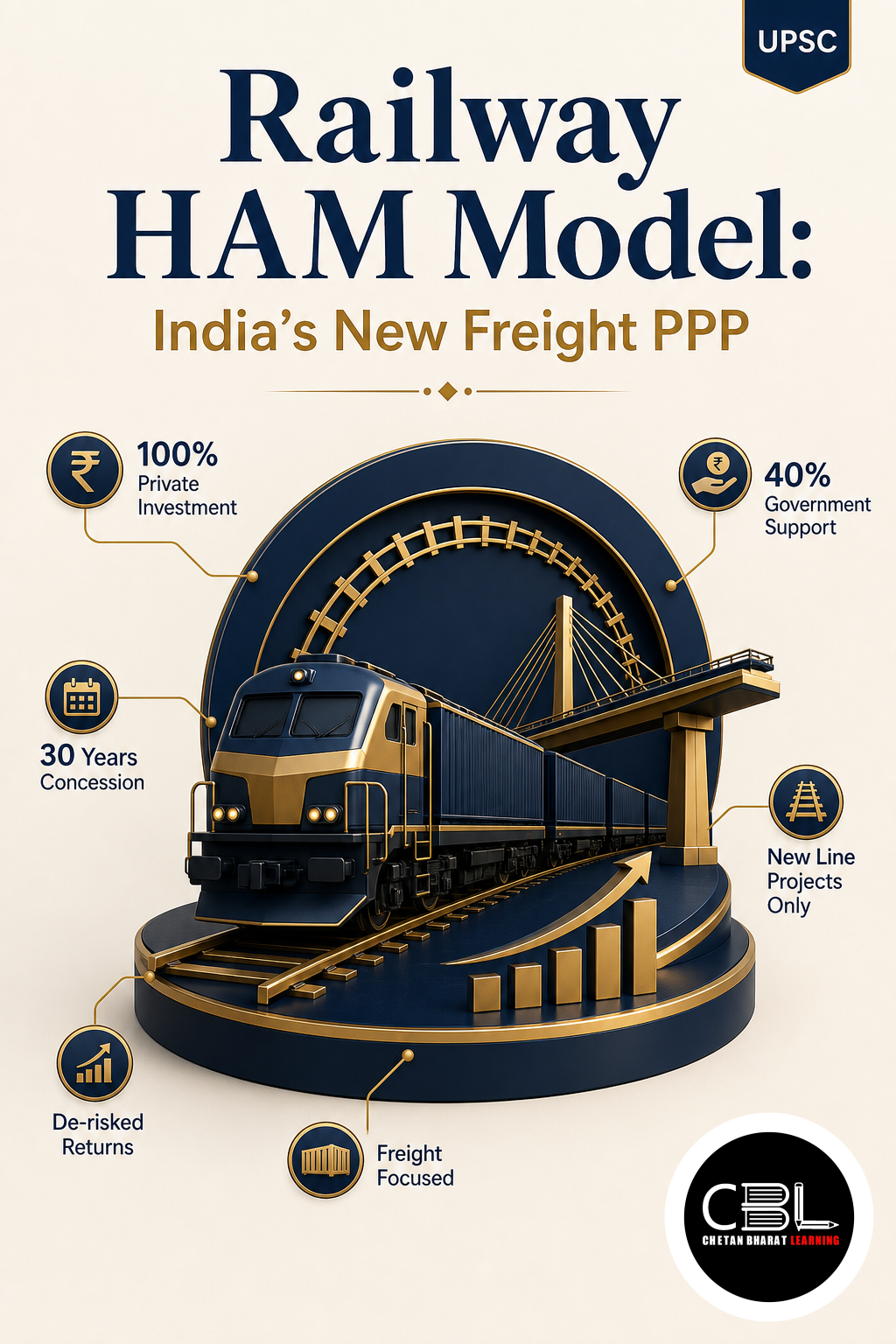
The Railway HAM Model adapts the Hybrid Annuity Model used in road infrastructure to railway projects. Under the proposed framework, the government supports part of the project cost, the private partner contributes the remaining finance and executes construction, and the government later makes periodic annuity payments. The design reduces the private developer’s exposure to uncertain user revenue while retaining private participation in delivery.
HAM sits between fully government-funded infrastructure and a conventional private concession. It combines public funding, private capital and shared contractual risk rather than asking the developer to recover the entire investment directly from users. In railway freight projects, this distinction is crucial because the wider economic value of a line can exceed the commercial revenue visible to a private investor.
Why is Railway HAM Model in News?
Indian Railways is looking to build six freight lines with private firms through this hybrid financing structure. The move marks a first for the railway system, targeting projects where capacity expansion, station or terminal requirements, safety infrastructure and modernisation may be socially valuable but commercially difficult under a pure revenue-risk model. The proposal tests whether an established infrastructure-financing idea can attract investment to freight corridors with uncertain traffic.
Traditional public-private partnerships can struggle when projected demand fails to materialise. A private operator that depends heavily on user revenue may face falling cash flows even when the infrastructure still creates regional development, lower logistics costs or strategic connectivity. The policy response is to reallocate some revenue risk while preserving private execution.
Key Features
The proposed structure rests on risk allocation, predictable government support and private-sector delivery rather than complete privatisation of railway infrastructure.
- Government support reduces demand risk: Public funding and annuity commitments lower the developer’s dependence on uncertain freight volumes, making socially useful projects more bankable.
- Private capital shares the financing burden: The model mobilises non-government resources for construction while keeping the private participant financially invested in delivery quality and timelines.
- Private execution can improve efficiency: Construction expertise, technology, project management and commercial discipline can support faster completion when contracts define responsibilities clearly.
- Annuity payments reshape revenue recovery: Scheduled payments shift more revenue uncertainty towards the public side over the operating period.
- Railway benefits extend beyond private returns: Freight lines can reduce logistics costs, ease road congestion, lower emissions, promote regional development and strengthen strategic connectivity.
This mix of private returns and social returns explains why HAM is relevant to railways. A freight line may not generate enough direct cash flow for a private concessionaire, yet it lowers economy-wide transport costs and improves industrial access. Public support can bridge this gap when broader benefits are credible and the project remains economically justified.
Challenges
HAM reallocates risk between the state and private partner rather than removing it. That makes contract design, fiscal discipline and institutional capacity as important as private participation itself.
- Future government payment burden: Annuity commitments create multi-year fiscal obligations that must be assessed for long-term affordability.
- Complex contracts can generate disputes: Ambiguous performance standards, delays or scope changes can lead to litigation and renegotiation.
- Land and approvals remain public bottlenecks: Delayed land acquisition or clearances can stall construction despite private financing.
- Safety and affordability need safeguards: Contracts must protect safety standards, network integration and reasonable access.
- Poor project selection can socialise losses: Financing weak projects without sound analysis can saddle the state with liabilities and limited value.
Institutional learning is also vital. Roads and railways differ in operating systems, network effects, safety requirements and revenue structures, so HAM must be adapted with realistic traffic assumptions and clear risk allocation.
Way Forward
Indian Railways should treat HAM as one instrument within a broader financing portfolio. Projects need rigorous economic appraisal, realistic freight forecasts, timely land availability and transparent bidding before accepting long-term liabilities.
Contracts should define measurable construction and maintenance standards, payment triggers, dispute-resolution mechanisms and safeguards for safety and network integration. Periodic disclosure of costs and contingent liabilities can strengthen fiscal transparency, while competition among qualified bidders can protect value for money.
Prelims Practice Corner
Q1. What is the central feature of the Hybrid Annuity Model?
(a) Full private financing with no public support (b) Shared public-private financing and risk (c) Complete government construction (d) Financing only through user charges
Answer: (b) HAM combines government support, private participation and a shared allocation of project risks.
Q2. Why can a conventional revenue-risk PPP struggle in a freight project?
(a) Traffic can be lower than projected (b) Railways cannot carry freight (c) Private firms cannot construct infrastructure (d) Freight projects have no social benefits
Answer: (a) Lower-than-expected traffic can weaken revenue and make recovery of private investment difficult.
Q3. Which of the following can be a wider social benefit of railway freight infrastructure?
(a) Lower logistics costs (b) Reduced road congestion (c) Regional development (d) All of the above
Answer: (d) Freight infrastructure produces logistics, congestion and regional-development benefits beyond direct revenue.
Q4. In PPP theory, efficient risk allocation means which principle?
(a) Government must bear every risk (b) Private firms must bear every risk (c) Risk should lie with the party best able to manage it (d) Risks should never be specified in contracts
Answer: (c) PPPs work better when each risk is assigned to the party that can manage it most effectively.
Q5. Which fiscal issue can arise from annuity-based infrastructure contracts?
(a) No future government liability (b) Multi-year payment commitments (c) Automatic elimination of project risk (d) Complete absence of public expenditure
Answer: (b) Annuity contracts can create future payment obligations that must be assessed for long-term affordability.
Mains Practice Questions
Q1. Explain how the Hybrid Annuity Model can address the financing challenges of railway freight infrastructure. (10 marks)
Answer Structure:
- Intro: Define HAM as a shared public-private financing and risk-allocation model.
- Body: Discuss uncertain freight demand, annuity support, private execution, social returns, fiscal liabilities and contract design.
- Conclusion: Present HAM as useful where public value is high but commercial viability remains uncertain.
Q2. Public-private partnerships succeed through efficient risk allocation, not merely private financing. Discuss with reference to railway infrastructure. (15 marks)
Answer Structure:
- Intro: Explain PPPs as contractual sharing of responsibilities between government and private participants.
- Body: Examine demand risk, construction risk, land and approvals, annuity liabilities, safety, value for money and social returns.
- Conclusion: Emphasise transparent contracts, sound project selection and risk assignment based on institutional capacity.
FAQs on Railway HAM Model
Why is HAM being considered for railway freight projects?
Some freight projects can create large public benefits while generating uncertain direct revenue. HAM can reduce private demand risk while retaining private capital and execution capacity.
How is HAM different from a traditional BOT model?
A traditional BOT arrangement can place greater investment and demand risk on the private operator. HAM shares financing and shifts more revenue risk towards the government through support and periodic payments.
Does HAM eliminate infrastructure project risk?
No. It redistributes risk and can still create fiscal liabilities, contractual disputes and implementation problems. Its success depends on project selection, clear contracts and capable public oversight.
Related Current Affairs
Preparing for UPSC, PCS or HCS?
Talk to a mentor at Chetan Bharat Learning, Chandigarh. Free guidance on choosing the right exam and building a study plan.
Chat on WhatsAppCall 97793 53345UPSC / IAS / PCS coaching in Chandigarh · Trusted by aspirants across Punjab & Haryana
Leave a Reply
You must be logged in to post a comment.