

UPSC Mapping
Exam-wise Mapping
| Exam | Syllabus |
|---|---|
| Prelims | Environment Protection Act; EIA Notification 2006; Supreme Court |
| Mains | GS Paper III – Environment and Sustainable Development |
Key Case Details
| Case | Vanashakti v. Union of India |
|---|---|
| Judgment Date | 29 July 2026 |
| Citation | 2026 INSC 761 |
| Governing Framework | EIA Notification, 2006 |
| Core Ruling | Prior Clearance Remains Mandatory |
Article
What is Post-Facto Environmental Clearance?
Post-Facto Environmental Clearance is an approval sought after a project has already started an activity requiring prior environmental permission. Such cases can involve construction, industrial production, expansion or modernisation undertaken without first completing the legally prescribed environmental appraisal.
The normal framework under the EIA Notification, 2006 requires specified projects to obtain clearance before beginning construction or preparing land, except for securing it. Prior assessment allows regulators and affected communities to examine environmental consequences before irreversible commitments occur.
The clearance process can involve screening, scoping, preparation of an Environmental Impact Assessment report, public consultation and appraisal. The exact stages depend on the project category and provisions governing the concerned activity.
Category A projects generally undergo appraisal by an Expert Appraisal Committee at the central level. Category B projects ordinarily come before State-level institutions, subject to the classification and conditions contained in the notification.
Retrospective approval creates a legal and policy difficulty because the project has already altered the factual position. Regulators may face pressure to preserve completed infrastructure, employment and public investment despite the original breach.
Environmental law relies heavily on the precautionary principle, which encourages action before serious damage occurs. An approval issued after construction cannot fully restore opportunities lost during site selection, design scrutiny and public participation.
Why is Post-Facto Environmental Clearance in News?
The Union Environment Ministry directed appraisal authorities to resume processing pending Post-Facto Environmental Clearance applications in September 2026. The instruction followed the Supreme Court’s final judgment in Vanashakti v. Union of India delivered on 29 July 2026.
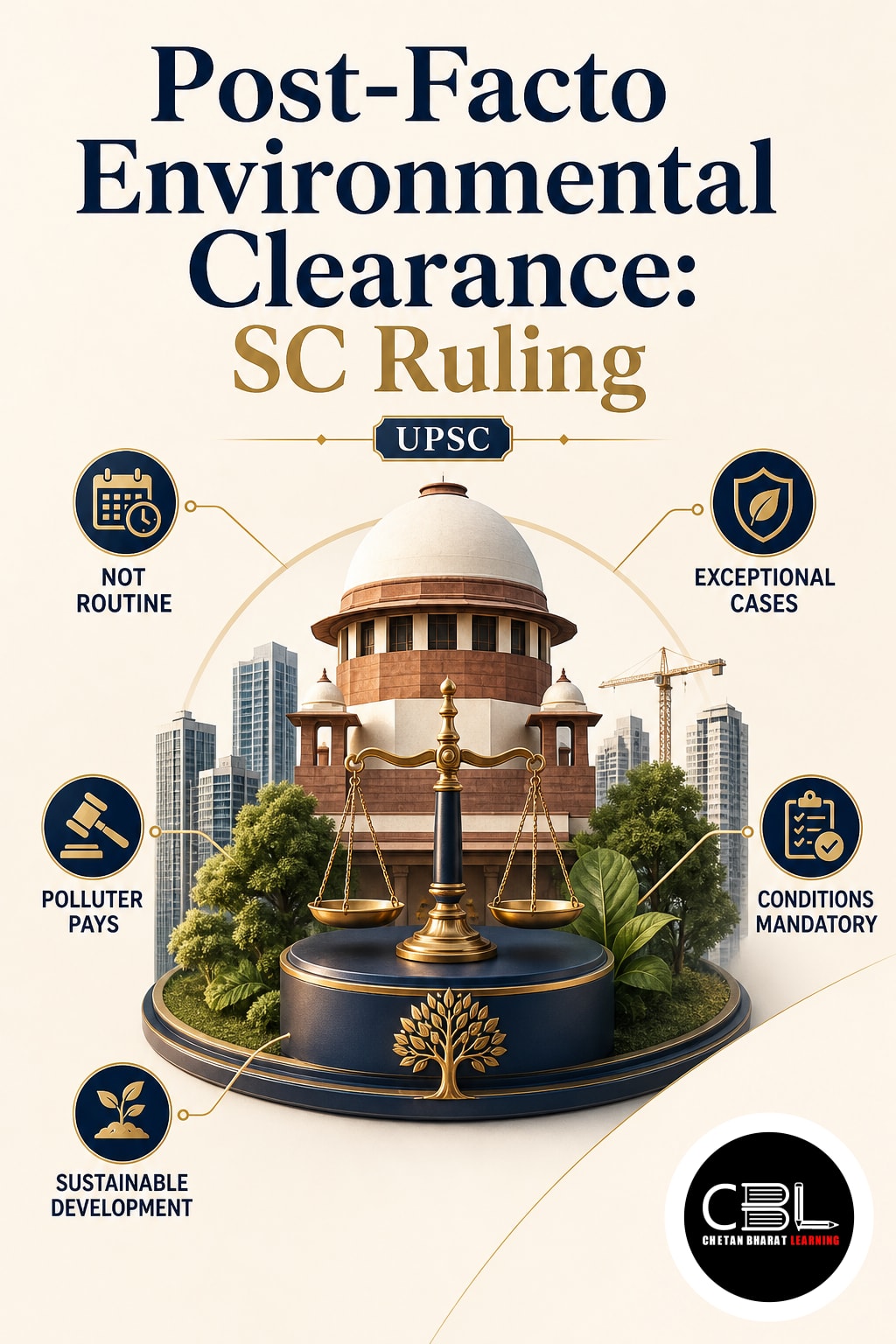
The Court held that prior environmental approval under the 2006 framework remains mandatory. Its detailed Vanashakti case summary explains the distinction between a limited statutory exception and an open-ended administrative regularisation mechanism.
The Court upheld a 2017 notification that created a one-time, narrowly tailored and time-bound process for existing violation cases. It treated that notification as valid delegated legislation issued under Section 3 of the Environment Protection Act, 1986.
The Court quashed the 2021 Office Memorandum prospectively because it established a continuing mechanism through an administrative instruction. The judgment found that such an order could not substantially modify the statutory prior-clearance regime.
Clearances already granted under the two instruments remain valid unless challenged individually according to law. Applications submitted earlier may also reach their legal conclusion, including those affected by previous stays or court orders.
Authorities cannot accept fresh applications under the 2017 notification or the 2021 memorandum. The Ministry’s September directive consequently asked committees to process eligible pending, returned, rejected or delisted matters without opening a new general window.
Key Features
- Prior approval remains the rule: Project proponents must obtain environmental permission before commencing activities covered by the EIA Notification, 2006.
- 2017 window remains valid: The Court upheld the limited notification as time-bound delegated legislation addressing specified existing violations.
- 2021 memorandum stands quashed: An administrative instruction cannot create a perpetual route that displaces the statutory prior-clearance framework.
- Pending cases receive protection: Previously filed applications may be processed, while no fresh applications can enter through the quashed mechanisms.
- Future exceptions require law: Any new amnesty must use a valid statutory notification that is narrow, time-bound and supported by overriding public interest.
The ruling distinguishes regularisation from an automatic entitlement. A project cannot demand retrospective approval merely because substantial construction, investment or employment already exists.
Authorities must still examine environmental damage, legal compliance and available remedial measures. An appraisal may result in rejection, closure requirements, penalties or restoration obligations rather than approval.
The Court linked environmental protection with Articles 14 and 21 of the Constitution. Arbitrary regularisation can reward non-compliant entities and undermine the right to live in a clean and healthy environment.
The decision also recognised sustainable development as a balancing framework rather than permission to ignore environmental conditions. Regulators must consider ecological damage alongside employment, completed public infrastructure and other genuine public interests.
The judgment used the idea of eco-centric proportionality to examine competing interests. This approach requires decision-makers to consider the rights of present and future generations along with the intrinsic value of ecological systems.
The Court preserved its constitutional power under Article 142 to grant appropriate relief in exceptional cases. This judicial authority does not create a routine administrative route for project proponents seeking delayed approval.
Challenges
- Regularisation incentives: Repeated amnesty windows may encourage developers to begin work and seek legal approval only after making substantial investments.
- Lost preventive scrutiny: Retrospective appraisal cannot fully reproduce the choices available before site preparation and construction began.
- Weak enforcement capacity: Authorities may detect violations only after considerable ecological damage or public expenditure has occurred.
- Remediation difficulties: Restoration costs and ecological losses can remain uncertain when reliable pre-project baseline data are unavailable.
- Unequal treatment: Compliant proponents may face delays and costs while violators gain commercial advantages by starting projects early.
Environmental assessment works best during planning because authorities can compare alternative sites, technologies and project sizes. Once physical assets exist, decision-makers may view closure or demolition as economically disproportionate.
Affected communities can lose meaningful participation when consultation occurs after a project has become operational. Their suggestions may no longer influence basic decisions involving location, design, resource use or pollution-control technology.
A penalty that remains lower than the economic benefit from early construction may not deter violations. Regulators must calculate restoration costs and environmental compensation using transparent scientific methods.
Pending applications may involve different sectors, project stages and levels of environmental harm. Applying a uniform response could overlook distinctions between procedural delay, negligent conduct and deliberate avoidance of legal requirements.
Central and State authorities need consistent interpretations of the judgment. Divergent appraisal practices could create uncertainty, forum shopping and uneven environmental protection across jurisdictions.
Closure can protect the environment but may also affect workers and communities dependent on an operating facility. Decision-makers must separate genuine public interest from commercial claims presented as unavoidable social consequences.
The debate reflects wider concerns about regulatory institutions examined in these environment and ecology updates. Strong rules require credible inspections, public information and timely enforcement to influence behaviour.
Way Forward
Authorities should prioritise early detection through satellite imagery, consent databases and integrated digital monitoring. Identifying land preparation or construction at an initial stage can prevent regulators from confronting completed projects.
The government should connect building permissions, industrial consents and environmental approvals through interoperable databases. Local authorities should receive automated warnings when a listed project begins without the required clearance.
Appraisal committees must publish reasoned decisions explaining environmental damage, mitigation conditions and public-interest considerations. Transparent orders can demonstrate that pending cases are receiving scrutiny rather than automatic regularisation.
The Environment Ministry’s clearance framework should integrate geospatial decision-support tools with field verification. Digital proximity analysis can identify forests, wetlands, protected areas and eco-sensitive zones requiring additional safeguards.
Environmental compensation should reflect restoration expenses, unlawful economic gains and the duration of non-compliance. Penalties must remain strong enough to ensure that prior compliance costs less than retrospective violation.
Independent experts should prepare damage-assessment and remediation plans for serious violations. Project proponents should finance restoration under the polluter pays principle without controlling the scientific evaluation.
Public consultation should occur wherever meaningful remedial or operational choices remain available. Communities need access to environmental reports, compliance records and proposed restoration measures in understandable formats.
Any future exceptional window must clearly identify the overriding public interest, eligible project class and closing date. Parliament and courts should be able to review whether the measure remains proportionate to its stated objective.
Regulators should maintain a public registry of projects operating without valid prior approval. The registry can record enforcement action, appraisal status, penalties, remediation progress and responsible officials.
Post-Facto Environmental Clearance must remain an exceptional legal response rather than an alternative approval pathway. Strong preventive enforcement, transparent appraisal and effective restoration can reconcile development needs with constitutional environmental protection.
Prelims Practice Corner
Q1. The EIA Notification, 2006 was issued under which legislation?
- (a) Water Act, 1974
- (b) Forest Conservation Act, 1980
- (c) Environment Protection Act, 1986
- (d) Biological Diversity Act, 2002
Answer: (c) The notification derives its legal authority from the Environment Protection Act, 1986.
Q2. What did the Supreme Court decide regarding the 2017 notification?
- (a) It declared the notification unconstitutional
- (b) It upheld it as a limited and time-bound statutory measure
- (c) It converted it into a permanent scheme
- (d) It replaced it with the 2021 memorandum
Answer: (b) The Court upheld the 2017 notification as narrowly tailored and time-bound delegated legislation.
Q3. Why was the 2021 Office Memorandum quashed?
- (a) It applied only to wildlife sanctuaries
- (b) It ended all environmental appraisal
- (c) It created a continuing regime through an administrative instruction
- (d) It transferred all powers to local bodies
Answer: (c) An administrative order could not substantially alter the statutory prior-clearance framework.
Q4. Which constitutional provision empowers the Supreme Court to pass orders necessary for complete justice?
- (a) Article 32
- (b) Article 136
- (c) Article 142
- (d) Article 226
Answer: (c) Article 142 empowers the Supreme Court to pass orders necessary for complete justice.
Q5. Which principle requires the polluter to bear the cost of environmental restoration?
- (a) Public choice principle
- (b) Polluter pays principle
- (c) Pleasure doctrine
- (d) Harmonious construction
Answer: (b) The polluter pays principle places remediation expenses on the entity responsible for pollution.
Mains Practice Questions
Q1. Retrospective environmental approval creates tension between the precautionary principle and claims of economic proportionality. Discuss. (250 words, 15 marks)
Answer Structure
- Intro: Explain the requirement of prior appraisal under the EIA Notification, 2006.
- Body: Discuss prevention, public consultation, completed investments, employment, remediation and the Vanashakti principles.
- Conclusion: Support strict prior compliance with narrowly defined statutory exceptions.
Q2. Effective environmental governance depends as much on enforcement capacity as on the quality of environmental laws. Examine. (150 words, 10 marks)
Answer Structure
- Intro: Connect legal safeguards with timely monitoring and regulatory action.
- Body: Cover inspections, institutional capacity, public data, deterrent penalties and restoration monitoring.
- Conclusion: Recommend integrated digital oversight supported by accountable field enforcement.
FAQs on Post-Facto Environmental Clearance
Did the Supreme Court permit a permanent retrospective-clearance system?
No. The Court upheld prior approval as the rule and quashed the open-ended 2021 administrative mechanism.
Can authorities accept fresh applications under the old mechanisms?
No fresh applications can be accepted under the 2017 notification or 2021 memorandum. Eligible applications already submitted may be processed according to the judgment.
Can the government create another exceptional clearance window?
It may act only through a valid statutory notification under the Environment Protection Act. Any exception must remain narrowly tailored, time-bound and justified by an overriding public interest.
Related Current Affairs
Preparing for UPSC, PCS or HCS?
Talk to a mentor at Chetan Bharat Learning, Chandigarh. Free guidance on choosing the right exam and building a study plan.
Chat on WhatsAppCall 97793 53345UPSC / IAS / PCS coaching in Chandigarh · Trusted by aspirants across Punjab & Haryana
Leave a Reply
You must be logged in to post a comment.