
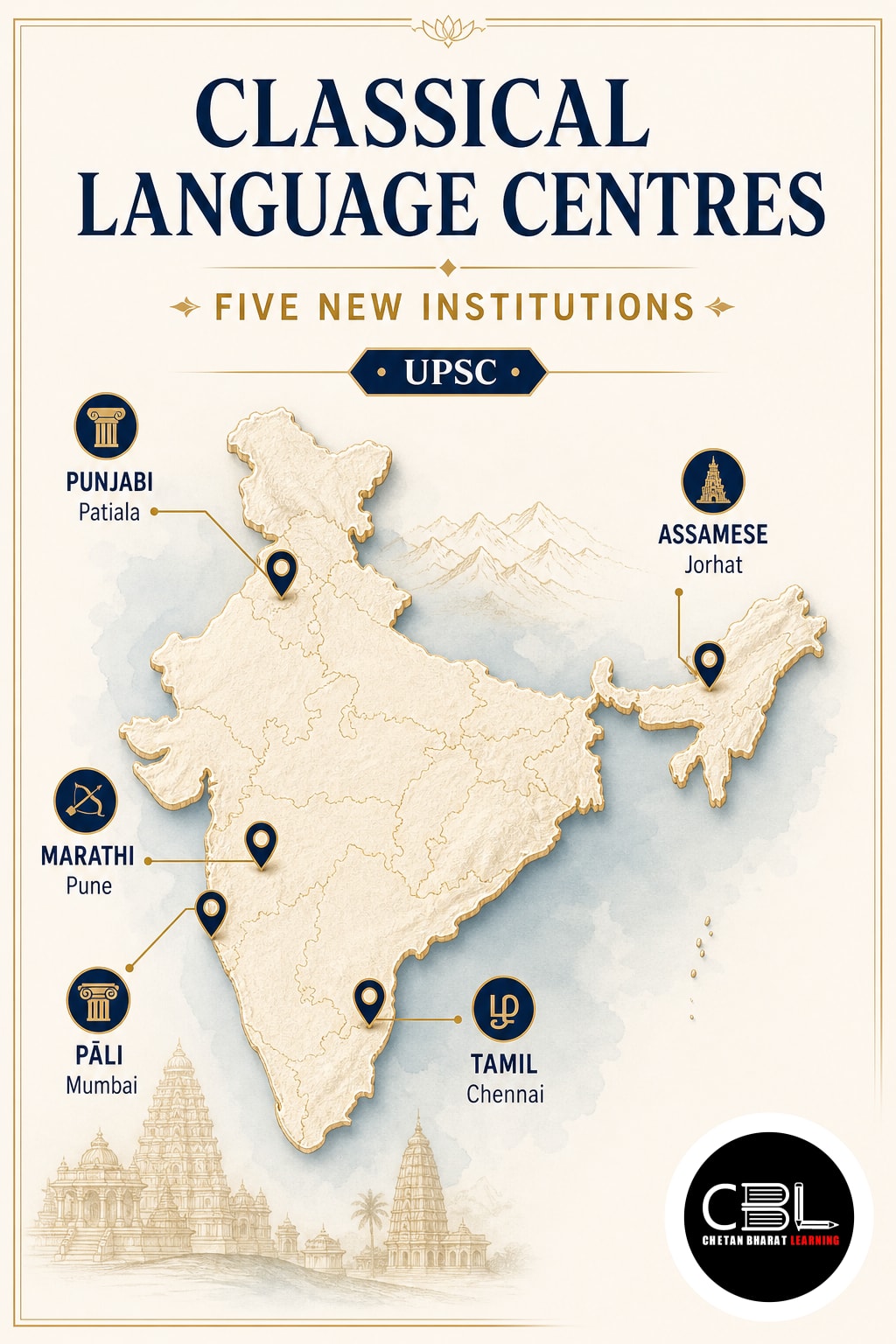

UPSC Mapping
Important for
| Prelims | Classical Languages, Institutions and Cultural Heritage |
|---|---|
| Mains | GS Paper I – Indian Culture and Literary Heritage |
Quick Facts
| Approved | October 2026 |
|---|---|
| Ministry | Ministry of Education |
| New Centres | Five |
| Languages Covered | Assamese, Bengali, Marathi, Pali and Prakrit |
| Classical Languages in India | Eleven |
What are Classical Language Centres?
Classical Language Centres are specialised academic institutions established to advance research, preservation and teaching related to recognised classical languages. They bring together linguists, historians, manuscript specialists, translators and digital humanities researchers within a dedicated institutional framework.
Their work can include preparing critical editions, cataloguing manuscripts, compiling dictionaries and translating important texts. They can also document inscriptions, oral traditions and regional variations connected with each language’s historical development.
Digitisation represents another major responsibility because many manuscripts remain dispersed across libraries, monasteries, private collections and research institutions. High-quality digital archives can protect vulnerable material while allowing scholars to study it without repeatedly handling the original document.
The centres are expected to serve as platforms for advanced scholarship rather than functioning only as language-teaching departments. Their location within established universities can connect classical studies with archaeology, philosophy, history, literature and computational linguistics.
Why are Classical Language Centres in News?
The Ministry of Education approved five new Classical Language Centres for Assamese, Bengali, Marathi, Pali and Prakrit in October 2026. These languages had received classical status through a Union Cabinet decision in October 2024.
The Ministry of Education announcement identified one host institution for each language. The centres will promote advanced research, preservation, digitisation, dissemination and stronger regional academic ecosystems.
Tezpur University in Assam will host the centre for Classical Assamese. Visva-Bharati University in West Bengal will host the centre for Classical Bengali, while Deccan College Post-Graduate and Research Institute in Pune will support Classical Marathi. The Central University of Odisha will house the centre for Classical Pali. The Central University of Gujarat will establish the corresponding institution for Classical Prakrit.
Key Features
- Dedicated institutions: Each language receives a specialised academic platform within an identified university.
- Advanced research: Linguistic, literary, historical, philosophical and interdisciplinary studies using classical sources.
- Preservation and digitisation: Cataloguing, conserving and digitally reproducing manuscripts, inscriptions and rare publications.
- Public dissemination: Translations, lectures, exhibitions and digital resources to reach beyond academic circles.
- Regional networks: Host universities coordinate scholars, repositories and cultural institutions associated with each tradition.
Challenges
- Dispersed sources: Manuscripts and inscriptions spread across public repositories, religious institutions and private collections.
- Shortage of specialists: Limited scholars trained in palaeography, manuscriptology and textual criticism.
- Digitisation hurdles: Fragile documents, complex scripts and weak OCR tools.
- Institutional fragmentation: Lack of common cataloguing or research standards across bodies.
- Limited public engagement: Academic outputs may remain inaccessible without translations and open resources.
Way Forward
- Prepare time-bound research and preservation plans with publicly reported milestones.
- Establish a national digital framework for metadata, imaging, transliteration and archives.
- Introduce fellowships and structured training in manuscriptology, palaeography, lexicography and computational linguistics.
- Collaborate with archives, monasteries, museums and private custodians using mobile digitisation units.
- Publish dictionaries, grammars, critical editions and translations in print and open digital formats.
- Engage community scholars, teachers and cultural organisations for outreach and collection identification.
- Conduct independent academic reviews focusing on scholarly outputs and trained human resources.
Prelims Practice Corner
Q1. How many classical languages are currently recognised by the Government of India?
- a) Six
- b) Eight
- c) Eleven
- d) Twenty-two
Answer: (c) India currently recognises eleven languages as classical languages.
Q2. Which university will host the Centre of Excellence for Classical Assamese?
- a) Gauhati University
- b) Tezpur University
- c) Dibrugarh University
- d) Assam University
Answer: (b) Tezpur University in Assam will host the centre for Classical Assamese.
Q3. Consider the following pairs: 1. Bengali–Visva-Bharati University, 2. Marathi–Deccan College, 3. Prakrit–Central University of Gujarat. Which pairs are correctly matched?
- a) 1 only
- b) 1 and 2 only
- c) 2 and 3 only
- d) 1, 2 and 3
Answer: (d) All three pairs are correctly matched.
Q4. Which five languages received classical status in 2024?
- a) Marathi, Pali, Prakrit, Assamese and Bengali
- b) Hindi, Urdu, Sindhi, Kashmiri and Punjabi
- c) Tamil, Telugu, Kannada, Malayalam and Odia
- d) Maithili, Santali, Konkani, Bodo and Dogri
Answer: (a) The Union Cabinet approved classical status for these five languages in October 2024.
Q5. Which was the first language recognised as a classical language by the Government of India?
- a) Sanskrit
- b) Tamil
- c) Telugu
- d) Odia
Answer: (b) Tamil became the first recognised classical language in 2004.
Mains Practice Questions
Q1. Dedicated academic institutions are essential for converting classical language recognition into meaningful cultural preservation. Discuss. (250 words, 15 marks)
Answer Structure:
- Intro: Explain classical language recognition and the need for lasting institutional support.
- Body: Discuss research, manuscript conservation, digitisation, translation, scholar training, coordination and public outreach.
- Conclusion: Link professional autonomy and stable funding with intergenerational preservation.
Q2. Examine the opportunities and challenges presented by digitisation of India’s classical literary heritage. (150 words, 10 marks)
Answer Structure:
- Intro: Present digitisation as a tool for preservation and wider scholarly access.
- Body: Cover fragile sources, searchable archives, script recognition, metadata, cultural sensitivity and digital inequality.
- Conclusion: Recommend common standards alongside continued conservation of original materials.
FAQs on Classical Language Centres
Which five languages received new Centres of Excellence?
The Ministry of Education approved centres for Classical Assamese, Bengali, Marathi, Pali and Prakrit. Each centre will operate through a designated higher education institution.
Is classical language status mentioned in the Constitution?
Classical language status is a government policy classification based on linguistic and literary criteria. It is distinct from inclusion in the Eighth Schedule of the Constitution.
What work will the new centres undertake?
They will promote advanced research, manuscript preservation, digitisation and wider dissemination. They can also train scholars and develop translations, dictionaries and accessible educational resources.
Related Current Affairs
Preparing for UPSC, PCS or HCS?
Talk to a mentor at Chetan Bharat Learning, Chandigarh. Free guidance on choosing the right exam and building a study plan.
Chat on WhatsAppCall 97793 53345UPSC / IAS / PCS coaching in Chandigarh · Trusted by aspirants across Punjab & Haryana
Leave a Reply
You must be logged in to post a comment.