
UPSC Mapping
Prelims
DAP, SSP, NBS and PM-PRANAM
Mains
GS Paper III: Agriculture and Input Security
Quick Facts
| Indicator | Value |
|---|---|
| Annual Sulphur Use | 3.8–3.9 million tonnes |
| Fertiliser Share | 2–2.1 million tonnes |
| Elemental Sulphur Imports | About 2.1 million tonnes |
| Phosphoric Acid Capacity | About 2.2 million tonnes |
What is Phosphatic Fertiliser Security?
Phosphatic Fertiliser Security means maintaining reliable, affordable and timely access to phosphorus-bearing farm nutrients. India must secure several linked inputs, including rock phosphate, sulphur, phosphoric acid and finished fertilisers; a disruption at any stage can reduce domestic output, delay seasonal distribution or raise the subsidy needed to protect farmers across major food-producing states during time-sensitive sowing and nutrient-application periods annually.
Phosphorus supports root development, flowering, seed formation and the transfer of energy within plants. Farmers commonly obtain it through diammonium phosphate, single super phosphate and NPK complexes. These products differ in nutrient composition, but all require dependable manufacturing, quality control and last-mile distribution during short sowing windows; stable access also prevents farmers from shifting towards unsuitable products merely because the recommended grade has become scarce or expensive.
Why is Phosphatic Fertiliser Security in News?
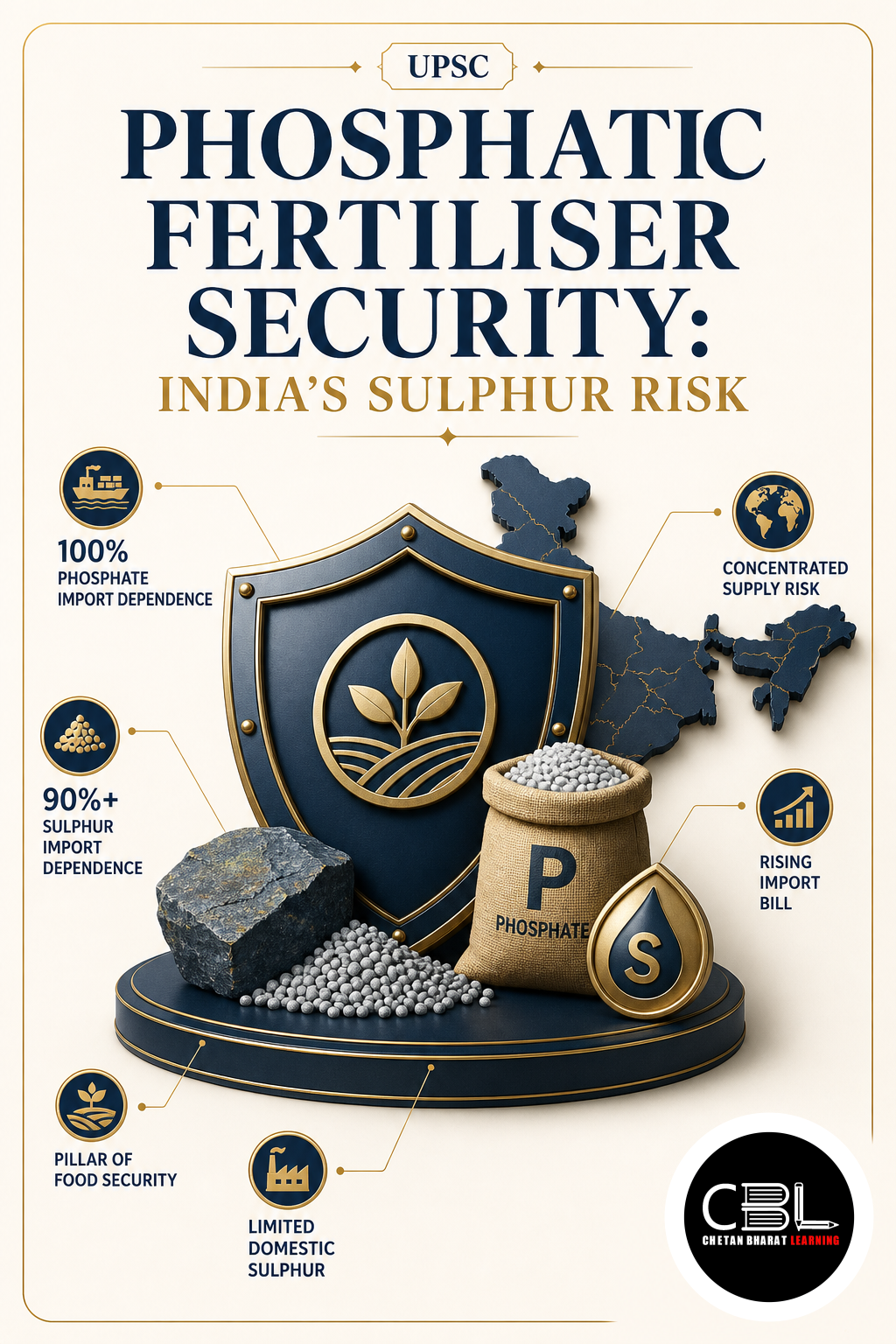
Geopolitical conflict and attacks on energy infrastructure have disturbed supplies from Russia and West Asia. International sulphur prices reportedly reached about US$1,050–1,100 per tonne, sharply increasing conversion costs for Indian producers. The pressure matters because India imports around 2.1 million tonnes of elemental sulphur and sources a large share from West Asia; such concentration exposes Indian plants to common shocks affecting production facilities, maritime passages, insurance costs and delivery schedules across several suppliers.
Nearly ninety per cent of global sulphur emerges as a by-product of petroleum refining and natural-gas processing. Producers cannot quickly expand output when fertiliser demand rises because sulphur supply follows hydrocarbon production. The Union government acknowledged international movements in DAP, MOP and sulphur prices while approving the Kharif 2026 subsidy decision; rising input costs can consequently increase working-capital requirements for manufacturers even when the government shields farmers through administered support.
Key Features
The vulnerability arises from an interconnected value chain rather than one isolated import item. Its principal features include feedstock dependence, conversion capacity and seasonal farm demand.
- Sulphur-dependent conversion: Producers use sulphuric acid to make phosphate rock sufficiently soluble for manufacturing major phosphatic fertilisers.
- Multiple exposed products: A sulphur shortage can constrain DAP, SSP and popular NPKS grades used across diverse crops and soils.
- Large capacity gap: India has roughly 2.2 million tonnes of phosphoric acid capacity against estimated requirements of 4.3–4.5 million tonnes.
- Concentrated import routes: Dependence on the UAE, Qatar and Oman exposes supplies to conflict, shipping disruption and freight volatility.
- Administered affordability: The Nutrient Based Subsidy supports P and K fertilisers according to their nitrogen, phosphorus, potassium and sulphur content.
The chain begins with mining and international trade in phosphate rock. Manufacturers then use sulphuric acid to produce phosphoric acid or directly process material for SSP. Plants combine the resulting intermediates with ammonia or other nutrients to manufacture marketable grades.
This industrial structure explains why adequate rock-phosphate contracts cannot alone guarantee supply. Firms also require acid plants, dependable sulphur, energy, port handling and railway movement. Any bottleneck can delay dispatches during the kharif or rabi application window; manufacturers must therefore synchronise feedstock purchases, maintenance schedules, inventories and transport bookings well before states communicate their final seasonal requirements.
Challenges
India must manage immediate availability without locking agriculture into inefficient nutrient use. The central challenges involve import concentration, price transmission and agronomic balance.
- Geopolitical exposure: Conflict near refineries, gas-processing plants or shipping routes can simultaneously reduce production and obstruct deliveries.
- Limited domestic recovery: Indian refineries and non-ferrous smelters recover sulphur, but their output cannot satisfy total national demand.
- Fiscal pressure: Higher landed costs force the government to choose between a larger subsidy bill and increased retail prices.
- Nutrient imbalance: Price distortions can encourage excessive use of selected fertilisers while crops receive inadequate secondary and micronutrients.
- Regional delivery constraints: Port congestion, storage shortages and slow rail movement can create local scarcity despite adequate national stocks.
The problem also extends beyond annual import volumes. Spot purchases during a global shortage attract high prices, while long contracts may still face force-majeure events. Public policy must therefore combine strategic procurement with transparent stock monitoring and timely information for states; Phosphatic Fertiliser Security improves when authorities identify regional deficits early and redirect available stocks before local shortages disrupt sowing decisions.
Farmers need crop-specific recommendations rather than blanket substitution between products. DAP, SSP, compost and bio-fertilisers do not supply identical nutrients or produce identical field responses. Readers can connect this debate with the economy and agriculture coverage on subsidies, trade exposure and supply chains.
Way Forward
India should diversify sulphur and phosphate sourcing through long-term contracts, joint ventures and wider supplier geography. Domestic refineries can improve recovery efficiency, while fertiliser plants can add sulphuric acid storage, flexible procurement arrangements and calibrated strategic buffers for critical feedstocks. The government should strengthen port planning, real-time stock visibility and coordinated rail allocation, while regular stress tests examine maritime chokepoints, supplier concentration, energy shocks and currency movements.
Policy must promote balanced plant nutrition instead of treating every alternative as a direct replacement for DAP; soil testing and extension services can guide suitable combinations of SSP, NPK grades, organic inputs, bio-fertilisers and Nano DAP. The Nutrient Based Subsidy should reflect genuine input-cost movements, while states use PM-PRANAM incentives to reduce avoidable chemical-fertiliser consumption and expand sustainable alternatives. Together, evidence-based application, supply diversification and efficient nutrient use can protect farm productivity, fiscal stability and national food security.
Prelims Practice Corner
Q1. Which substance is primarily used to convert phosphate rock into phosphoric acid?
(a) Hydrochloric acid (b) Sulphuric acid (c) Nitric acid (d) Acetic acid
Show answer
Answer: (b) Sulphuric acid reacts with phosphate rock during wet-process phosphoric acid production.
Q2. The Nutrient Based Subsidy for P and K fertilisers considers which nutrients?
(a) N, P, K and S (b) N, Ca, Fe and Zn (c) P, Mg, Cu and B (d) K, Cl, Na and Ca
Show answer
Answer: (a) The scheme fixes subsidy rates for nitrogen, phosphorus, potassium and sulphur content.
Q3. PM-PRANAM primarily encourages states and Union Territories to:
(a) Abolish all fertiliser subsidies (b) Import only finished DAP (c) Reduce chemical-fertiliser consumption (d) Replace soil testing
Show answer
Answer: (c) It incentivises reduced chemical-fertiliser use and promotes balanced, alternative inputs.
Q4. Consider the following statements about sulphur: 1. Most global sulphur is recovered from oil refining and natural-gas processing. 2. Its supply can therefore respond independently of hydrocarbon production. Which is correct?
(a) 1 only (b) 2 only (c) Both 1 and 2 (d) Neither 1 nor 2
Show answer
Answer: (a) Sulphur commonly emerges as a hydrocarbon-processing by-product, which limits independent supply adjustment.
Q5. Which fertiliser supplies both phosphorus and sulphur?
(a) Urea (b) Muriate of potash (c) Single super phosphate (d) Calcium ammonium nitrate
Show answer
Answer: (c) Single super phosphate contains phosphorus and sulphur, along with calcium.
Mains Practice Questions
Q1. Examine India’s vulnerability in the phosphatic fertiliser value chain and suggest measures to improve supply resilience. (250 words, 15 marks)
Intro: Define the value chain and link phosphorus availability with agricultural productivity.
Body: Cover import concentration, sulphur dependence, capacity gaps, price risks, logistics and diversification measures.
Conclusion: Advocate resilient sourcing alongside efficient and balanced nutrient use.
Q2. Fertiliser self-reliance requires demand efficiency as much as domestic production. Discuss. (150 words, 10 marks)
Intro: Explain why physical supply and responsible nutrient application are complementary goals.
Body: Discuss NBS, soil testing, SSP, Nano DAP, extension services, PM-PRANAM and domestic feedstock constraints.
Conclusion: Link balanced fertilisation with farm incomes, soil health and fiscal sustainability.
FAQs on Phosphatic Fertiliser Security
Why is sulphur important for phosphatic fertilisers?
Manufacturers convert elemental sulphur into sulphuric acid, which processes phosphate rock into plant-available forms. A shortage can therefore constrain DAP, SSP and complex fertiliser production.
What is the Nutrient Based Subsidy Scheme?
The Union government provides fixed support for subsidised P and K fertilisers according to their N, P, K and S content. The scheme aims to maintain affordability and encourage balanced formulations.
Can Nano DAP completely replace conventional DAP?
Nano DAP can supplement nutrient management when farmers follow validated crop-specific protocols. Authorities should base substitution decisions on field evidence, soil conditions and recommended application practices.
Related Current Affairs
Preparing for UPSC, PCS or HCS?
Talk to a mentor at Chetan Bharat Learning, Chandigarh. Free guidance on choosing the right exam and building a study plan.
Chat on WhatsAppCall 97793 53345UPSC / IAS / PCS coaching in Chandigarh · Trusted by aspirants across Punjab & Haryana
Leave a Reply
You must be logged in to post a comment.