

UPSC Mapping
- Prelims: Monetary Policy and Government Securities
- Mains: GS Paper III: Indian Economy
Quick Facts
| Authority | Reserve Bank of India |
|---|---|
| Auction Date | 21 September 2026 |
| Face Value Accepted | ₹25,000 crore |
| Transaction | Outright sale of government securities |
What are Open Market Operations?
Open Market Operations are RBI purchases or sales of existing government securities in the market to adjust rupee liquidity on a durable basis. When RBI buys securities, it pays market participants and adds funds to the financial system. When RBI sells securities, buyers pay RBI and funds leave the system. The operation changes the quantity of available liquidity through a transaction in bonds. Its direction depends on whether the central bank buys or sells.
An outright transaction transfers a security without an agreement to reverse that specific trade on a set date. This makes it useful when RBI wants a more durable liquidity adjustment than an overnight facility provides. An OMO sale concerns securities already in circulation; it is different from a fresh government borrowing auction. It also differs from changing the repo rate, which alters the policy price of short-term borrowing. RBI can use these instruments together as conditions change.
Why are Open Market Operations in the News?
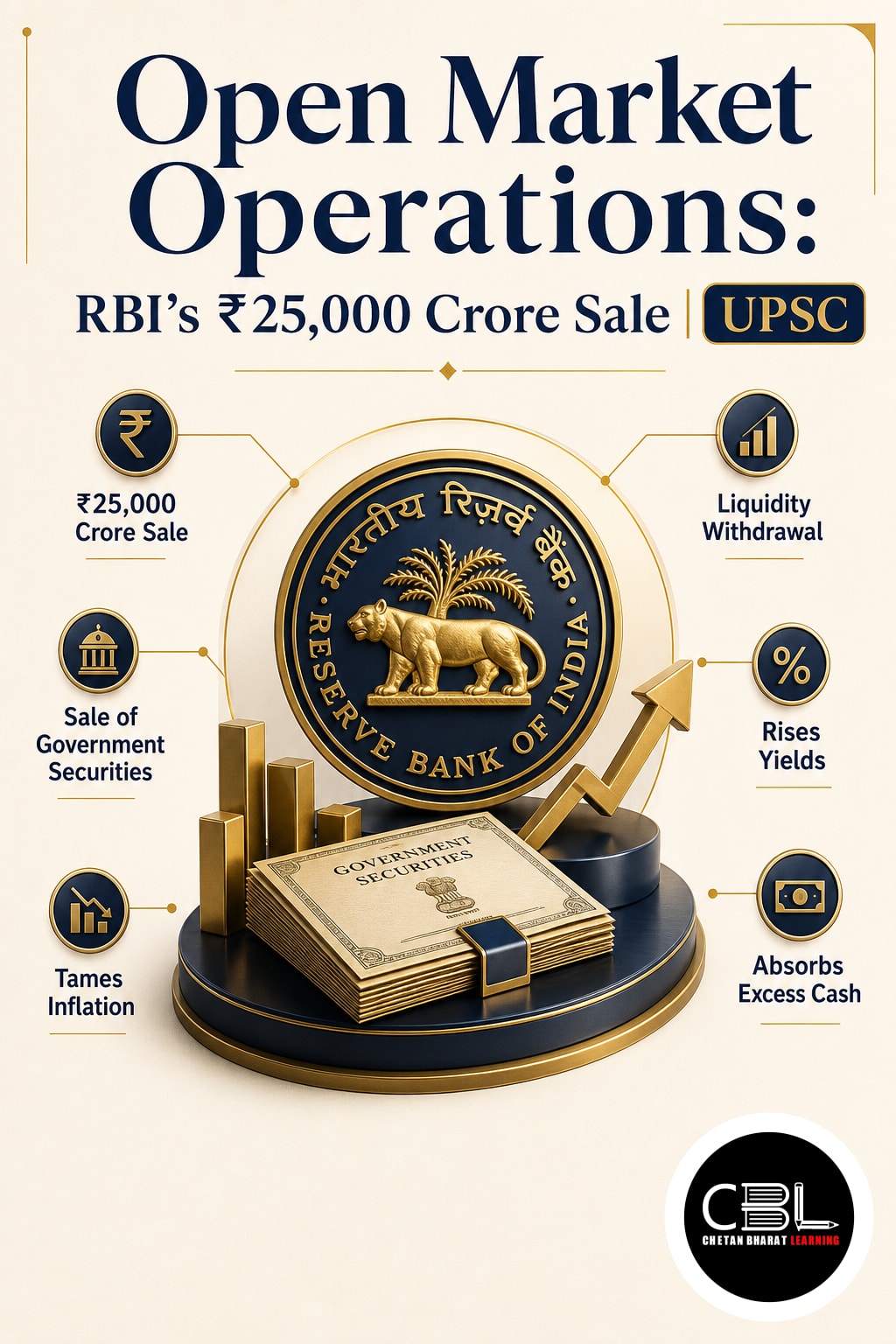
RBI announced an auction to sell Government of India securities with an aggregate notified face value of ₹25,000 crore on 21 September 2026. Its announcement listed six eligible securities maturing between 2027 and 2032. Eligible participants submitted bids through RBI’s e-Kuber system. The RBI auction announcement set out the timing, eligible securities and bidding arrangements. These details make the event a concrete case study for monetary policy questions.
RBI’s published cut-offs show accepted bids totalling ₹25,000 crore in face value across five securities; it accepted no bids for the sixth. Face value describes the principal amount of the bonds, while auction prices determine the funds buyers actually pay. The sale therefore signals liquidity absorption, but the accepted face value should not be treated as an exact measure of rupees withdrawn. Bond prices, yields and broader funding conditions may also respond to other market developments.
Key Features
Open Market Operations work through a clear exchange of securities and funds. The following features explain both the September sale and the wider monetary policy instrument.
- Direction of liquidity: An RBI sale receives funds from buyers and absorbs liquidity, while an RBI purchase pays sellers and injects liquidity into the system.
- Existing securities: The central bank trades government bonds already in circulation, so the operation does not itself create a new borrowing obligation for the government.
- Durable adjustment: An outright trade has no scheduled reversal within that transaction, helping RBI address liquidity needs that extend beyond a single day.
- Auction mechanism: RBI announces the securities and aggregate amount, receives eligible bids and publishes results that show which bids it accepted.
- Market transmission: The sale changes available funds and the supply of bonds held by market participants, although other factors also influence yields and credit conditions.
Challenges
RBI must judge the size and persistence of surplus liquidity before choosing an outright sale. Market conditions can change while an announced auction moves towards settlement.
- Measuring surplus: Tax payments, government spending and currency demand can move funds quickly, making a temporary surplus hard to distinguish from a lasting one.
- Bond market response: A larger supply of securities to investors can affect prices and yields, complicating financing conditions for borrowers across the economy.
- External flows: Changes in foreign investment or global interest rates can alter domestic liquidity and bond demand after RBI plans an operation.
- Uneven transmission: Banks and other market participants hold different portfolios, so a system-wide liquidity change may reach lending rates at different speeds.
- Policy communication: Investors may read a liquidity action as a signal about future interest rates; RBI’s policy trade-offs require clear explanation alongside each auction.
Way Forward
RBI can assess liquidity trends alongside government cash flows, currency demand and conditions in the bond market. It can then calibrate the amount and timing of future purchases or sales to the persistence of those pressures. Publishing auction terms and results helps participants distinguish an operational adjustment from a change in the policy rate. The September results provide an example: the accepted face value reached the announced aggregate, although individual securities drew different outcomes.
For UPSC, the central distinction remains simple: an outright RBI sale absorbs liquidity, while a purchase injects it. A complete answer should add that the effect on bond yields depends on demand, inflation expectations and other market conditions. RBI’s government securities FAQ explains the purpose of these transactions and their durable liquidity role. Linking that mechanism to the September auction produces a precise answer without assuming an automatic change in interest rates.
Prelims Practice Corner
Q1. What is the immediate liquidity direction of an outright RBI sale of government securities?
- (a) Injection
- (b) Absorption
- (c) No change by definition
- (d) Automatic increase in the repo rate
Answer: (b) Buyers pay RBI, removing funds from the financial system.
Q2. Which instrument did RBI sell in its 21 September 2026 auction?
- (a) Corporate shares
- (b) Gold reserves
- (c) Government of India securities
- (d) Foreign currency notes
Answer: (c) RBI offered existing Government of India securities for sale.
Q3. What aggregate face value did RBI accept in that auction?
- (a) ₹5,000 crore
- (b) ₹10,000 crore
- (c) ₹25,000 crore
- (d) ₹50,000 crore
Answer: (c) The accepted face values across five securities totalled ₹25,000 crore.
Q4. Which statement correctly distinguishes an outright OMO sale from a fresh government borrowing auction?
- (a) Both create new securities
- (b) An OMO sale trades existing securities
- (c) An OMO sale changes the repo rate
- (d) Neither involves government securities
Answer: (b) RBI sells securities already in circulation during an outright OMO sale.
Q5. Through which RBI system were eligible participants asked to submit bids for the September auction?
- (a) e-Kuber
- (b) UPI Lite
- (c) GSTN
- (d) SWIFT only
Answer: (a) RBI directed eligible participants to place electronic bids through e-Kuber.
Mains Practice Questions
Q1. Explain how an outright sale of government securities helps RBI manage liquidity. Distinguish it from a change in the repo rate. (10 marks)
Answer Structure:
- Intro: Define an outright OMO sale as an RBI transaction in existing government securities.
- Body: Trace the payment and liquidity flow; explain durable adjustment, bond market effects and the repo rate distinction.
- Conclusion: Note that RBI calibrates the instrument to prevailing liquidity conditions.
Q2. Discuss the benefits and challenges of using bond sales to absorb surplus banking system liquidity. (15 marks)
Answer Structure:
- Intro: Frame the issue through RBI’s September 2026 sale auction.
- Body: Cover durable absorption, liquidity assessment, bond yields, external flows and policy communication.
- Conclusion: Recommend calibrated auctions supported by transparent results and continuing liquidity assessment.
FAQs on Open Market Operations
Does an RBI OMO sale increase or decrease liquidity?
It decreases banking system liquidity because buyers pay RBI for the securities. An RBI purchase has the opposite effect.
Was the September 2026 sale a fresh government bond issue?
No. RBI offered existing Government of India securities in an open market sale. A fresh issue would raise new borrowing for the government.
Does an OMO sale automatically raise every lending rate?
No. It absorbs liquidity and may influence bond yields and funding conditions. Lending rates also depend on other policy decisions, market conditions and banks’ pricing choices.
Related Current Affairs
Preparing for UPSC, PCS or HCS?
Talk to a mentor at Chetan Bharat Learning, Chandigarh. Free guidance on choosing the right exam and building a study plan.
Chat on WhatsAppCall 97793 53345UPSC / IAS / PCS coaching in Chandigarh · Trusted by aspirants across Punjab & Haryana
Leave a Reply
You must be logged in to post a comment.