
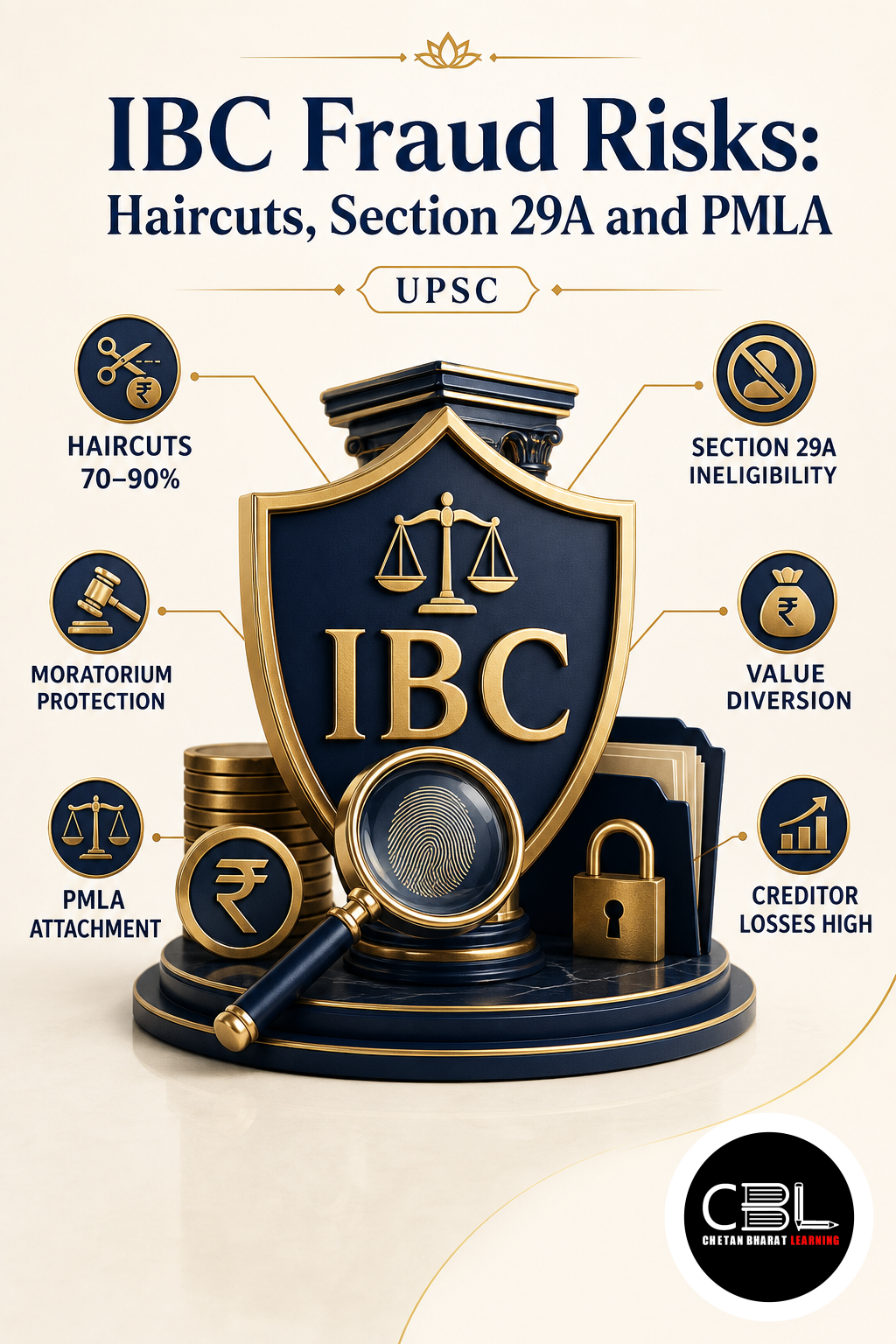

IBC Fraud Risks have placed India’s corporate insolvency framework under renewed scrutiny. Enforcement agencies have flagged possible promoter re-entry, inflated related-party claims, manipulated creditor decisions, asset stripping and questionable valuations. These concerns do not negate the Code’s contribution to resolving stressed assets, but they underline the need for transparent and credible resolution. Aspirants can follow the daily current affairs archive for related economic developments.
What are IBC Fraud Risks?
IBC Fraud Risks refer to attempts to manipulate insolvency proceedings for an improper financial or controlling advantage. A dishonest participant may conceal assets, inflate claims, influence creditor voting or use connected entities to acquire a distressed company cheaply. Such conduct can transfer value away from legitimate creditors while allowing parties associated with the earlier failure to benefit from the resolution.
The Insolvency and Bankruptcy Code, 2016 seeks the time-bound resolution of financial distress, maximisation of asset value and balanced treatment of stakeholders. Its central purpose is not simply debt collection. Resolution may preserve a viable company as a going concern, protect employment and retain productive capacity. Fraudulent use of the process undermines these objectives by converting restructuring into a channel for value diversion.
Why are IBC Fraud Risks in News?
IBC Fraud Risks gained attention after the Enforcement Directorate identified suspected insolvency malpractices and disproportionate creditor haircuts as areas requiring closer examination. The concerns were discussed at the agency’s 36th Quarterly Conference of Zonal Officers in Bengaluru. Officials reportedly focused on possible circumvention of Section 29A, related-party influence, asset stripping and the use of insolvency proceedings to frustrate money-laundering investigations.
The debate intensified following a personal insolvency settlement involving Subhash Chandra. An NCLT order dated 25 August 2026 approved a proposal of ₹6.25 crore against admitted claims exceeding ₹22,000 crore. A specially constituted five-member bench stayed that order on 1 September and directed a rehearing. The proceedings remain subject to adjudication, but the extraordinary difference between claims and proposed payment sharpened concerns about voting composition, disclosure and scrutiny.
Recent reporting on the enforcement focus on insolvency fraud also highlighted falling recovery rates and divergent valuation practices. A low recovery does not automatically prove fraud because distressed assets may already have lost substantial value. It should nevertheless trigger deeper examination when connected parties, incomplete disclosures or unusual voting patterns accompany the haircut.
Key Features
Several statutory safeguards seek to preserve the independence and commercial integrity of insolvency resolution.
- Section 29A eligibility bar: Specified defaulting promoters, wilful defaulters and connected persons cannot regain assets through the resolution process when statutory disqualifications apply.
- Committee of Creditors: Financial creditors evaluate resolution plans and exercise commercial judgment through voting based on their admitted financial exposure.
- Resolution professional: The professional manages the process, verifies claims, maintains the corporate debtor as a going concern and places compliant plans before creditors.
- Avoidance transactions: The Code permits scrutiny of preferential, undervalued, extortionate and fraudulent transactions that may have diverted value before insolvency.
- Judicial supervision: The NCLT examines statutory compliance, while the NCLAT and the Supreme Court provide appellate oversight within their respective jurisdictions.
A creditor haircut represents the difference between admitted claims and the amount recoverable under an approved plan. Haircuts may reflect deterioration in the debtor’s business, obsolete assets, litigation risks or the gap between accounting values and realistic market prices. Comparing a resolution amount only with admitted claims can therefore mislead. Recovery against liquidation value and fair value, resolution time and post-resolution performance also matter.
The IBBI’s official insolvency database publishes process outcomes and institutional material. Its 2024–25 annual report noted that realisation through approved resolution plans exceeded liquidation value on average, even though recovery against admitted claims remained substantially lower. This distinction supports the Code’s resolution-first philosophy while also demonstrating why early admission and value preservation remain critical.
Challenges
Controlling IBC Fraud Risks requires stronger scrutiny without converting every commercial loss into a criminal investigation.
- Connected-party influence: Complex corporate structures can conceal relationships between the debtor, creditors, resolution applicants and ultimate beneficial owners.
- Valuation divergence: Different assumptions about cash flow, asset condition and market demand may produce widely varying estimates for the same enterprise.
- Information asymmetry: Incomplete books, unrecorded liabilities and prior asset transfers can prevent bidders and creditors from assessing true value.
- Delayed resolution: Litigation, repeated bidding and procedural bottlenecks erode enterprise value and may force creditors to accept deeper haircuts.
- Regulatory overlap: Insolvency, money-laundering, securities, company-law and criminal proceedings can create uncertainty over assets and institutional jurisdiction.
The interaction between the IBC and the Prevention of Money Laundering Act requires particular care. Section 14 establishes a moratorium on specified proceedings during corporate insolvency. Section 32A can protect a corporate debtor and its property from liability for earlier offences after a qualifying change of control, subject to statutory conditions. The PMLA separately authorises investigation and attachment of proceeds of crime.
A genuine and unrelated successful applicant needs a clean asset to revive the company. At the same time, insolvency cannot legitimise property derived from crime or protect persons responsible for unlawful conduct. Authorities must distinguish the corporate debtor from culpable individuals and determine whether the statutory conditions for immunity exist. CBL’s economy and banking coverage explains related financial-sector reforms.
Way Forward
India should address IBC Fraud Risks through transparent valuation, beneficial-ownership verification and closer examination of connected-party claims. Resolution professionals should receive timely access to bank records, statutory filings and transaction data. CoC members should record reasons for accepting exceptional haircuts, while independent valuers must disclose assumptions, conflicts and sensitivity ranges. Digital audit trails can help regulators detect coordinated voting and suspicious transactions.
The IBBI, NCLT, Enforcement Directorate, financial regulators and state police need structured information-sharing protocols. Enforcement intervention should target credible evidence of fraud without routinely delaying legitimate resolutions. Specialised benches, stronger tribunal capacity and earlier admission of viable cases can reduce value erosion. The authoritative Insolvency and Bankruptcy Code should remain anchored in revival, value maximisation and fair treatment while preventing abuse by promoters or connected entities.
FAQs on IBC Fraud Risks
Does a deep creditor haircut automatically prove fraud?
No. A distressed company’s assets may have deteriorated before insolvency, producing a low market value. A deep haircut requires closer scrutiny when combined with hidden relationships, manipulated claims or unreliable valuations.
Why is Section 29A important?
It prevents specified ineligible promoters, wilful defaulters and connected persons from acquiring a corporate debtor through resolution. The provision seeks to stop those responsible for default from regaining control without satisfying legal conditions.
What is the main tension between the IBC and PMLA?
The Code seeks timely revival and a clean transfer to eligible applicants, while the PMLA targets proceeds of crime. Coordination is needed so legitimate resolutions continue without shielding culpable persons or unlawful property.
Related Current Affairs
Preparing for UPSC, PCS or HCS?
Talk to a mentor at Chetan Bharat Learning, Chandigarh. Free guidance on choosing the right exam and building a study plan.
Chat on WhatsAppCall 97793 53345UPSC / IAS / PCS coaching in Chandigarh · Trusted by aspirants across Punjab & Haryana
Leave a Reply
You must be logged in to post a comment.