

UPSC Mapping
| Prelims | Environment and Economy |
|---|---|
| Mains | GS Paper 3 (Environment & Industry) |
Article
The Green Steel Mission represents a critical step for India’s industrial decarbonization and climate goals. Aspiring civil servants must understand its multidimensional impact on heavy manufacturing. This flagship initiative directly supports the national target of achieving net-zero emissions by 2070. It aims to transform the highly carbon-intensive steel production landscape across the country. Explore our daily current affairs archive for more structured updates on such national programs.
Quick Facts
| Launch Year | 2024 |
|---|---|
| Nodal Ministry | Ministry of Steel |
| Target Intensity | 2.2 tCO2e per tonne |
What is the Green Steel Mission?
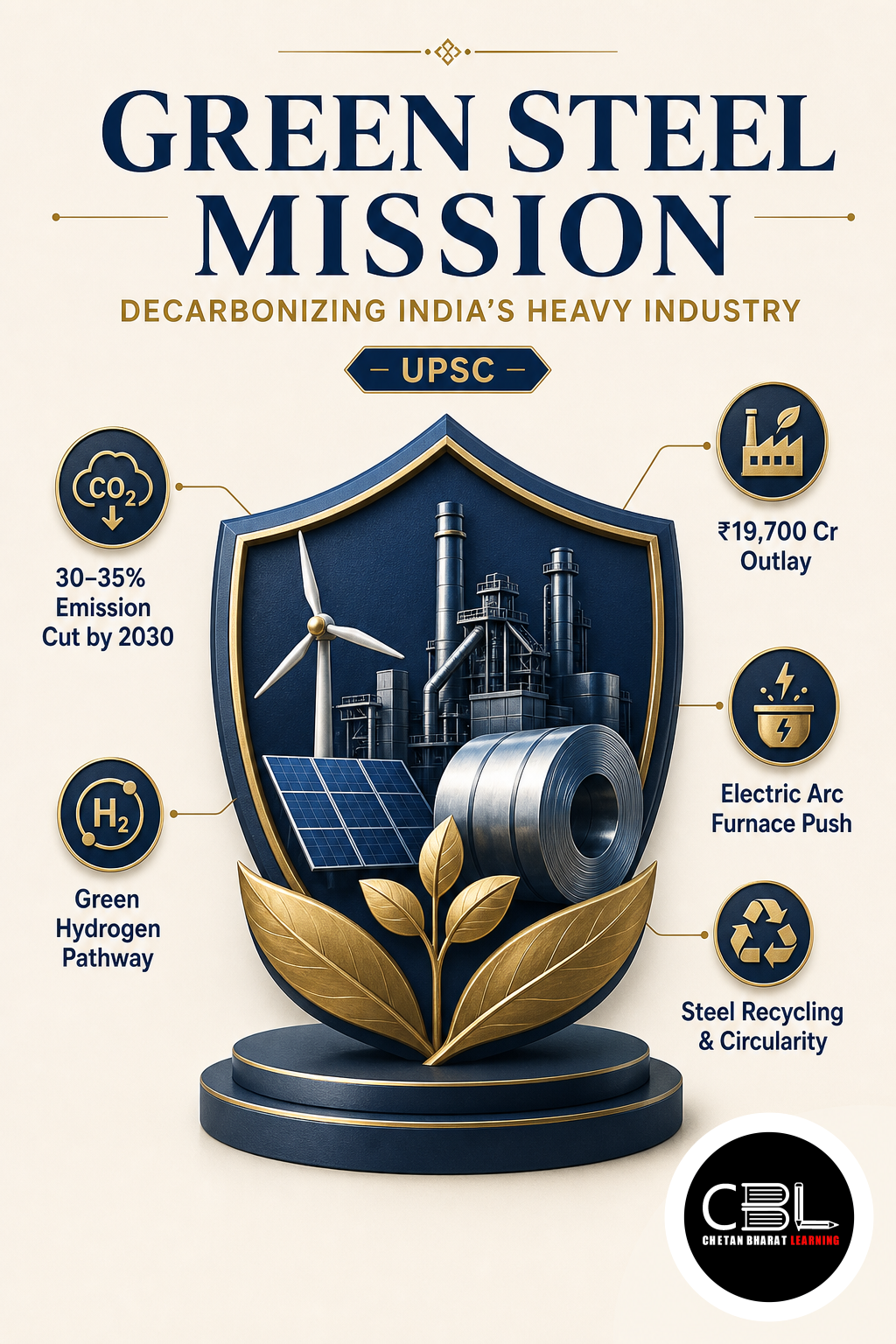
The Green Steel Mission is a strategic national initiative designed to drastically reduce the emissions intensity of domestic steel production. It specifically targets a reduction from 2.55 tonnes to 2.2 tonnes of CO2-equivalent per tonne of steel by the year 2030. A dedicated certification system launched recently defines steel below this strict threshold as genuinely green. This framework actively encourages a structural shift away from the conventional blast furnace-basic oxygen furnace route. The mission provides a clear roadmap for the industry to adopt cleaner technologies systematically.
Furthermore, the policy promotes the increased use of recycled steel scrap and electric arc furnaces. It also envisions Direct Reduced Iron becoming a near-zero-carbon process when green hydrogen replaces natural gas. This transition requires massive investments in renewable electricity and advanced metallurgical research. The government aims to position India as a global leader in sustainable heavy manufacturing. Such structural shifts are absolutely vital for long-term industrial competitiveness and climate resilience.
Why is the Green Steel Mission in News?
India’s steelmaking emissions are currently roughly 32% higher than the global average. Steel production accounts for nearly 12% of India’s total greenhouse gas emissions. The country produced around 160 million tonnes of steel recently, ranking second only to China globally. You can verify these industrial milestones through the official PIB release on heavy industry decarbonization.
Additionally, the European Union’s Carbon Border Adjustment Mechanism strengthens the economic case for immediate action. This mechanism imposes carbon costs on imported goods, directly impacting Indian steel exports. Planned capacity expansion could increase the highly polluting blast furnace share to around 56% by 2030. This creates a severe risk of long-term carbon lock-in for the national economy. The Green Steel Mission provides the necessary policy intervention to prevent this irreversible trajectory.
Key Features
The architecture of this transformative initiative rests on several foundational pillars designed to stimulate rapid market adoption.
- Certification System: A rigorous framework defines and certifies steel with emissions below 2.2 tonnes of CO2-equivalent per tonne as green.
- Technology Promotion: The policy actively incentivizes the adoption of electric arc furnaces and hydrogen-based direct reduced iron technologies.
- Scrap Utilization: It mandates higher utilization rates of recycled steel scrap to reduce the reliance on virgin iron ore processing.
- Financial Incentives: The government offers viability gap funding and tax benefits to early movers adopting clean steel manufacturing processes.
- Capacity Building: Dedicated programs train engineers and technicians in advanced, low-carbon metallurgical techniques and plant operations.
Challenges
Despite its ambitious vision, the Green Steel Mission faces several structural and economic hurdles that require careful navigation.
- High Capital Costs: Transitioning to hydrogen-based steelmaking requires massive upfront investments in new infrastructure and renewable energy integration.
- Technology Dependence: Critical components for advanced electrolyzers and electric arc furnaces still rely heavily on foreign imports.
- Grid Reliability: The intermittent nature of solar and wind power poses significant challenges for maintaining continuous, high-temperature industrial operations.
- Raw Material Constraints: Securing a consistent, high-quality supply of domestic steel scrap remains a persistent logistical challenge for manufacturers.
- Global Trade Frictions: Varying international definitions of green steel can lead to disputes and complicate export certification processes.
Addressing these bottlenecks requires coordinated policy interventions and sustained public investment. Aspirants should review our UPSC prelims strategy guide to understand how such industrial policy challenges are frequently framed in examinations.
Way Forward
To realize the full potential of the Green Steel Mission, the government must prioritize the rapid expansion of dedicated renewable energy capacity. Subsidizing green hydrogen production will drastically improve the cost competitiveness of hydrogen-based direct reduced iron against traditional coal methods. Implementing mandatory green public procurement policies will also create guaranteed initial demand for certified low-carbon steel.
Moreover, establishing clear domestic standards aligned with global best practices will attract crucial foreign direct investment. The NITI Aayog has consistently emphasized the need for a holistic ecosystem approach involving states, private players, and academia. This comprehensive strategy will ultimately make India a true leader in the global clean industrial transition.
Prelims Package
Q1. Consider the following statements regarding the Green Steel Mission:
1. It aims to reduce emissions intensity to 2.2 tonnes of CO2-equivalent per tonne by 2030.
2. It promotes the conventional blast furnace-basic oxygen furnace route as the primary green technology.
Which of the statements given above is/are correct?
(a) 1 only (b) 2 only (c) Both 1 and 2 (d) Neither 1 nor 2
Answer: (a) The mission actively discourages the conventional blast furnace route in favor of electric arc and hydrogen-based methods.
Q2. Which gas is targeted to replace natural gas in the Direct Reduced Iron process to achieve near-zero carbon emissions?
(a) Biogas (b) Green Hydrogen (c) Methane (d) Syngas
Answer: (b) Green hydrogen replaces natural gas to eliminate carbon emissions in the direct reduced iron process.
Q3. What percentage of India’s total greenhouse gas emissions is accounted for by steel production?
(a) Nearly 5% (b) Nearly 12% (c) Nearly 20% (d) Nearly 32%
Answer: (b) Steel production accounts for nearly 12% of India’s total greenhouse gas emissions.
Q4. The European Union’s mechanism that imposes carbon costs on imported goods, impacting Indian steel, is called:
(a) Carbon Credit Trading Scheme (b) Carbon Border Adjustment Mechanism (c) Green Deal Industrial Plan (d) Emissions Trading System
Answer: (b) The Carbon Border Adjustment Mechanism (CBAM) imposes carbon costs on specific imported goods.
Q5. Which ministry serves as the nodal authority for the Green Steel Mission in India?
(a) Ministry of Environment, Forest and Climate Change (b) Ministry of Heavy Industries (c) Ministry of Steel (d) Ministry of New and Renewable Energy
Answer: (c) The Ministry of Steel is the nodal ministry responsible for the Green Steel Mission.
Mains Package
Q1. Discuss the significance of the Green Steel Mission in helping India meet its climate commitments. What are the major challenges in its implementation? (150 words, 10 marks)
Answer Structure:
- Intro: Define the Green Steel Mission and its core emission intensity target.
- Body: Significance (decarbonizing heavy industry, aligning with net-zero 2070, improving export competitiveness); Challenges (high capital costs, technology dependence, grid reliability, scrap availability).
- Conclusion: Emphasize the need for sustained R&D and international collaboration to overcome bottlenecks.
Q2. ‘Global carbon pricing mechanisms like CBAM present both a challenge and an opportunity for India’s heavy industries.’ Critically examine. (250 words, 15 marks)
Answer Structure:
- Intro: Contextualize the rise of carbon border taxes and India’s position as a major steel producer.
- Body: Challenges (increased export costs, compliance burdens, risk of carbon lock-in); Opportunities (catalyst for domestic green steel adoption, access to green finance, first-mover advantage in sustainable manufacturing).
- Conclusion: Summarize how proactive policy support and rapid decarbonization can transform this regulatory challenge into a strategic economic advantage.
FAQs
What is the primary target of the Green Steel Mission?
The primary target is to reduce the emissions intensity of steel production from 2.55 tonnes to 2.2 tonnes of CO2-equivalent per tonne of steel by the year 2030.
How does green hydrogen contribute to the Green Steel Mission?
Green hydrogen replaces natural gas in the Direct Reduced Iron process, eliminating carbon emissions and making the steel production pathway near-zero-carbon.
Which ministry oversees the Green Steel Mission in India?
The Ministry of Steel is the nodal ministry responsible for the formulation and implementation of the Green Steel Mission.
Related Current Affairs
Preparing for UPSC, PCS or HCS?
Talk to a mentor at Chetan Bharat Learning, Chandigarh. Free guidance on choosing the right exam and building a study plan.
Chat on WhatsAppCall 97793 53345UPSC / IAS / PCS coaching in Chandigarh · Trusted by aspirants across Punjab & Haryana
Leave a Reply
You must be logged in to post a comment.