
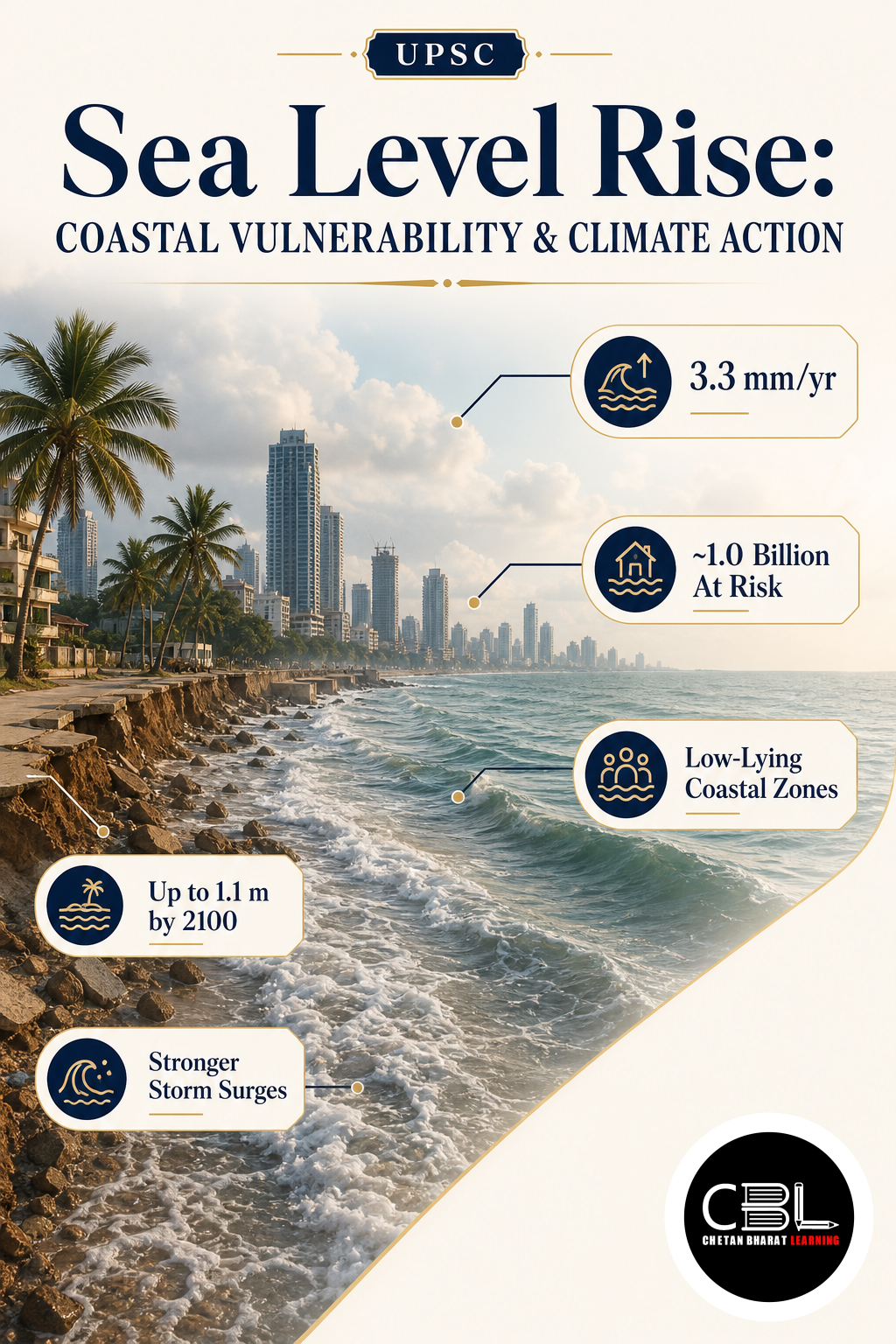

UPSC Mapping
| Prelims | Mains |
|---|---|
| Geography | GS Paper 1 & 3 |
Quick Facts
| Report | UN 2024 |
|---|---|
| Global Rise | 5.9 mm |
| At Risk | 770 Million |
| Key Cities | Mumbai, Kolkata |
What is Sea Level Rise?
The Sea Level Rise phenomenon primarily results from two interconnected physical processes driven by global warming. First, thermal expansion occurs as ocean waters absorb excess atmospheric heat and expand in volume. Second, the accelerated melting of land-based ice sheets adds massive freshwater quantities globally.
It is crucial to distinguish this from the melting of floating sea ice, which does not significantly alter global water volumes. The Intergovernmental Panel on Climate Change consistently highlights these mechanisms as the dominant drivers of contemporary oceanic changes. Coastal regions experience these impacts unevenly due to complex local ocean currents.
Historical tide gauge records and modern satellite altimetry confirm that the current rate of increase is unprecedented in recent geological history. This rapid acceleration leaves coastal ecosystems and human settlements with insufficient time to adapt naturally. Consequently, proactive engineering and policy interventions become absolutely essential for long-term survival.
Why is Sea Level Rise in News?
A recent United Nations report on Sea Level Rise presented at the 55th Pacific Islands Forum highlighted alarming new data. The global ocean surface rose by a record 5.9 millimeters in 2024 alone, signaling an accelerating trajectory. An official UN climate release warned that at least 770 million people face severe inundation risks.
The comprehensive assessment specifically identified South Asian metropolises like Mumbai, Kolkata, and Dhaka as highly vulnerable hotspots. More than 14 million residents in these specific urban clusters face immediate risks of losing their homes permanently. Compounding this crisis, severe land subsidence in cities like Mumbai drastically intensifies the localized flooding impacts.
Global leaders emphasized the urgent need for improved scientific data and targeted support for vulnerable communities worldwide. The recommendations strongly advocate for stronger early-warning systems and significantly greater adaptation finance from developed nations. Such international cooperation remains vital to prevent mass displacement and catastrophic infrastructure losses across the Global South.
Key Features
- Thermal Expansion: Warming oceans absorb immense heat energy, causing the water molecules to expand and increase overall volume.
- Glacial Melt: Rapid degradation of the Greenland and Antarctic ice sheets injects unprecedented freshwater quantities into marine ecosystems.
- Coastal Inundation: Permanent submergence of low-lying territories directly threatens indigenous communities and Small Island Developing States globally.
- Saltwater Intrusion: Rising marine waters push salt deep into coastal freshwater aquifers, devastating local agriculture and drinking supplies.
- Storm Amplification: Higher baseline ocean levels significantly amplify the destructive power of storm surges during severe cyclonic events.
Challenges
- Land Subsidence: Unplanned urban extraction of groundwater causes coastal cities to sink, compounding the relative water increase drastically.
- Infrastructure Loss: Critical coastal assets like major ports, national highways, and thermal power plants face permanent inundation risks.
- Climate Refugees: Mass displacement of vulnerable populations creates severe socio-economic burdens and potential geopolitical border tensions regionally.
- Ecosystem Degradation: Rapid inundation frequently outpaces the natural inland migration capabilities of vital coastal mangroves and wetland habitats.
- Maritime Disputes: Shifting coastlines and completely submerged islands complicate established Exclusive Economic Zones and international maritime boundary agreements.
Administrators remain cautious due to the massive financial requirements and uncertain short-term returns on coastal defense projects. Addressing these structural barriers requires coordinated efforts between central ministries and state governments.
Way Forward
The international community must aggressively pursue faster emission cuts to limit future thermal expansion and glacial melt. Establishing robust early-warning systems and securing greater adaptation finance will protect vulnerable coastal demographics effectively. A comprehensive MoEFCC strategy should prioritize nature-based solutions like massive mangrove restoration along vulnerable shorelines.
Developing robust domestic building codes for elevated infrastructure will provide crucial initial resilience for coastal cities. Simultaneously, policymakers must strictly enforce groundwater extraction limits to halt the dangerous land subsidence exacerbating urban flooding. Long-term success ultimately depends on integrating scientific data with localized urban planning to protect millions of citizens.
Policymakers must also introduce standardized coastal regulation protocols to prevent unauthorized construction in highly vulnerable inundation zones. Harmonizing these regulatory frameworks with established global standards will eliminate unnecessary ecological degradation and facilitate smoother climate adaptation. A unified national mapping authority could oversee risk assessments across all regional coastal districts.
Furthermore, integrating massive seawall projects with natural wetland preservation requires advanced hydrological modeling and high-capacity drainage systems. Upgrading existing municipal stormwater infrastructure will prevent urban waterlogging and ensure maximum resilience against extreme cyclonic events. These complementary investments will ultimately determine the true environmental integrity and economic feasibility of coastal defense strategies.
Prelims Practice Corner
Q1. What are the two primary physical drivers of global oceanic volume increase?
(a) Melting sea ice and increased rainfall
(b) Thermal expansion and land-based ice melt
(c) Tectonic plate shifting and volcanic activity
(d) Ocean acidification and coral bleaching
Answer: (b) The warming of ocean waters causes thermal expansion, while melting glaciers and ice sheets add freshwater volume.
Q2. According to the recent UN report, which South Asian cities are identified as highly vulnerable hotspots?
(a) Chennai and Visakhapatnam
(b) Mumbai, Kolkata, and Dhaka
(c) Kochi and Thiruvananthapuram
(d) Surat and Mangaluru
Answer: (b) The report specifically highlights Mumbai, Kolkata, and Dhaka as facing immediate risks of permanent inundation.
Q3. How does land subsidence exacerbate the impact of rising oceans in urban areas like Mumbai?
(a) It increases the salinity of the soil
(b) It causes the land to sink, increasing relative water levels
(c) It triggers frequent seismic activities
(d) It destroys coastal mangrove forests
Answer: (b) Unplanned groundwater extraction causes the ground to sink, drastically intensifying localized flooding impacts.
Q4. What is the primary consequence of saltwater intrusion in coastal regions?
(a) Increase in marine biodiversity
(b) Contamination of freshwater aquifers and agricultural land
(c) Acceleration of coral reef growth
(d) Reduction in cyclonic storm intensity
Answer: (b) Rising marine waters push salt deep into coastal aquifers, devastating local agriculture and drinking water supplies.
Q5. Why does the melting of floating Arctic sea ice not significantly contribute to global volume increase?
(a) It is composed of salt water
(b) It displaces its own weight in water already
(c) It evaporates rapidly in summer
(d) It is located far from major ocean currents
Answer: (b) According to Archimedes’ principle, floating ice already displaces a volume of water equal to its melted mass.
Mains Practice Questions
Q1. Discuss the geographical and socio-economic implications of rising oceans on India’s coastal cities, with special reference to the phenomenon of land subsidence. (250 words)
- Intro: Define the dual threat of thermal expansion and glacial melt, highlighting India’s long coastline vulnerability.
- Body: Discuss socio-economic impacts like infrastructure loss and climate refugees. Explain how excessive groundwater extraction causes land subsidence in cities like Mumbai, artificially accelerating relative inundation.
- Conclusion: Emphasize the need for strict groundwater regulation and nature-based solutions like mangrove restoration to build coastal resilience.
Q2. Small Island Developing States face disproportionate risks from climate change. Analyze this statement in the context of the recent UN report on oceanic changes and global adaptation finance. (150 words)
- Intro: Highlight the existential threat to SIDS due to their low elevation and limited landmass.
- Body: Discuss the loss of Exclusive Economic Zones, saltwater intrusion, and mass displacement. Critically analyze the shortfall in global adaptation finance and the need for robust early-warning systems.
- Conclusion: Conclude that international climate justice demands immediate financial and technological support for these highly vulnerable nations.
FAQs on Sea Level Rise
What is the difference between sea ice melt and land ice melt?
Melting floating sea ice does not significantly raise global water levels because it already displaces its own mass. Conversely, melting land-based glaciers and ice sheets add entirely new water volumes to the oceans.
How does land subsidence worsen the impact in Mumbai?
Unplanned extraction of groundwater causes the physical ground to sink over time. This localized sinking combines with rising ocean waters to drastically accelerate the frequency and severity of urban flooding.
What is saltwater intrusion and why is it dangerous?
Saltwater intrusion occurs when rising marine waters push salt deep into coastal freshwater aquifers. This contaminates local drinking water supplies and renders fertile agricultural soils completely barren.
Related Current Affairs
Preparing for UPSC, PCS or HCS?
Talk to a mentor at Chetan Bharat Learning, Chandigarh. Free guidance on choosing the right exam and building a study plan.
Chat on WhatsAppCall 97793 53345UPSC / IAS / PCS coaching in Chandigarh · Trusted by aspirants across Punjab & Haryana
Leave a Reply
You must be logged in to post a comment.