

UPSC Mapping
| Prelims | Mains |
|---|---|
| Environment | GS Paper 3 |
Quick Facts
| Launch Year | 2023 |
|---|---|
| Secretariat | Virtual |
| Type | Multilateral Platform |
| Authority | MoPNG |
What is Global Biofuel Alliance?
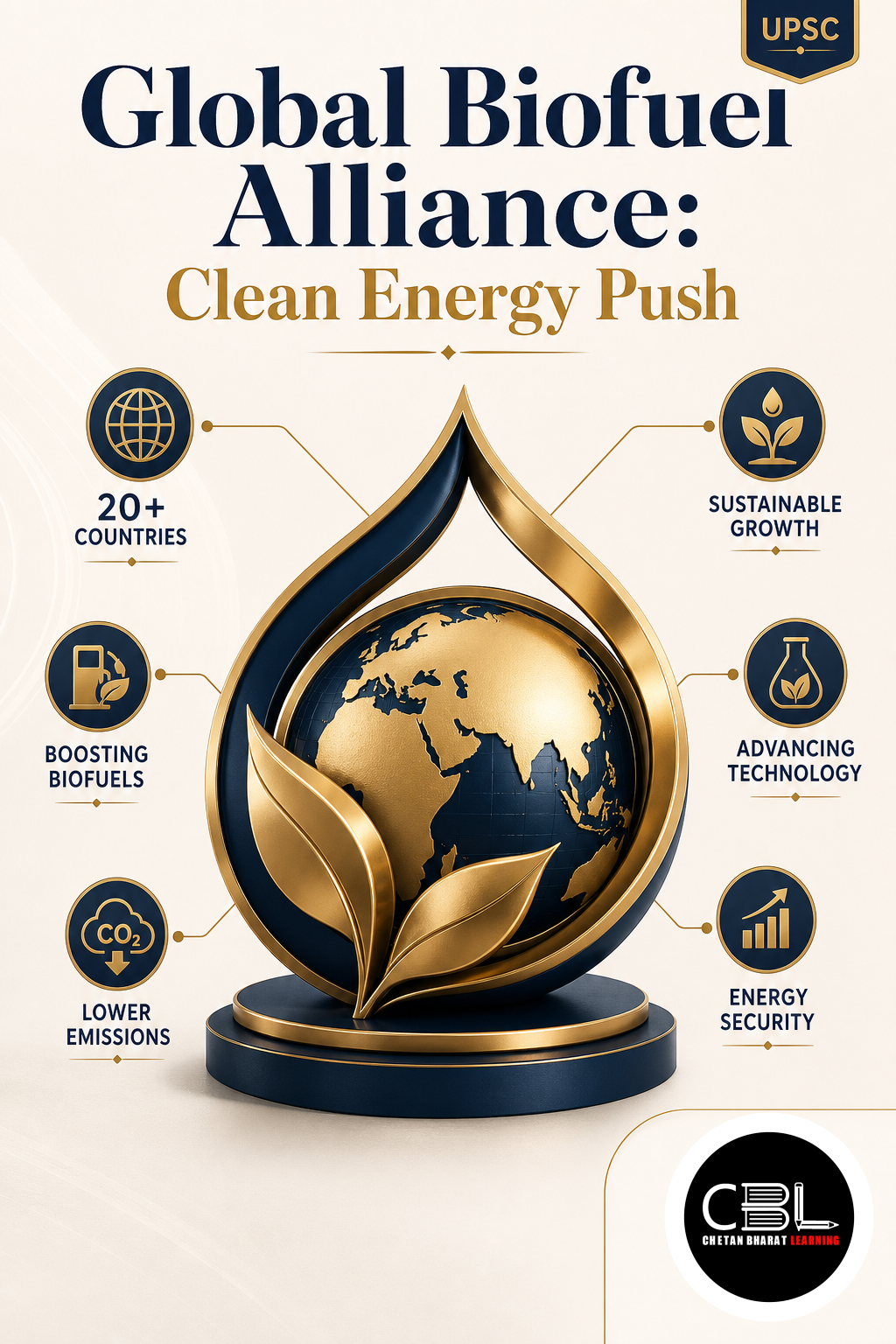
The Global Biofuel Alliance operates as an international platform facilitating the widespread adoption of sustainable liquid fuels. Member nations share critical technological expertise and establish unified standards for ethanol production. This cooperation completely eliminates fragmented regulatory barriers hindering international clean fuel trade today.
The initiative primarily supports countries lacking indigenous technological capabilities to process agricultural residues into advanced biofuels. Developing nations receive direct financial assistance and technical training to build modern biorefineries. The organization aims to establish a complete ecosystem covering feedstock collection and distribution networks globally.
Why is Global Biofuel Alliance in News?
The Union Ministry recently highlighted substantial progress in expanding the Global Biofuel Alliance membership across emerging economies. Several African and Latin American nations have officially joined the platform to attract massive green investments. A recent PIB release detailed the successful deployment of joint research facilities under this framework.
International partnerships are simultaneously expanding market access for Indian ethanol exporters entering the European aviation sector. Global demand for sustainable aviation fuel continues to rise sharply as airlines enforce stricter carbon offset mandates. These regulatory shifts create highly lucrative opportunities for domestic manufacturers scaling up their operations rapidly.
Key Features
- Knowledge Sharing: Virtual repository of best practices for efficient feedstock management and conversion technologies.
- Standardization: Universal quality benchmarks to facilitate seamless cross-border trading of liquid biofuels.
- Financial Support: Concessional loans to developing nations constructing their first commercial biorefineries.
- Capacity Building: Specialized training programs for engineers and policymakers to manage complex biofuel supply chains.
- Market Creation: Advocacy for minimum sustainable fuel blending requirements in aviation and shipping.
Challenges
- Feedstock Scarcity: Securing consistent supplies of agricultural residue without disrupting food security.
- High Production Costs: Advanced second-generation biofuels remain costlier than fossil-based alternatives.
- Infrastructure Deficits: Specialized pipelines and storage for volatile ethanol blends are lacking.
- Technology Reliance: Dependence on imported enzymes and catalysts for advanced biomass fermentation.
- Land Use Conflicts: Dedicated energy crop plantations compete with essential food cultivation.
Investors remain cautious due to long gestation periods and uncertain short-term returns on these massive infrastructure projects. Read our detailed breakdown on renewable energy infrastructure bottlenecks.
Way Forward
The government must aggressively pursue international technology transfer agreements to localize advanced enzyme manufacturing capabilities. Establishing joint ventures with global leaders will rapidly bridge existing technological gaps in domestic supply chains. A comprehensive MNRE strategy should also prioritize skilling programs to create a specialized workforce.
Developing robust domestic demand mandates will provide crucial initial market certainty for private investors entering the sector. Simultaneously, policymakers must streamline environmental clearances for establishing dedicated agricultural residue collection centers across rural districts. Long-term success ultimately depends on creating a self-sustaining commercial ecosystem independent of perpetual state subsidies.
Expanding the Global Biofuel Alliance membership further will solidify India’s position as the undisputed leader of the Global South. Harmonizing these regulatory frameworks with established international standards will eliminate unnecessary trade barriers and facilitate smoother cross-border transactions. A unified global certification authority could eventually oversee quality control across all regional production hubs.
Prelims Practice Corner
Q1. Which organization acts as the primary nodal agency in India for the Global Biofuel Alliance?
- (a) NITI Aayog
- (b) Ministry of Petroleum and Natural Gas
- (c) Ministry of Environment
- (d) Ministry of Power
Answer: (b) The Ministry of Petroleum and Natural Gas oversees the implementation and international coordination of the alliance.
Q2. The primary objective of this multilateral platform is to:
- (a) Ban fossil fuel extraction globally
- (b) Facilitate the adoption of sustainable liquid fuels
- (c) Regulate international carbon taxes
- (d) Fund nuclear energy research
Answer: (b) It aims to accelerate the worldwide adoption and trade of sustainable biofuels like ethanol and biodiesel.
Q3. Which of the following is considered a major challenge for advanced biofuel production?
- (a) Excessive water generation
- (b) High cost of second-generation feedstock processing
- (c) Lack of sunlight
- (d) Overproduction of crude oil
Answer: (b) Processing agricultural residues into second-generation biofuels remains technologically complex and expensive.
Q4. What role does the platform play regarding international trade?
- (a) It imposes heavy tariffs on ethanol exports
- (b) It develops universal quality benchmarks for cross-border trading
- (c) It bans biofuel exports to developed nations
- (d) It mandates the use of coal for transport
Answer: (b) Member countries collaboratively develop universal quality benchmarks to facilitate seamless cross-border trading.
Q5. Sustainable Aviation Fuel (SAF) is primarily targeted at which sector?
- (a) Maritime shipping
- (b) Commercial airlines and aviation
- (c) Urban electric vehicles
- (d) Railway freight transport
Answer: (b) SAF is specifically designed to decarbonize the commercial aviation sector, which cannot easily electrify.
Mains Practice Questions
Q1. Discuss the potential of the Global Biofuel Alliance in reducing India’s import dependency and achieving its climate goals. What are the key infrastructural bottlenecks hindering its immediate success? (250 words)
Answer Structure
- Intro: Define the alliance and its core objective to accelerate sustainable energy transitions globally.
- Body: Discuss potential in reducing crude oil imports, boosting rural incomes, and meeting COP26 targets. Highlight bottlenecks like feedstock scarcity, high 2G processing costs, and lack of dedicated pipelines.
- Conclusion: Emphasize the need for integrated smart grids and international technology partnerships to ensure commercial viability.
Q2. Establishing domestic demand mandates is crucial for the commercial viability of advanced biofuels. Analyze this statement in the context of global energy transitions and India’s export ambitions. (150 words)
Answer Structure
- Intro: Explain the concept of blending mandates and their role in de-risking private investments.
- Body: Link domestic consumption to economies of scale. Discuss how scale reduces costs, making exports competitive against global players facing strict carbon border taxes.
- Conclusion: Conclude that a strong domestic market acts as the foundational launchpad for becoming a global export hub.
FAQs on Global Biofuel Alliance
What is the main difference between first and second-generation biofuels?
First-generation biofuels are derived from food crops like sugarcane and corn, potentially impacting food security. Second-generation biofuels utilize non-food agricultural residues and municipal waste, eliminating the food-versus-fuel conflict entirely.
How will the alliance benefit the Indian economy?
The initiative will create thousands of rural jobs in feedstock collection while significantly reducing the country’s massive crude oil import bills. It also positions India as a major global exporter of clean energy derivatives.
Why is feedstock scarcity a concern for biofuel production?
Securing consistent supplies of agricultural residue requires complex rural logistics and competes with existing uses like cattle fodder. Large-scale biorefineries can consume thousands of tons daily, potentially straining local biomass resources.
Related Current Affairs
Preparing for UPSC, PCS or HCS?
Talk to a mentor at Chetan Bharat Learning, Chandigarh. Free guidance on choosing the right exam and building a study plan.
Chat on WhatsAppCall 97793 53345UPSC / IAS / PCS coaching in Chandigarh · Trusted by aspirants across Punjab & Haryana
Leave a Reply
You must be logged in to post a comment.