
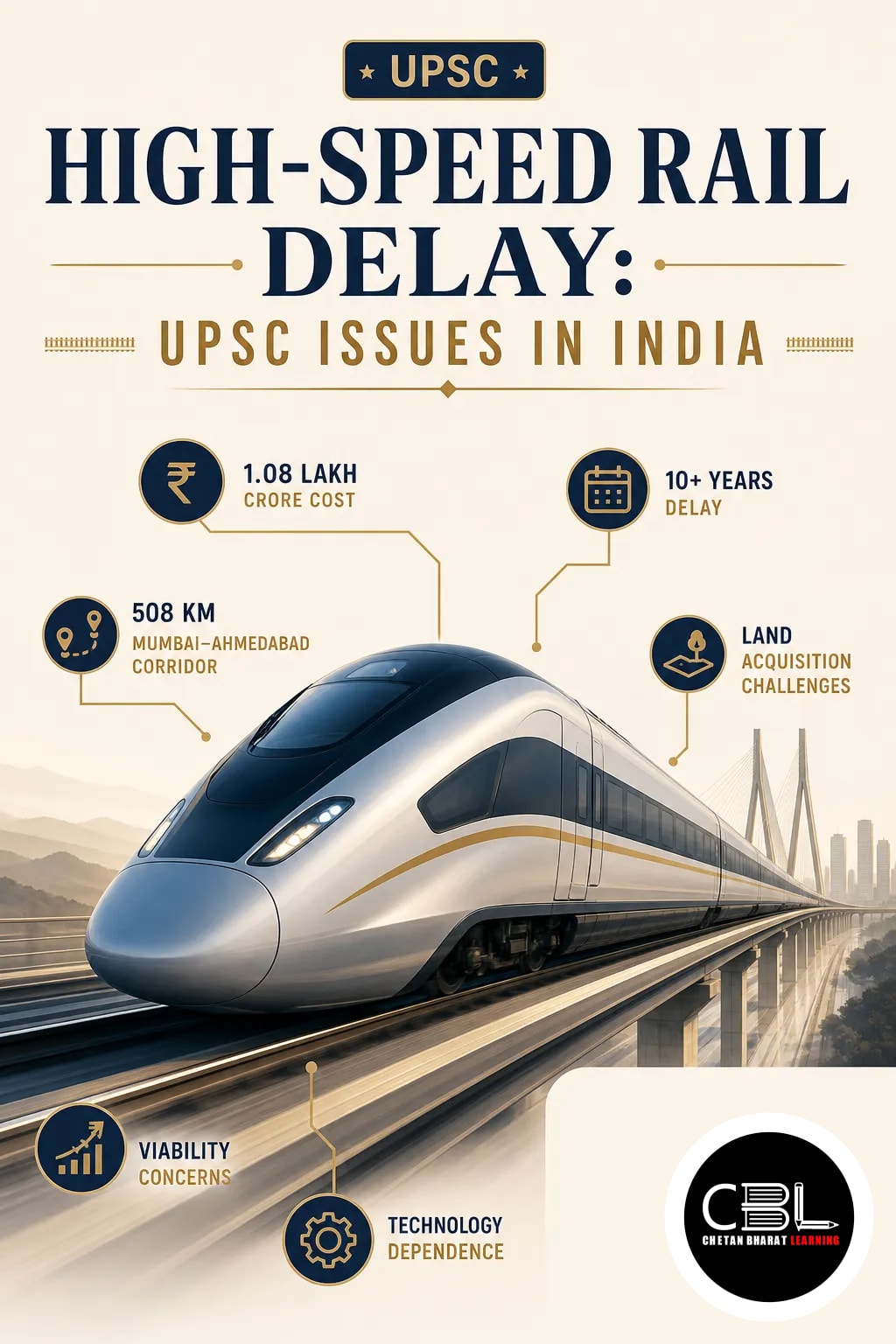

India’s high-speed rail project has taken a long detour, and the current affairs archive helps place it in the wider infrastructure debate. The Mumbai-Ahmedabad line remains the central example of how major transport projects face land, finance, and execution hurdles.
What is high-speed rail?
High-speed rail refers to a railway system designed for much faster passenger movement than conventional lines. In India, the term is linked most closely to the bullet train project, which aims to reduce travel time on a dense economic corridor.
This model needs specialised tracks, signalling, rolling stock, land acquisition, and complex safety systems. It also demands strong coordination among the Union government, states, railways, and implementing agencies.
Why in News?
The project has attracted attention because its path has been slower and more complicated than originally expected. The issue is not only technical; it also shows how large infrastructure works can move through repeated administrative and financial adjustments.
For UPSC, the topic matters because it connects with capital-intensive public investment, project design, and governance capacity. It also tests understanding of how India builds transport infrastructure across federal and regulatory layers.
Key Features
- Faster inter-city travel High-speed rail is designed to cut journey time between major urban centres and improve mobility.
- Dedicated infrastructure It uses specialised track systems, safety features, and advanced operations rather than conventional rail alignment.
- High capital cost Such projects need large upfront investment for land, civil works, technology, and rolling stock.
- Multi-level coordination The project depends on cooperation between the Union government, states, railways, and financing partners.
- Economic corridor impact It can support business travel, regional integration, and development around connected stations.
Challenges
- Land acquisition delays Large linear projects often face delays in securing land and clearing local hurdles.
- Financing pressure Heavy borrowing and long gestation periods can strain public finances and implementation schedules.
- Technology dependence Imported systems and specialised know-how can slow execution if procurement and adaptation lag.
- Coordination gaps Multiple authorities working on one corridor can create procedural delays and decision bottlenecks.
- Demand uncertainty Planning becomes harder when ridership, fares, and revenue recovery remain uncertain.
Way Forward
India needs realistic timelines, phased execution, and transparent cost management for high-speed rail projects. Strong project appraisal, early land preparation, and stable financing can reduce avoidable overruns.
Future corridors should also be chosen on the basis of economic viability, passenger demand, and wider connectivity. That approach can make high-value transport investment more sustainable and more credible for public planning.
Source: Indian Express Explained, 2026-10-24
- Economic Resilience: India’s Growth Amid Global Risks (27 Aug 2026)
- Ways and Means Advances (10 May 2023)
This topic is useful for state PCS papers on infrastructure planning, public-private coordination, and transport-led growth. It also helps in answers on how large projects affect land use, urban development, and fiscal choices at the state level.
FAQ
Why does the bullet train project matter for UPSC?
It combines infrastructure, public finance, governance, and technology. UPSC can frame it as a case study in project execution and economic planning.
What is the main policy lesson from such delays?
Large projects need realistic scheduling, early land readiness, and stable funding. Coordination among institutions should begin before construction accelerates.
How can state PCS aspirants use this topic?
They can use it in answers on infrastructure governance, urban transport, and public investment. It is also relevant to questions on land acquisition and regional development.
Related Current Affairs
Preparing for UPSC, PCS or HCS?
Talk to a mentor at Chetan Bharat Learning, Chandigarh. Free guidance on choosing the right exam and building a study plan.
Chat on WhatsAppCall 97793 53345UPSC / IAS / PCS coaching in Chandigarh · Trusted by aspirants across Punjab & Haryana
Leave a Reply
You must be logged in to post a comment.