
UPSC Mapping
- Prelims: Environment and S&T
- Mains: GS Paper 3 (Environment)
Quick Facts
| Discovery Location | Arabian Sea |
|---|---|
| Parent Mission | Deep Ocean Mission |
| Taxonomic Family | Rajidae |
Article
What is Dipturus dhritiae?
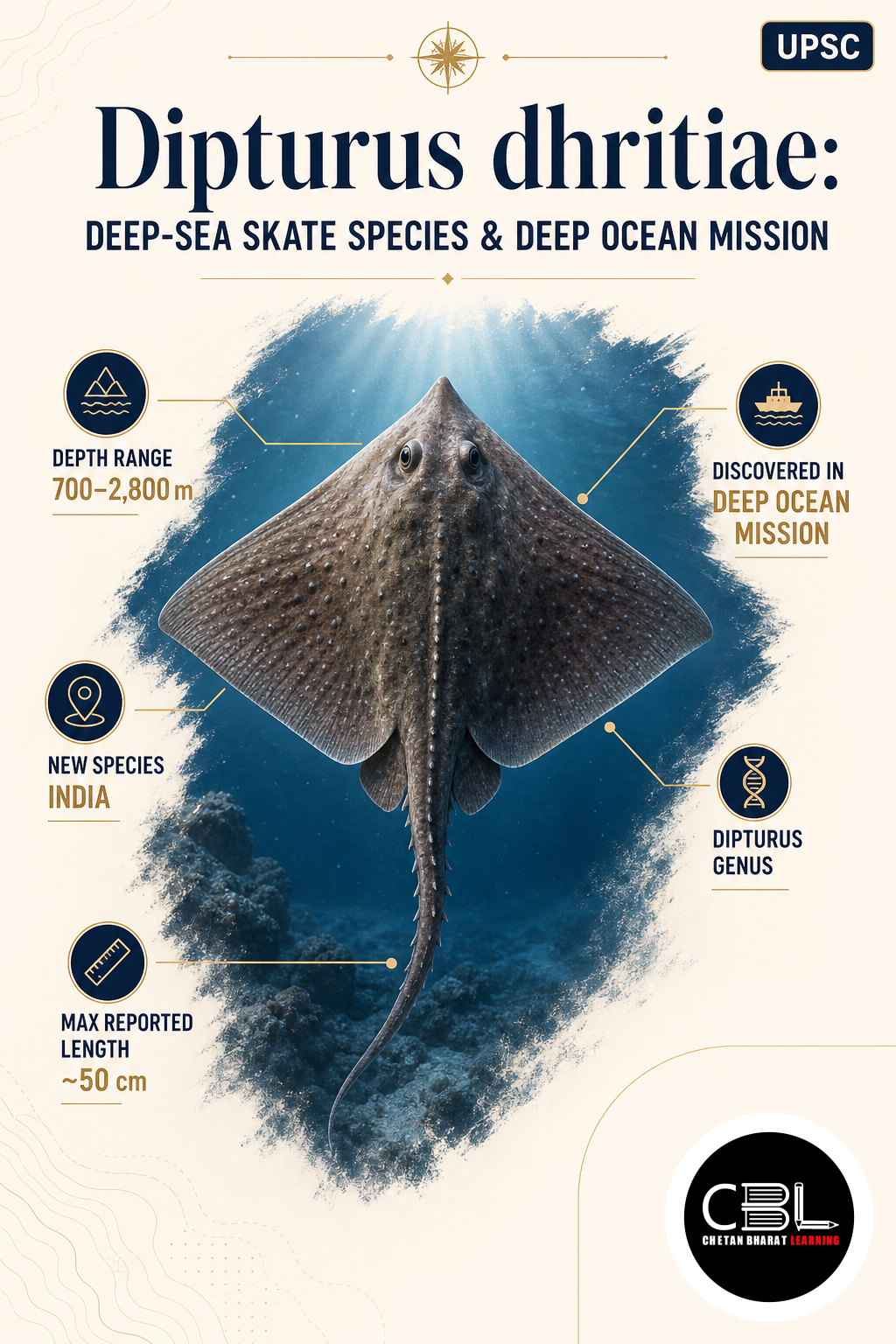
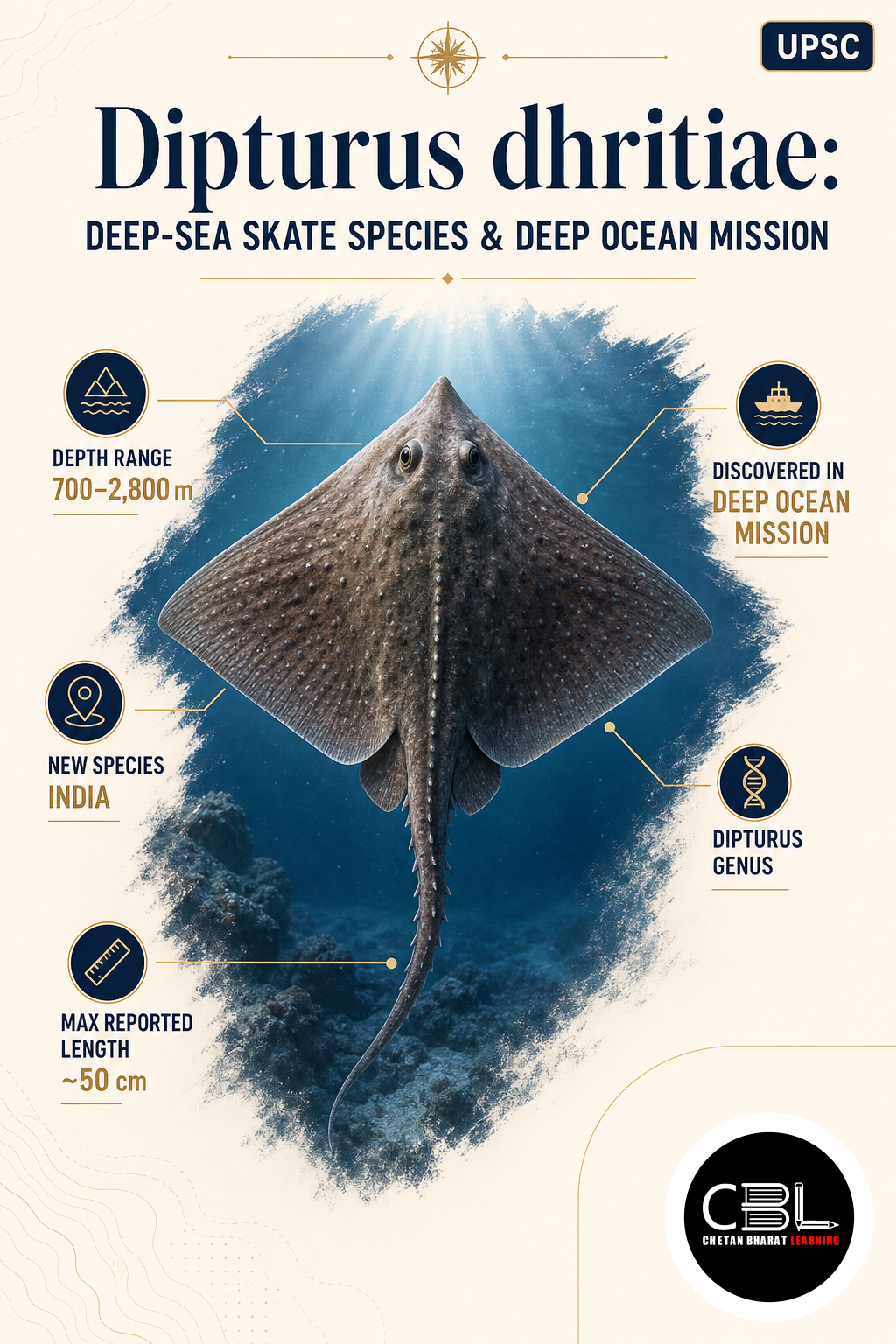
The term Dipturus dhritiae refers to a newly identified species of deep-sea skate belonging to the family Rajidae. As a cartilaginous fish, it is closely related to sharks and rays. The Zoological Survey of India (ZSI) officially documented this unique marine organism and named it in honor of Dhriti Banerjee, the first woman director of the ZSI. The species inhabits the deeper, less-explored zones of the Arabian Sea.
This discovery falls under the broader ambit of the Deep Ocean Mission, which aims to explore and conserve deep-sea biodiversity systematically. Understanding such species is vital for mapping India’s marine biological wealth and provides critical baseline data for future ecological assessments. The ZSI employs rigorous morphological and genetic analyses to validate findings, ensuring accurate taxonomic classification and long-term conservation planning.
Why is Dipturus dhritiae in News?
The discovery gained prominence following official announcements by the Ministry of Earth Sciences, emerging as a direct outcome of investigations under the Deep Ocean Mission. This finding significantly expands our understanding of India’s marine biological diversity and validates the scientific objectives of the mission.
Furthermore, the identification highlights the ecological richness of the Arabian Sea, whose deep-sea ecosystems remain largely unmapped and vulnerable to anthropogenic pressures. Dipturus dhritiae serves as a bio-indicator for the health of benthic habitats, prompting policymakers to emphasize protection measures. Industrial exploitation poses severe threats to these fragile environments, requiring immediate regulatory intervention and sustained scientific monitoring.
Key Features
- Cartilaginous Anatomy: Flexible skeleton made of cartilage rather than bone.
- Taxonomic Classification: Belongs to the family Rajidae.
- Dedicated Nomenclature: Named in honor of Dhriti Banerjee, the first woman director of the ZSI.
- Deep-Sea Habitat: Thrives in benthic zones of the Arabian Sea.
- Scientific Validation: Validated through rigorous morphological analysis.
Challenges
- Vulnerability to Overfishing: Susceptible to commercial fishing activities.
- Incidental Bycatch: Frequently captured accidentally by non-selective fishing gear.
- Low Reproductive Output: Naturally produces fewer offspring, slowing population recovery.
- Habitat Degradation: Deep-sea trawling destroys delicate benthic environments.
- Data Deficiency: Limited baseline data complicates targeted conservation strategies.
Way Forward
To conserve Dipturus dhritiae, the government must expand marine protected areas and implement strict deep-sea trawling regulations. Strengthening the ZSI’s technical capabilities will ensure continuous monitoring of new species, while promoting sustainable fishing practices can reduce bycatch. International cooperation is vital for managing shared marine resources in the Arabian Sea, and clear guidelines should mandate transparent reporting of biodiversity findings. Aligning efforts with conventions like UNCLOS will further enhance India’s marine ecological security.
Prelims Practice Questions
Q1. With reference to Dipturus dhritiae, consider the following statements:
1. It is a newly discovered deep-sea skate species found in the Arabian Sea.
2. It belongs to the family Rajidae, making it a cartilaginous fish.
3. It was discovered during the Samudrayaan mission exclusively.
Which of the statements given above is/are correct?
(a) 1 only (b) 1 and 2 only (c) 2 and 3 only (d) 1, 2 and 3
Answer: (b) Statement 3 is incorrect because it was discovered during investigations under the Deep Ocean Mission.
Q2. The species Dipturus dhritiae was named in honor of:
(a) The first woman Director of the Zoological Survey of India (b) The founder of the Deep Ocean Mission (c) A renowned marine biologist from Kerala (d) The current Minister of Earth Sciences
Answer: (a) It is named after Dhriti Banerjee, the first woman director of the ZSI.
Q3. Why are deep-sea skate species particularly vulnerable to population decline?
(a) They have high reproductive output and short lifespans (b) They are highly resistant to changes in water temperature (c) They have low reproductive output and slow population recovery (d) They exclusively inhabit shallow coastal waters
Answer: (c) They are vulnerable due to low reproductive output and slow population recovery.
Q4. Which of the following is a major threat to the habitat of Dipturus dhritiae?
(a) Coral bleaching (b) Deep-sea trawling and incidental bycatch (c) Mangrove deforestation (d) Freshwater pollution
Answer: (b) Deep-sea trawling destroys benthic environments, and non-selective gear causes bycatch.
Q5. Consider the following features of Dipturus dhritiae: 1. Cartilaginous skeleton 2. Family Rajidae 3. Benthic habitat. Which of the above are correct?
(a) 1 and 2 only (b) 2 and 3 only (c) 1 and 3 only (d) 1, 2 and 3
Answer: (d) All three are correct features of this species.
Mains Practice Questions
Q1. Discuss the significance of discovering species like Dipturus dhritiae under the Deep Ocean Mission. (150 words, 10 marks)
Answer Structure:
- Intro: Define the Deep Ocean Mission and its marine biodiversity objectives.
- Body: Significance in mapping biological wealth, understanding benthic ecosystems, honoring scientific leadership, role of ZSI.
- Conclusion: Emphasize need for sustained funding and international collaboration.
Q2. Deep-sea marine biodiversity faces unique conservation challenges. Critically analyze these challenges and suggest a comprehensive way forward. (250 words, 15 marks)
Answer Structure:
- Intro: Contextualize vulnerability of deep-sea ecosystems to trawling and mining.
- Body: Analyze challenges (bycatch, low reproductive output, habitat degradation, data deficiency). Suggest way forward (MPAs, sustainable gear, ZSI capacity building, UNCLOS alignment).
- Conclusion: Conclude that protecting deep-sea biodiversity requires a paradigm shift to holistic stewardship.
FAQs on Dipturus dhritiae
What is Dipturus dhritiae?
Dipturus dhritiae is a newly discovered species of deep-sea skate in the family Rajidae, found in the Arabian Sea during the Deep Ocean Mission.
Why was the species named Dipturus dhritiae?
It was named in honor of Dhriti Banerjee, the first woman director of the ZSI, recognizing her contribution to biodiversity research.
What are the main threats to deep-sea skate species?
They are highly vulnerable to overfishing and incidental bycatch due to non-selective fishing gear. Their low reproductive output and slow population recovery make them susceptible to habitat degradation from deep-sea trawling.
Related Current Affairs
Preparing for UPSC, PCS or HCS?
Talk to a mentor at Chetan Bharat Learning, Chandigarh. Free guidance on choosing the right exam and building a study plan.
Chat on WhatsAppCall 97793 53345UPSC / IAS / PCS coaching in Chandigarh · Trusted by aspirants across Punjab & Haryana
Leave a Reply
You must be logged in to post a comment.