

| Important for | Prelims: Environment and Ecology Mains: GS Paper 3 (Environment) |
|---|---|
| Report Year | 2026 |
| Publishing Agency | Food and Agriculture Organization |
| Threat Ranking | 4th major threat to soil function |
What is soil biodiversity?
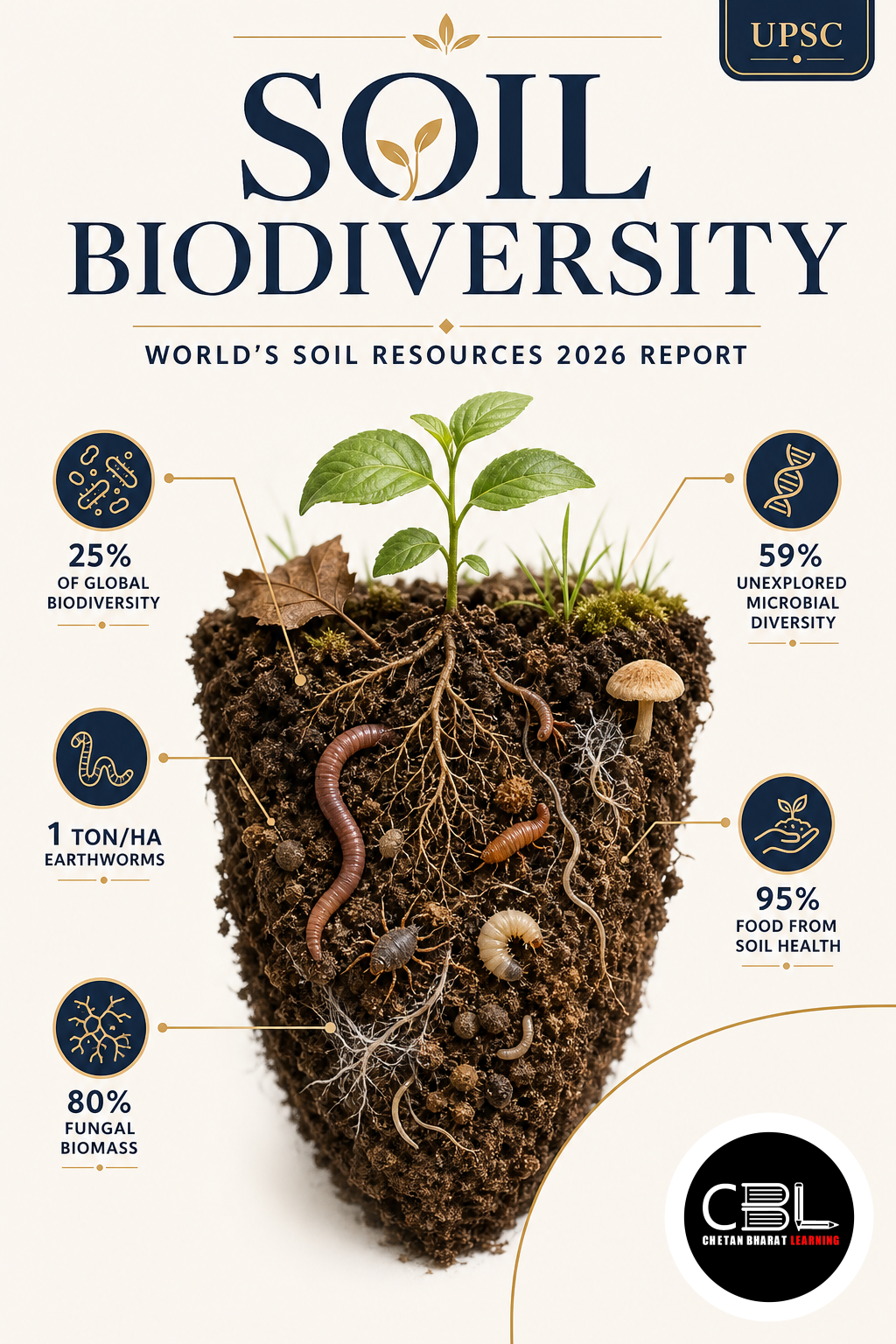
It refers to the vast variety of life existing belowground, ranging from microscopic genes and species to complex communities and entire soil ecosystems. This hidden world includes essential organisms such as bacteria, fungi, archaea, protozoa, nematodes, earthworms, and arthropods. These organisms perform critical ecological functions, including nutrient cycling, organic matter decomposition, and water filtration. The intricate web of interactions among these organisms maintains soil structure and fertility. Without this biological diversity, terrestrial ecosystems would fundamentally collapse.
Historically, agricultural policies focused primarily on aboveground crop yields and chemical inputs. The modern understanding of this subterranean life shifts this paradigm toward holistic ecosystem management. It recognizes that healthy soil is a living, dynamic entity rather than an inert growing medium. The Food and Agriculture Organization emphasizes that preserving this biological richness is essential for global food security. Sustainable agricultural practices must therefore prioritize the conservation of these microscopic and macroscopic life forms.
Why is soil biodiversity in News?
The issue recently gained immense prominence following the release of the Status of the World’s Soil Resources 2026 report by the FAO. Prepared under the FAO’s Global Soil Partnership and the Intergovernmental Technical Panel on Soils, this comprehensive assessment evaluates major soil threats based on evidence from 75 countries. You can verify the latest environmental assessments and policy recommendations on the FAO official portal. The report delivers a stark warning about the rapid deterioration of subterranean ecosystems globally.
Furthermore, the findings reveal an alarming global implementation gap in sustainable land management. Sustainable soil-management practices are currently deteriorating in 58% of regional and sub-regional assessments. Conversely, they are improving in only around 10% of assessed areas. This data underscores the urgent need for coordinated international action to reverse habitat loss. Policymakers are now prioritizing soil health as a central component of climate action and sustainable development goals.
Key Features
The ecological framework of soil biodiversity incorporates several distinct biological and functional dimensions.
- Functional Diversity: It encompasses a wide range of organisms, from bacteria and fungi to earthworms and arthropods, each performing unique ecological roles.
- Nutrient Cycling: Microorganisms actively decompose organic matter, releasing essential nutrients like nitrogen and phosphorus for plant uptake.
- Soil Structure Maintenance: Fungal hyphae and earthworm burrows create stable soil aggregates, improving water infiltration and preventing erosion.
- Disease Suppression: A diverse soil microbiome naturally suppresses plant pathogens, reducing the need for chemical pesticides.
- Carbon Sequestration: Soil organisms play a vital role in stabilizing soil organic carbon, mitigating global climate change.
Challenges
Despite its critical importance, soil biodiversity faces severe structural and operational threats requiring immediate mitigation efforts.
- Habitat Loss: Intensive irrigation, heavy machinery usage, and urban expansion physically destroy delicate subterranean habitats.
- Chemical Contamination: Excessive application of synthetic fertilizers and pesticides significantly alters soil chemistry, decimating beneficial microbial populations.
- Loss of Organic Carbon: Poor land management accelerates the depletion of soil organic matter, starving soil organisms of their primary energy source.
- Nutrient Mismanagement: Imbalanced fertilization disrupts natural nutrient cycling processes, leading to soil acidification and salinization.
- Global Implementation Gap: Sustainable soil-management practices are deteriorating in 58% of regions, highlighting a severe policy execution failure.
Way Forward
To maximize the resilience of soil biodiversity, governments must prioritize the widespread adoption of regenerative agricultural practices. Promoting crop rotation, cover cropping, and reduced tillage is absolutely vital for restoring subterranean habitats. Strengthening the technical capabilities of agricultural extension services will ensure farmers receive adequate training in sustainable soil management. The government must actively incentivize organic farming and the use of bio-fertilizers to reduce chemical dependency.
Additionally, international cooperation is vital to bridge the global implementation gap in soil conservation. Policymakers should establish clear guidelines to mandate transparent reporting of soil health indicators at the national level. For detailed policy frameworks on sustainable agriculture, refer to the PRS Legislative Research database. A robust, transparent, and inclusive system will ultimately drive global food security and climate action forward. Continuous academic research will further refine the operational guidelines for conservation.
Prelims Practice Corner
Q1. With reference to soil biodiversity, consider the following statements:
- It includes organisms like bacteria, fungi, archaea, protozoa, nematodes, earthworms and arthropods.
- Loss of soil biodiversity ranks as the number one threat to soil function globally.
- The Global Soil Partnership was established in 2012.
Which of the statements given above is/are correct?
- (a) 1 only
- (b) 1 and 3 only
- (c) 2 and 3 only
- (d) 1, 2 and 3
Answer: (b) Statement 2 is incorrect because it ranks 4th, after soil erosion, loss of soil organic carbon, and nutrient mismanagement.
Q2. According to the Status of the World’s Soil Resources 2026 report, what is a major threat causing habitat loss for soil organisms?
- (a) Reduced irrigation
- (b) Intensive irrigation, heavy machinery, fertilisers and pesticides
- (c) Organic farming practices
- (d) Afforestation programs
Answer: (b) Intensive irrigation, heavy machinery, fertilisers and pesticides significantly alter soil habitats.
Q3. The Global Implementation Gap in sustainable soil-management practices shows that:
- (a) Practices are improving in 58% of regions
- (b) Practices are deteriorating in 58% of regional assessments
- (c) Practices are stable globally
- (d) Practices are improving in 90% of regions
Answer: (b) Sustainable soil-management practices are deteriorating in 58% of regional and sub-regional assessments.
Q4. Which of the following is NOT a primary objective of the FAO’s Global Soil Partnership (GSP)?
- (a) Promote sustainable soil management
- (b) Improve soil governance
- (c) Guarantee healthy and productive soils
- (d) Maximize synthetic fertilizer usage
Answer: (d) The GSP aims to support ecosystem services for food security and climate action, not maximize synthetic fertilizer usage.
Q5. Consider the following organisms that contribute to soil biodiversity: 1. Bacteria 2. Earthworms 3. Arthropods. Which of the above are included?
- (a) 1 and 2 only
- (b) 2 and 3 only
- (c) 1 and 3 only
- (d) 1, 2 and 3
Answer: (d) All three are major organisms that constitute soil biodiversity.
Mains Practice Questions
Q1. Discuss the significance of soil biodiversity for global food security and climate action. What are the major threats identified in the 2026 report? (150 words, 10 marks)
Answer Structure:
- Intro: Define soil biodiversity and its role as a foundational pillar of terrestrial ecosystems.
- Body: Discuss significance (nutrient cycling, carbon sequestration, disease suppression) and threats (habitat loss, chemical contamination, nutrient mismanagement, global implementation gap).
- Conclusion: Suggest a way forward focusing on regenerative agriculture and robust biological monitoring mechanisms.
Q2. The global implementation gap in sustainable soil management poses a severe risk to future agricultural resilience. Critically analyze this statement and suggest remedial measures. (250 words, 15 marks)
Answer Structure:
- Intro: Contextualize the FAO’s 2026 report findings highlighting the deterioration of sustainable practices in 58% of regions.
- Body: Analyze the risks (loss of organic carbon, chemical dependency, reduced crop yields, climate vulnerability). Discuss remedial measures (policy incentives for organic farming, agricultural extension training, international cooperation, transparent soil health reporting).
- Conclusion: Conclude that bridging this implementation gap requires a paradigm shift from chemical-intensive farming to holistic, biology-centric soil management.
FAQs on soil biodiversity
- What is soil biodiversity and why is it important?
- Soil biodiversity refers to the variety of life belowground, including bacteria, fungi, earthworms, and arthropods. It is crucial for nutrient cycling, maintaining soil structure, suppressing diseases, and sequestering carbon.
- What are the major threats to soil biodiversity according to the 2026 report?
- Major threats include habitat loss from intensive irrigation and heavy machinery, chemical contamination from excessive fertilizers and pesticides, loss of organic carbon, and nutrient mismanagement.
- What is the role of the FAO’s Global Soil Partnership?
- Established in 2012, the GSP aims to position soils on the global agenda by promoting sustainable soil management, improving soil governance, and supporting ecosystem services for food security and climate action.
Related Current Affairs
Preparing for UPSC, PCS or HCS?
Talk to a mentor at Chetan Bharat Learning, Chandigarh. Free guidance on choosing the right exam and building a study plan.
Chat on WhatsAppCall 97793 53345UPSC / IAS / PCS coaching in Chandigarh · Trusted by aspirants across Punjab & Haryana
Leave a Reply
You must be logged in to post a comment.