
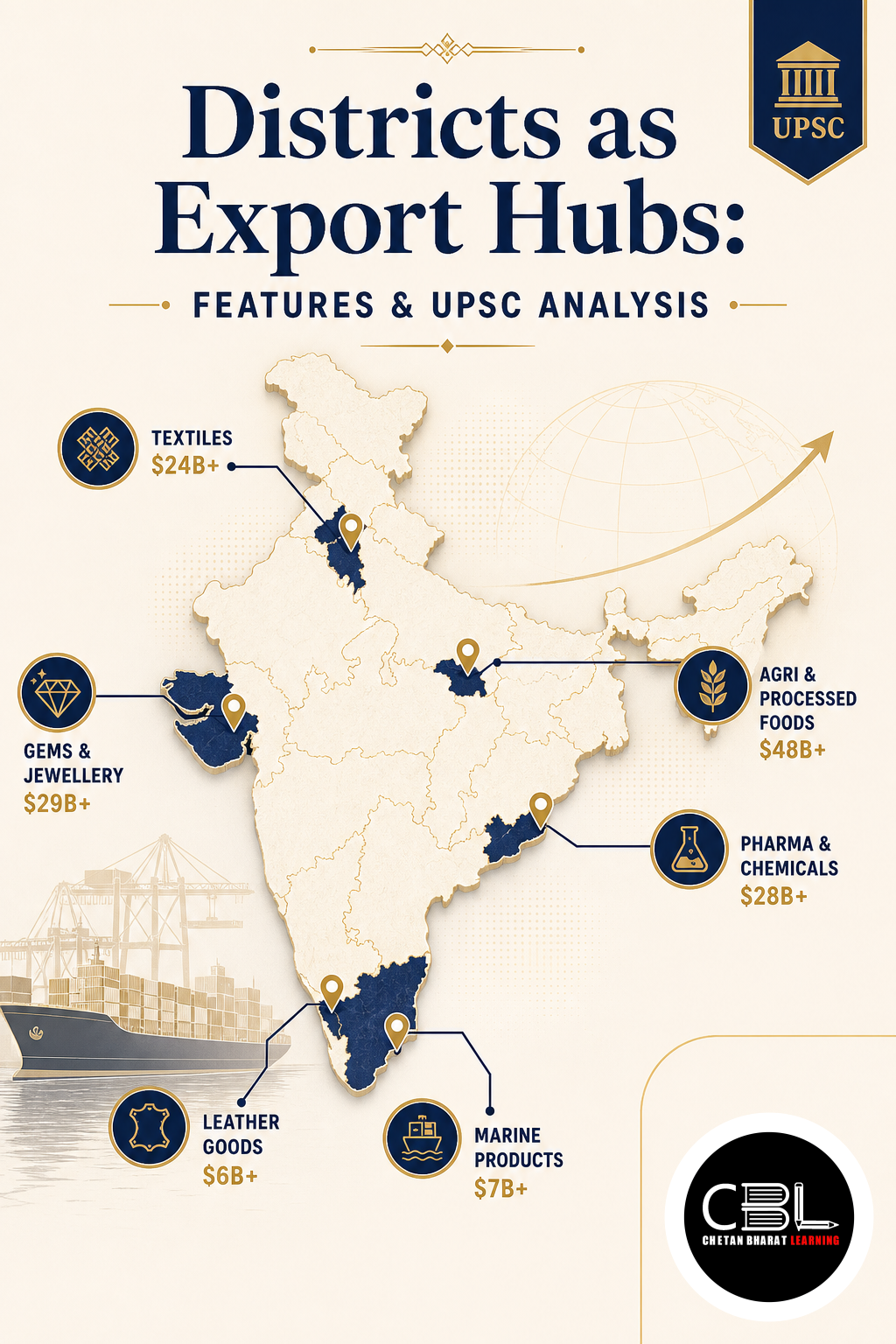

The Districts as Export Hubs framework represents a transformative approach to decentralizing India’s trade ecosystem. Rolled out by the Department of Commerce, this initiative aims to convert every district into a strategic export planning unit. Aspirants must thoroughly understand its operational architecture for the upcoming civil services examination. You can explore more such vital topics in our daily current affairs archive. This policy marks a significant departure from centralized industrial cluster models. It actively empowers untapped manufacturing centers in the hinterland. The Directorate General of Foreign Trade leads this convergence framework to boost national export volumes.
What is the Districts as Export Hubs framework?
The Districts as Export Hubs framework operates as a comprehensive strategy to localize export promotion across the country. It operationally merges the One District One Product scheme to integrate product branding with district-wide trade infrastructure. The initiative pools capital from existing central and state programs like Interest Equalization and RoSCTL. This approach avoids creating separate, redundant financial schemes. The framework relies on a robust three-tier architecture to ensure seamless execution across all administrative levels.
Historically, India’s export growth concentrated heavily in a few saturated industrial clusters. This new paradigm actively shifts focus toward untapped manufacturing centers in the rural hinterland. The Department of Commerce provides macro-policy direction and maintains the national monitoring portal. State Export Promotion Committees resolve policy conflicts and align state-level infrastructure investments. District Export Promotion Committees identify local opportunities and resolve ground-level bottlenecks with producers.
Why is the Districts as Export Hubs initiative in News?
The Districts as Export Hubs initiative recently gained prominence following the rapid expansion of its coverage to over 770 districts. Draft District Export Action Plans have been prepared for 590 districts, with 249 formally adopted. You can verify the latest official trade notifications and progress reports on the PIB release portal. This rapid scaling demonstrates the government’s firm commitment to grassroots economic development. It highlights a proactive shift from mere production to strategic export planning.
Furthermore, the partnership with EXIM Bank under the Grassroots Initiatives for Development program for six pilot districts showcases innovative financing models. The government has also forged logistics tie-ups with major e-commerce and logistics players like Amazon and DHL. These partnerships help buffer freight volatility for small manufacturers. Dak Ghar Niryat Kendras now streamline low-volume postal exports, significantly reducing the entry barrier for micro-enterprises. This multi-agency coordination marks a new era in India’s trade facilitation ecosystem.
Key Features
The architectural framework of the Districts as Export Hubs initiative incorporates several distinct administrative and economic dimensions.
- Three-Tier Governance: It utilizes a structured hierarchy involving the Department of Commerce, State Export Promotion Committees, and District Export Promotion Committees.
- ODOP Integration: The framework operationally merges the One District One Product scheme to align local branding with broader trade infrastructure.
- Pooled Funding Model: It leverages existing schemes like Interest Equalization and RoSCTL rather than creating new, isolated financial programs.
- Logistics Partnerships: Strategic tie-ups with private logistics players and postal networks help buffer freight volatility for small exporters.
- Action Plan Formulation: District Export Promotion Committees formulate diagnostic blueprints to map local clusters and set time-bound export targets.
This comprehensive structure ensures that various stakeholders can leverage the policy for specific domain requirements. The emphasis on pooled funding distinguishes it from traditional, siloed government schemes. By empowering district collectors with decision-making authority, the policy fosters rapid problem resolution. The institutional framework relies heavily on the Directorate General of Foreign Trade. This agency coordinates complex bilateral engagements to ensure consistent messaging across all international forums.
Challenges
Despite its ambitious goals, the Districts as Export Hubs initiative faces several structural and operational hurdles requiring immediate attention.
- Infrastructure Deficits: Many hinterland districts lack adequate cold chains, testing laboratories, and reliable power supply necessary for export-quality production.
- Skill Gaps: Local producers often lack knowledge of international quality standards, packaging norms, and complex customs documentation procedures.
- Bureaucratic Delays: Coordinating between multiple central and state agencies frequently leads to procedural bottlenecks and delayed fund disbursement.
- Market Access Barriers: Small and medium enterprises struggle to navigate non-tariff barriers and stringent phytosanitary requirements in foreign markets.
- Data Fragmentation: Inconsistent data sharing between district administrations and the national monitoring portal hampers accurate progress tracking.
Addressing these bottlenecks is crucial for long-term trade stability and inclusive growth. Aspirants can study related governance issues in our economy current affairs updates. Policymakers must remain vigilant against the uneven distribution of export benefits across different states. The verification of export readiness requires robust, localized capacity-building programs. Introducing dedicated export facilitation cells at the district level will help alleviate some of these operational difficulties significantly.
Way Forward
To maximize the strategic utility of Districts as Export Hubs, the government must prioritize comprehensive infrastructure development in rural manufacturing clusters. Establishing common facility centers and testing laboratories is absolutely vital for ensuring export-quality compliance. Strengthening the technical capabilities of local artisans and MSMEs will also ensure they meet international standards. The government must actively promote digital literacy to help producers navigate online export portals.
Additionally, diplomatic channels should focus on securing mutual recognition agreements for quality certifications. Policymakers must establish clear guidelines to mandate transparent reporting of district-level export performance. For detailed parliamentary discussions on trade agreements, refer to the PRS Legislative Research database. A robust, transparent, and inclusive system will ultimately drive India’s export competitiveness forward. Continuous academic research will further refine the operational guidelines for grassroots trade promotion.
FAQs on Districts as Export Hubs
What is the primary objective of the Districts as Export Hubs initiative?
The primary objective is to decentralize India’s export ecosystem by transforming every district from a mere production center into a strategic export planning unit, focusing on untapped hinterland manufacturing.
How does the initiative handle funding for district-level export promotion?
Instead of creating a separate financial scheme, the initiative pools capital from existing central and state programs such as Interest Equalization, RoSCTL, and various MSME schemes.
What role do District Export Promotion Committees play in this framework?
Chaired by the District Magistrate or Collector, these committees identify local export opportunities, resolve ground-level bottlenecks with producers, and formulate District Export Action Plans.
Related Current Affairs
Preparing for UPSC, PCS or HCS?
Talk to a mentor at Chetan Bharat Learning, Chandigarh. Free guidance on choosing the right exam and building a study plan.
Chat on WhatsAppCall 97793 53345UPSC / IAS / PCS coaching in Chandigarh · Trusted by aspirants across Punjab & Haryana
Leave a Reply
You must be logged in to post a comment.