
UPSC Mapping
| Exam Level | Paper/Topic |
|---|---|
| Prelims | Polity and Governance |
| Mains | GS Paper 2 (Polity) |
Quick Facts
| Constitutional Provision | Enforceability | Primary Purpose |
|---|---|---|
| Article 142(1) & 142(2) | Throughout India | Ensure complete justice |
What is Article 142?
The framework of Article 142 operates as a constitutional safety valve to prevent injustice caused by rigid legal procedures. It allows the apex court to mould relief and bridge procedural gaps in exceptional circumstances. The provision explicitly makes Supreme Court decrees enforceable throughout the entire territory of India. This sweeping authority ensures that judicial orders face no geographical or jurisdictional barriers during execution. The judiciary has historically invoked this power to resolve complex human-rights and environmental disputes.
Furthermore, the second clause enables the court to secure attendance, document production, and initiate contempt proceedings. These powers remain subject to any specific parliamentary law enacted in this regard. Landmark judgments like the Union Carbide Bhopal Gas Tragedy case utilized this provision to mandate compensation. The Ayodhya judgment also relied on it to grant land to the Sunni Waqf Board. The constitutional challenge lies in achieving complete justice while maintaining strict institutional restraint and constitutional supremacy.
Why is Article 142 in News?
The application of Article 142 recently gained prominence after the Supreme Court invoked it to quash nationwide FIRs against July 2026 NEET protesters. The court exercised this extraordinary power after various state governments sought the withdrawal of these criminal cases. You can verify the latest judicial proceedings and constitutional interpretations on the Supreme Court portal. This intervention highlights the court’s proactive role in protecting students from prolonged legal harassment and career disruption.
Furthermore, this recent usage reignited the broader debate regarding the separation of powers in India. Supporters argue that the provision delivers interim relief when legislative delays leave rights-based issues unprotected. Critics caution that excessive use may result in judicial overreach and intrusion into the executive and legislative domains. The lack of codified parameters for defining complete justice diminishes direct accountability. This ongoing tension requires careful calibration by the judiciary to preserve democratic balance.
Key Features
The constitutional architecture of this provision incorporates several innovative design elements to ensure judicial efficacy.
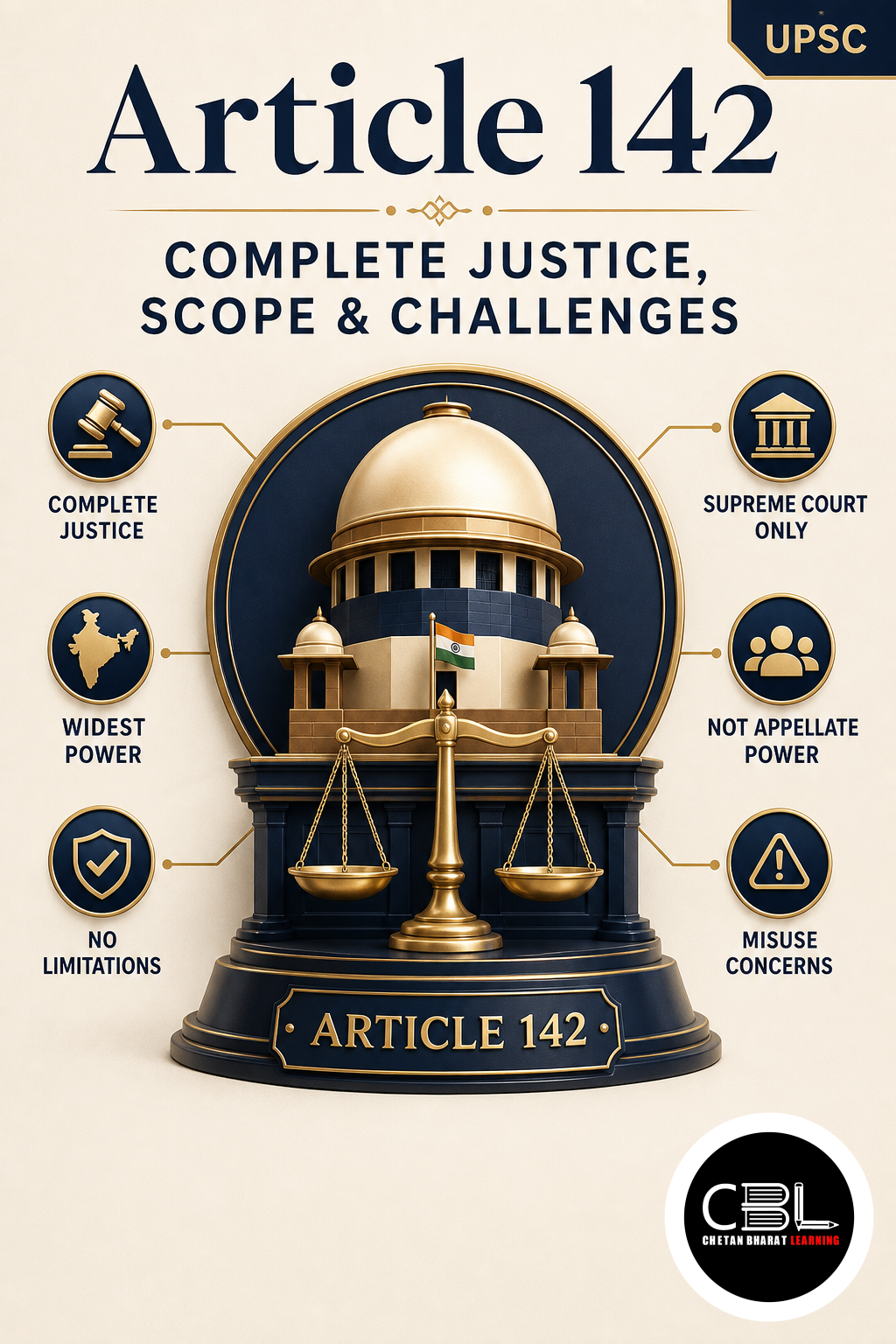
- Extraordinary Jurisdiction: Empowers the court to pass any decree or order necessary to ensure complete justice in pending matters.
- Nationwide Enforceability: Decrees passed under this provision are legally binding and enforceable throughout the entire territory of India.
- Procedural Flexibility: Allows the judiciary to mould relief and bridge statutory gaps when ordinary legal remedies are fundamentally inadequate.
- Contempt Powers: The second clause enables the court to punish contempt and secure the attendance of individuals or documents.
- Subject to Parliament: The enforcement mechanisms remain subject to any specific laws enacted by the Parliament under this article.
This comprehensive structure ensures that the apex court can address unique legal anomalies effectively. The emphasis on nationwide enforceability distinguishes it from standard High Court jurisdictions. By empowering the judiciary with flexible relief options, the policy fosters rapid dispute resolution. The institutional framework relies heavily on the self-restraint exercised by the judges themselves. This internal discipline provides the necessary check against arbitrary application of such sweeping powers.
Challenges
Despite its noble objectives, the invocation of this provision faces several structural and operational hurdles requiring immediate attention.
- Judicial Overreach Risks: Excessive invocation can blur the separation of powers, enabling the judiciary to intrude into legislative and executive domains.
- Lack of Codified Parameters: The absence of a strict legal definition for complete justice diminishes accountability and creates subjective application.
- Supplanting Substantive Law: The Supreme Court itself has held that this provision cannot be used to bypass or supplant existing substantive statutory laws.
- Institutional Restraint: Balancing the delivery of immediate justice with the need to maintain long-term constitutional supremacy remains a persistent challenge.
- Executive Friction: Frequent use to quash state-level FIRs or policies often generates friction between the judiciary and state governments.
Addressing these bottlenecks is crucial for the long-term credibility and acceptance of judicial interventions. Aspirants can study related governance issues in our polity current affairs updates. Policymakers must remain vigilant against the gradual erosion of legislative authority. The verification of grounds for invoking such extraordinary powers remains a persistent constitutional challenge. Introducing comprehensive judicial guidelines could help alleviate some of these operational difficulties significantly.
Way Forward
To maximize the constitutional utility of Article 142, the judiciary must establish clear, self-imposed guidelines for its invocation. Defining specific thresholds for what constitutes a failure of ordinary legal remedies will prevent arbitrary application. Strengthening the institutional restraint will ensure that the court respects the legitimate domain of the legislature and executive. A constitution bench should lay down comprehensive parameters similar to the Vishaka guidelines.
Additionally, Parliament should consider enacting specific framework legislation to operationalize the enforcement mechanisms under the second clause. Policymakers must establish clear statutory boundaries to complement the court’s extraordinary powers. For detailed legislative analysis on judicial reforms, refer to the PRS Legislative Research database. A robust, transparent, and balanced system will ultimately strengthen India’s democratic framework and constitutional supremacy.
Prelims Practice Corner
Q1. Article 142(1) of the Indian Constitution empowers the Supreme Court to:
Answer: (b) Pass any decree necessary for doing complete justice.
Q2. The decrees or orders passed by the Supreme Court under Article 142(1) are enforceable:
Answer: (b) Throughout the territory of India.
Q3. Which landmark case limited the use of this provision against substantive statutory law?
Answer: (b) Supreme Court Bar Association v. UoI (1998).
Q4. The second clause enables the court to secure attendance and document production, subject to:
Answer: (b) Any law made by Parliament.
Q5. The Supreme Court recently invoked this provision in the news primarily to:
Answer: (a) Quash nationwide FIRs against NEET protesters.
Mains Practice Questions
Q1. Discuss the significance of this constitutional provision in ensuring complete justice. What are the challenges associated with its frequent invocation? (150 words, 10 marks)
- Intro: Define the provision as an extraordinary constitutional safety valve for delivering complete justice.
- Body: Discuss significance (procedural flexibility, nationwide enforceability, protecting vulnerable rights) and challenges (judicial overreach, lack of codified parameters, executive friction).
- Conclusion: Suggest a balanced way forward focusing on self-imposed judicial guidelines and parliamentary framework legislation.
Q2. This provision acts as a constitutional safety valve, but its excessive use raises concerns regarding the separation of powers. Critically analyze. (250 words, 15 marks)
- Intro: Contextualize the debate between the need for flexible judicial relief and the imperative of maintaining institutional boundaries.
- Body: Analyze the safety valve argument (bridging statutory gaps, landmark environmental and human rights cases) versus the separation of powers critique (intrusion into executive domain, bypassing substantive law, lack of appeal mechanisms).
- Conclusion: Conclude that while the power is indispensable for constitutional supremacy, it must be exercised with strict institutional restraint and clear self-imposed thresholds.
FAQs on Article 142
What is the primary purpose of this constitutional provision?
The primary purpose is to empower the Supreme Court to pass any decree or order necessary to ensure complete justice in matters pending before it. It acts as a safety valve when ordinary legal remedies are inadequate.
Can this provision be used to bypass existing statutory laws?
No, the Supreme Court has explicitly ruled that this extraordinary power cannot be used to supplant or bypass substantive statutory laws. It is meant to supplement the law and bridge procedural gaps, not rewrite legislation.
Why is this provision frequently debated in the context of separation of powers?
It is debated because excessive invocation can blur the boundaries between the judiciary and the executive or legislature. Critics argue that using it to quash state policies or FIRs amounts to judicial overreach and intrusion into executive domains.
Related Current Affairs
Preparing for UPSC, PCS or HCS?
Talk to a mentor at Chetan Bharat Learning, Chandigarh. Free guidance on choosing the right exam and building a study plan.
Chat on WhatsAppCall 97793 53345UPSC / IAS / PCS coaching in Chandigarh · Trusted by aspirants across Punjab & Haryana
Leave a Reply
You must be logged in to post a comment.