
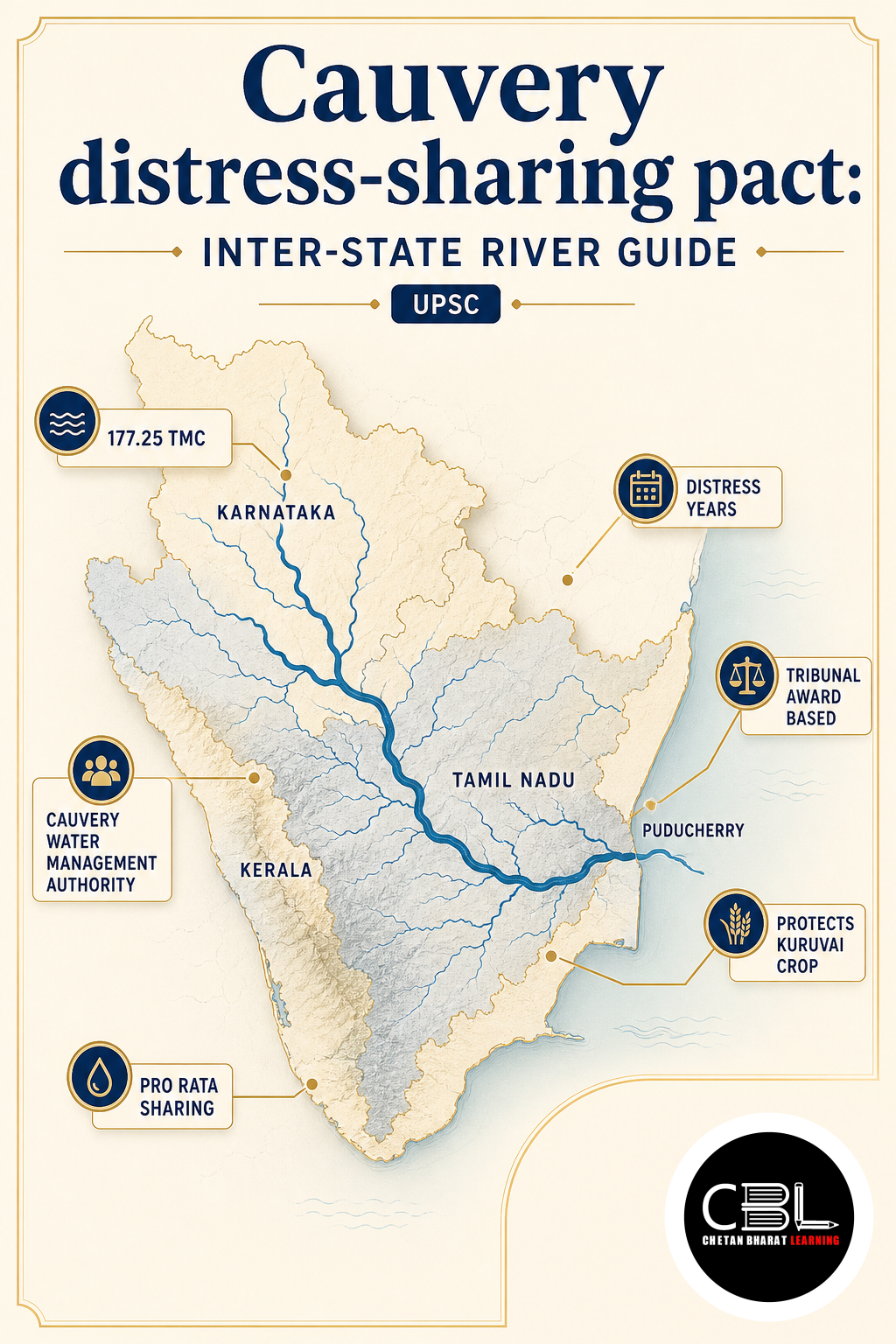

UPSC Mapping
| Prelims | Governance |
|---|---|
| Mains | GS Paper 2 |
| Normal Window | 230 Days |
|---|---|
| Core Issue | Monsoon Deficit |
| Nodal Body | CMA |
| Legal Basis | SC 2018 Verdict |
Article
What is Cauvery distress-sharing pact?
The Cauvery distress-sharing pact refers to a pre-agreed mathematical formula used to allocate river water during years of deficient rainfall. In a normal monsoon year, the Supreme Court’s 2018 verdict provides clear monthly release schedules. However, the apex court did not codify a specific mechanism for sharing the burden during distress years.
When the southwest monsoon fails, the total available water falls significantly short of the combined allocations. Without a formal distress formula, upper and lower riparian states immediately resort to aggressive political posturing and prolonged legal litigation. Establishing a clear mechanism ensures that scarcity is shared proportionately rather than fought over in courts.
Why is Cauvery distress-sharing pact in News?
The Tamil Nadu government recently delayed the opening of the Mettur Dam sluice gates for delta irrigation. The state cited a severe deficit in the southwest monsoon and Karnataka’s failure to honour its water-sharing obligations. You can review inter-state dispute mechanisms via the Ministry of Jal Shakti portal for precise river basin data.
Furthermore, Karnataka’s renewed push for the Mekedatu dam project has reignited historical fears in the lower riparian state. The Cauvery Water Management Authority (CMA) functions effectively during normal years but struggles to enforce compliance when reservoir levels drop critically low. Experts emphasize that the river must now meet the competing demands of traditional agriculture and rapid urbanisation.
Key Features
- Supreme Court Mandate: The 2018 verdict allocated specific quantum of water but left the distress-sharing mechanism largely undefined.
- Cauvery Management Authority: The CMA oversees the implementation of the tribunal awards and monitors daily reservoir storage levels.
- Normal Irrigation Window: The Mettur Dam gates typically open on June 12 and close on January 28, providing a 230-day agricultural cycle.
- Competing Demands: The river must simultaneously support water-intensive paddy cultivation and the massive drinking water needs of Bengaluru.
Challenges
- Climate Variability: Increasing hydrological uncertainty and erratic monsoon patterns make historical water-sharing assumptions obsolete.
- Political Federalism: River disputes frequently transform into emotional political issues, making rational hydrological compromises extremely difficult.
- Urbanisation Pressure: The massive expansion of metropolitan cities drastically increases the demand for drinking water at the expense of rural agriculture.
- Ecological Flows: Allocating 100% of the river water for human use destroys downstream aquatic ecosystems and wetlands.
- Litigation Delays: Relying solely on the judiciary to resolve annual scarcity issues causes massive delays in critical crop-sowing seasons.
Way Forward
The administration must urgently draft a comprehensive distress-sharing formula that automatically triggers proportional cuts during deficit years. Shifting away from water-intensive crops towards decentralized micro-irrigation will drastically reduce overall agricultural demand. Providing dedicated financial incentives will help farmers adopt sustainable cropping patterns.
Check the latest NITI Aayog reports for strategic river basin management recommendations. State governments must actively align their local groundwater policies with central guidelines to maximize regional synergies. This unified approach will significantly accelerate the transition towards a resilient water economy.
Prelims Practice Corner
Q1. Which dam’s sluice gates are traditionally opened for delta irrigation in Tamil Nadu?
- (a) Bhavanisagar
- (b) Mettur
- (c) Aliyar
- (d) Sathanur
Answer: (b) The Mettur Dam gates typically open in June for the Cauvery delta irrigation window.
Q2. Which statutory body oversees the implementation of the Cauvery water dispute verdict?
- (a) Central Water Commission
- (b) Cauvery Water Management Authority
- (c) National Green Tribunal
- (d) NITI Aayog
Answer: (b) The CMA was established to monitor and implement the Supreme Court’s allocation orders.
Q3. What is the primary reason the 2018 Supreme Court verdict struggles during deficit rainfall years?
- (a) It lacks a codified distress-sharing formula
- (b) It was overturned by Parliament
- (c) It only applies to Karnataka
- (d) It banned dam construction
Answer: (a) The court allocated specific quantum but did not codify a mechanism for sharing the burden during distress years.
Q4. Which proposed dam project by Karnataka recently reignited historical fears in Tamil Nadu?
- (a) Almatti
- (b) Mullaperiyar
- (c) Mekedatu
- (d) Polavaram
Answer: (c) Karnataka’s push for the Mekedatu dam project has reignited historical fears in the lower riparian state.
Q5. Under Article 262 of the Constitution, who has the ultimate authority to adjudicate inter-state river water disputes?
- (a) Supreme Court
- (b) Parliament
- (c) President
- (d) Interstate Council
Answer: (b) Article 262 empowers Parliament to provide for the adjudication of inter-state river water disputes.
Mains Practice Questions
Q1. Discuss the necessity of a pre-agreed distress-sharing formula for managing inter-state river water disputes in India. (10 marks)
Answer Structure:
- Intro: Define the core tension between upper and lower riparian states during years of deficient monsoon rainfall.
- Body: Explain the limitations of the 2018 Supreme Court verdict, the political complications of the Mekedatu project, and the necessity of proportional burden-sharing.
- Conclusion: Conclude that shifting from litigation to cooperative basin-level planning is essential for long-term water security.
Q2. “Climate variability and rapid urbanisation are fundamentally altering the hydrological assumptions of historical river water treaties.” Analyze. (15 marks)
Answer Structure:
- Intro: Introduce the concept of hydrological uncertainty and how erratic monsoons disrupt traditional agricultural irrigation windows.
- Body: Analyze the competing demands of water-intensive paddy cultivation versus the massive drinking water requirements of expanding metropolitan cities like Bengaluru.
- Conclusion: Suggest that disincentivising water-intensive crops and promoting decentralized micro-irrigation are critical demand-side reforms.
FAQs on Cauvery distress-sharing pact
Why do inter-state river disputes intensify during distress years?
During normal monsoon years, there is usually enough water to satisfy the allocated quotas of all riparian states. However, during distress years, the total available water falls drastically short, forcing states to fight over a shrinking resource without a clear legal mechanism for sharing the deficit.
What is the role of the Cauvery Water Management Authority (CMA)?
The CMA was established following the Supreme Court’s 2018 directive to oversee the implementation of the water-sharing award. It monitors daily reservoir storage levels, calculates releases, and ensures compliance from the basin states during the irrigation season.
How does urbanisation impact the Cauvery water dispute?
The rapid expansion of cities like Bengaluru has created a massive, non-negotiable demand for drinking water and industrial use. This urban demand directly competes with the traditional, highly water-intensive paddy cultivation in the delta regions, complicating historical allocation priorities.
Related Current Affairs
Preparing for UPSC, PCS or HCS?
Talk to a mentor at Chetan Bharat Learning, Chandigarh. Free guidance on choosing the right exam and building a study plan.
Chat on WhatsAppCall 97793 53345UPSC / IAS / PCS coaching in Chandigarh · Trusted by aspirants across Punjab & Haryana
Leave a Reply
You must be logged in to post a comment.