

UPSC Mapping
Article
Javelin Missile Deal ends a sixteen-year procurement journey for India. The agreement strengthens the Army’s anti-tank capability while reviving questions about technology transfer, indigenous development and the structure of major defence acquisitions. The episode also reflects deepening India-US defence cooperation; follow related developments in the daily current affairs archive.
What is Javelin Missile Deal?
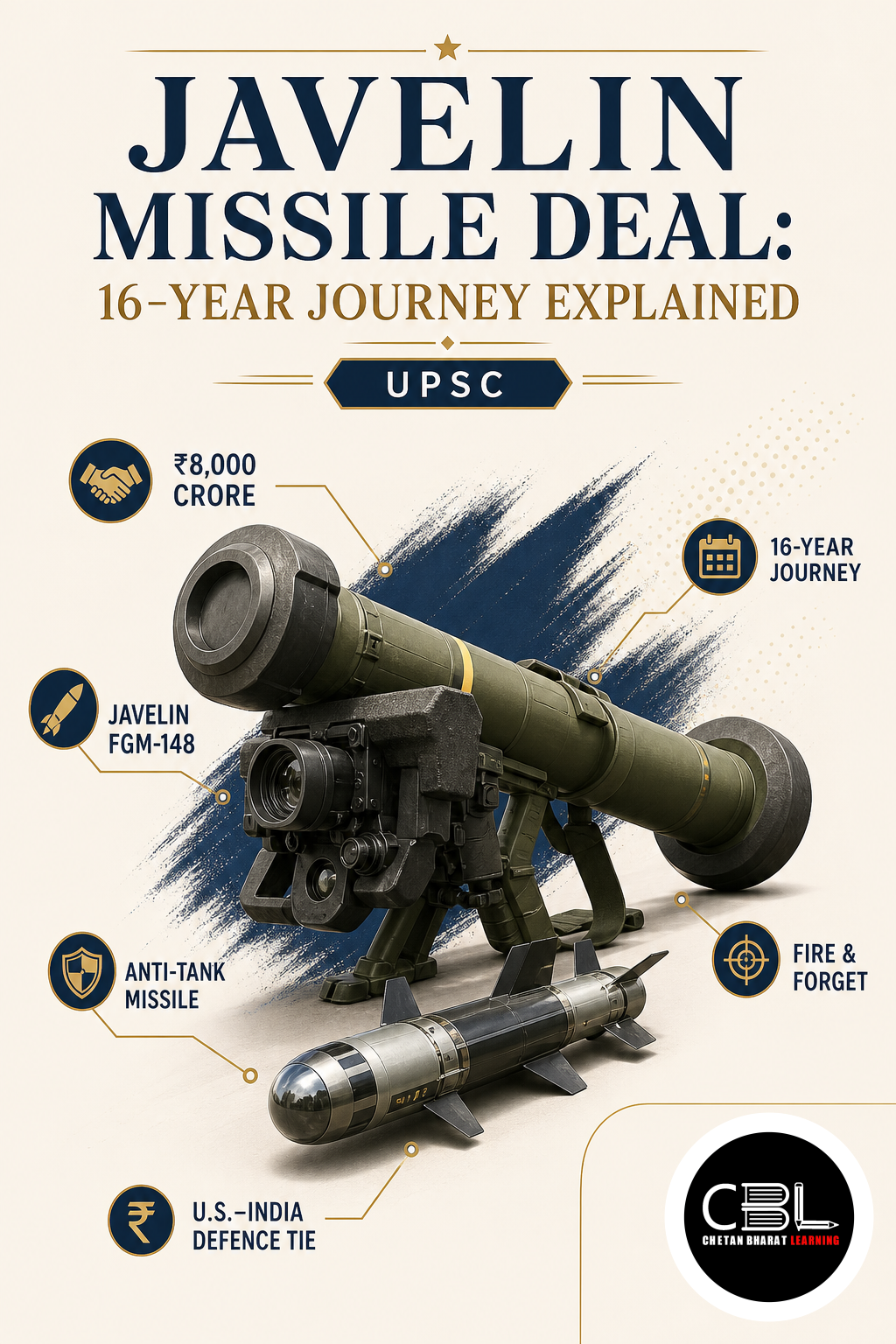
The Javelin Missile Deal concerns India’s purchase of the US-made Javelin anti-tank guided missile system through the Foreign Military Sales route. The Javelin is a man-portable, fire-and-forget ATGM designed against tanks, armoured vehicles and fortified positions, giving infantry a precision anti-armour option without requiring a dedicated armoured launcher. Its seeker-based guidance allows the missile to continue towards a locked target after launch without continuous operator control, enabling the firing team to disengage from the launch position more quickly.
The system is associated with top-attack capability, allowing engagement of armoured vehicles from above, where protection can be thinner, while a direct-attack profile is available for suitable targets. Its portability gives infantry formations a comparatively flexible response to armour across varied terrain and complements heavier anti-tank weapons already held by the Army. For India, the system addresses an operational requirement while raising a larger strategic question: whether imported capability should remain a stopgap or become a bridge towards deeper domestic production and indigenous missile development.
Why is Javelin Missile Deal in News?
The Indian Army finalised the procurement after a process that began in 2010, when India sought a third-generation anti-tank system to address inventory shortages and replace ageing Milan-2T and Konkurs missiles. On 28 August 2026, India signed a Letter of Offer and Acceptance under the US FMS mechanism, bringing the repeatedly stalled effort to a formal conclusion after sixteen years. The timeline matters because the original negotiations had failed largely over India’s demand for substantial transfer of technology, especially access to sensitive seeker technology that Washington was unwilling to release under the desired model.
After the first attempt stalled, India turned to Israel’s Spike system in 2014 and later made a limited emergency purchase, while indigenous anti-tank programmes continued to develop. The US cleared a possible Javelin sale in November 2025 involving missile rounds, command launch units, training and support equipment, after bilateral defence cooperation had deepened and co-production possibilities re-entered discussions. Official details of the approved US sale are available through the US Defense Security Cooperation Agency.
Key Features
- Fire-and-forget guidance: The operator locks onto a target before launch, after which the missile guides itself, reducing the firing team’s exposure.
- Top-attack profile: The system can approach an armoured target from above, exploiting comparatively vulnerable upper surfaces.
- Portable anti-armour capability: Carried by infantry teams, improving tactical mobility across varied terrain.
- Government-to-government purchase: FMS simplifies negotiations but ties delivery and technology conditions to US export framework.
- Technology-transfer distinction: Co-production doesn’t guarantee access to critical seeker design or manufacturing know-how.
Challenges
- Long acquisition cycles: Sixteen years highlights capability gaps when technology, trials and terms remain unsettled.
- Limited access to critical technology: Disagreement over seeker technology shows buying vs. owning know-how.
- Import dependence: Reliance on overseas lines for spares and support raises supply-chain risks.
- Cost versus inventory depth: Balancing sophistication with adequate training and war-reserve rounds.
- Import-indigenisation balance: Interim buys risk weakening incentives for domestic design without clear linkages.
Way Forward
India should use the Javelin Missile Deal as an operational bridge, linking foreign purchases to meaningful domestic manufacturing, maintenance and co-production. Indigenous anti-tank programmes need stable funding, realistic testing and assured orders to achieve economies of scale. Clear requirements, faster decisions and early alignment between users, developers and manufacturers will prevent future emergency procurements. Selective imports, co-development and technology absorption must run alongside sustained investment in seekers, propulsion, guidance and testing infrastructure. Strategic self-reliance should marry diversified partnerships with operationally necessary imports via the Ministry of Defence.
Prelims Practice Corner
Mains Practice Questions
FAQs on Javelin Missile Deal
Why did India’s first attempt to acquire Javelin missiles stall?
The earlier effort ran into restrictions over technology transfer, particularly sensitive seeker technology. India wanted greater technological access than the United States was prepared to provide under the proposed arrangement.
What makes Javelin different from older guided anti-tank weapons?
Its fire-and-forget guidance allows the missile to guide itself after the operator locks the target and fires. Its top-attack capability also provides an option for engaging armoured vehicles from above.
Does buying Javelin undermine Atmanirbhar Bharat in defence?
Not necessarily, because an import can fill an immediate capability gap while domestic systems mature. The strategic outcome depends on whether India simultaneously strengthens indigenous research, production, maintenance and critical technologies.
Related Current Affairs
Preparing for UPSC, PCS or HCS?
Talk to a mentor at Chetan Bharat Learning, Chandigarh. Free guidance on choosing the right exam and building a study plan.
Chat on WhatsAppCall 97793 53345UPSC / IAS / PCS coaching in Chandigarh · Trusted by aspirants across Punjab & Haryana
Leave a Reply
You must be logged in to post a comment.