

Important for
| Prelims | Indian Economy & Manufacturing |
|---|---|
| Mains | GS Paper 3 (Manufacturing & Economic Growth) |
Quick Facts
| Outlay | ₹62,500 crore |
|---|---|
| Target Production | ₹39 lakh crore |
What is the Mobile Phone Manufacturing Scheme?
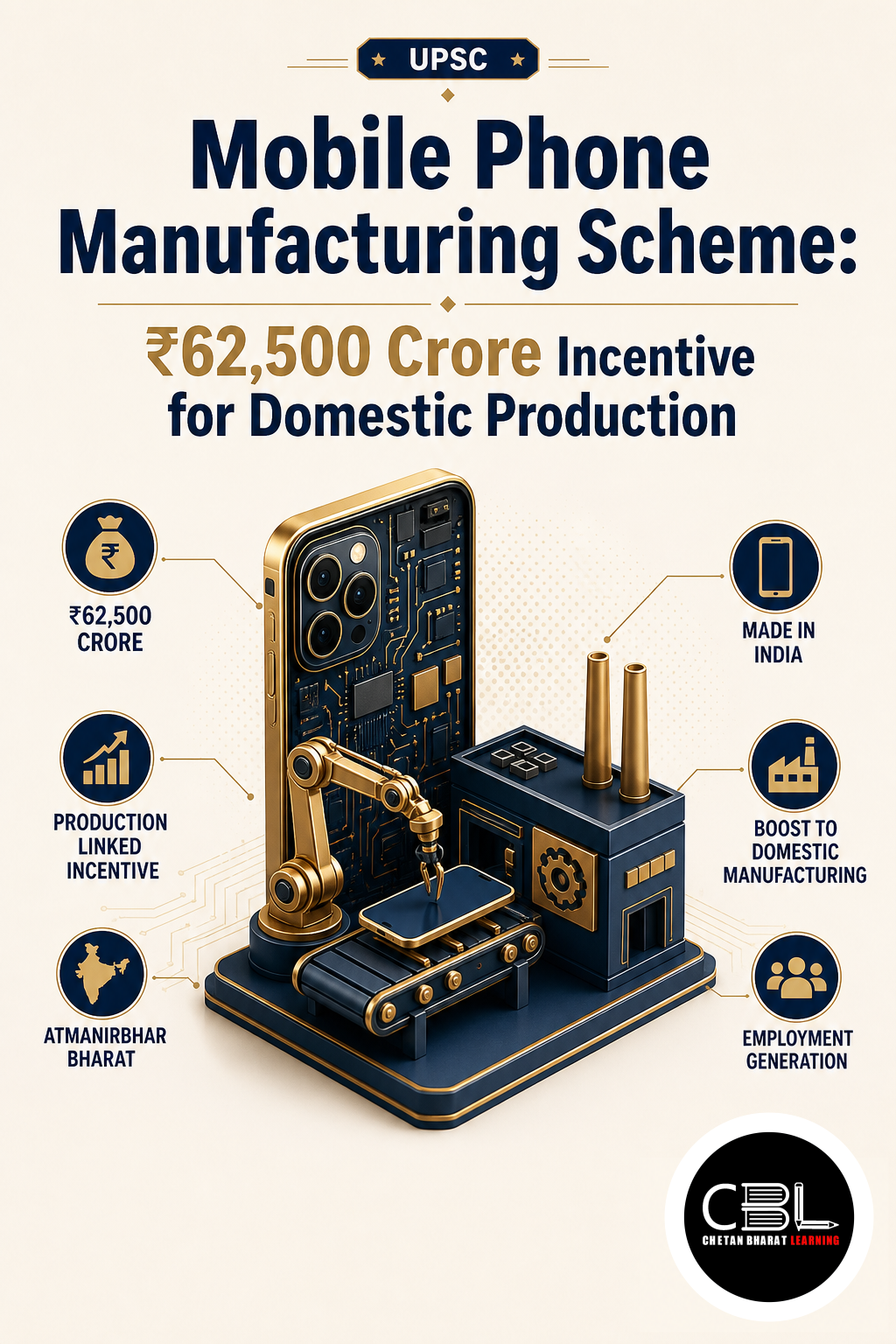
The Mobile Phone Manufacturing Scheme (MPMS) is a ₹62,500 crore incentive programme designed to boost domestic manufacturing of mobile phones and electronics. It replaces the earlier PLI scheme and sets ambitious targets: ₹39 lakh crore in cumulative production, ₹15 lakh crore in exports, 60,000 direct jobs, and 35–40% domestic value addition over the five-year period. The scheme offers cash payouts tied to incremental sales over a base year for two target segments: global manufacturers and domestic Indian brands.
India already manufactures 99.2% of domestically used phones, and mobile phones were the largest exported product category in 2025, accounting for 61% of total electronics exports. The new scheme aims to build on this success by encouraging localisation and design innovation.
Why is the Mobile Phone Manufacturing Scheme in News?
The Mobile Phone Manufacturing Scheme has been in the news following its formal notification by MeitY, replacing the PLI scheme. The scheme comes at a time when India is emerging as a global electronics manufacturing hub, and the government is keen to attract more investment and boost exports. The incentives are designed to encourage both large-scale manufacturers and domestic brands to expand their operations in India.
The scheme’s focus on domestic value addition (35-40%) and Indian design is significant, with an additional 3% design bonus for domestic brands. It also includes provisions for local sourcing, with up to 1.5% additional incentive if components are localized in at least 25% of total annual units.
Key Features of MPMS
- Two Target Segments: TS1 for large-scale manufacturers and EMS providers, and TS2 for domestic Indian-owned brands.
- Incentive Structure: TS1 offers tapered incentives from 2.75% to 2.25% on eligible sales; TS2 offers a flat 5% with an additional 3% design bonus.
- Sales Baseline: TS1 requires incremental sales over FY 2025-26 base, rising from additional ₹5,000 crore (FY27) to ₹25,000 crore (FY31). TS2 has no minimum sales requirement.
- Local Sourcing Bonus: Up to 1.5% additional incentive for both segments if components are localized in at least 25% of total annual units.
- Targets: Aims for ₹39 lakh crore production, ₹15 lakh crore exports, and 60,000 direct jobs.
Challenges in Implementation
- Component Ecosystem: India still imports many components, and building a robust local supply chain is a challenge.
- Global Competition: Other countries like Vietnam and China offer competitive incentives, posing a challenge for India.
- Infrastructure: Reliable power, logistics, and skilled labour are essential for scaling up manufacturing.
- Technology Transfer: Ensuring that global manufacturers transfer advanced technology and R&D capabilities is crucial.
- Monitoring and Compliance: Effective monitoring of incentives and compliance with local sourcing requirements is necessary.
Way Forward for Mobile Manufacturing
The Mobile Phone Manufacturing Scheme provides a strong push for India’s electronics manufacturing ambitions. To succeed, the government must focus on developing a robust component ecosystem, improving logistics, and ensuring a skilled workforce. The scheme’s emphasis on domestic value addition and design innovation is positive, but it requires sustained support for R&D and skill development.
Collaboration between industry and academia, along with a stable policy environment, will be key to attracting investment.
Prelims Practice Corner
- What is the total financial outlay of the Mobile Phone Manufacturing Scheme (MPMS)?
(a) ₹40,000 crore (b) ₹50,000 crore (c) ₹62,500 crore (d) ₹75,000 crore - What is the target for domestic value addition under MPMS?
(a) 25-30% (b) 35-40% (c) 45-50% (d) 55-60% - Which segment of MPMS offers a flat 5% incentive?
(a) TS1 (b) TS2 (c) Both (d) None - What is the additional incentive for design innovation under TS2?
(a) 1% (b) 2% (c) 3% (d) 5% - What is the local sourcing bonus percentage?
(a) 0.5% (b) 1.0% (c) 1.5% (d) 2.0%
Mains Practice Questions
Q1. “The Mobile Phone Manufacturing Scheme represents a strategic shift in India’s industrial policy.” Discuss its potential to transform India into a global electronics manufacturing hub. (250 words, 15 marks)
Answer Structure:
- Intro: Introduce MPMS as the successor to the PLI scheme.
- Body: Discuss targets (production, exports, jobs), incentives (TS1 vs TS2), design bonus, local sourcing, and challenges (component ecosystem, global competition).
- Conclusion: Highlight the need for a comprehensive ecosystem approach and technology transfer.
Q2. “Self-reliance in electronics manufacturing is crucial for India’s economic security.” Analyse the role of the Mobile Phone Manufacturing Scheme in achieving this goal. (250 words, 15 marks)
Answer Structure:
- Intro: Emphasize the importance of electronics manufacturing for India’s strategic interests.
- Body: Discuss the evolution from PLI to MPMS, its targets, incentives for domestic players, and the need for a robust component ecosystem.
- Conclusion: Suggest measures to address challenges and ensure long-term competitiveness.
FAQs on Mobile Phone Manufacturing Scheme
What is the difference between TS1 and TS2 under MPMS?
TS1 targets large-scale global manufacturers and EMS providers with a tapered incentive structure, while TS2 targets domestic Indian brands with a flat 5% incentive and an additional 3% design bonus.
What are the production and export targets under MPMS?
The scheme aims for ₹39 lakh crore in cumulative production and ₹15 lakh crore in exports over the five-year period.
What is the local sourcing bonus under MPMS?
Both TS1 and TS2 can receive up to 1.5% additional incentive if components are localized in at least 25% of their total annual units.
Related Current Affairs
Preparing for UPSC, PCS or HCS?
Talk to a mentor at Chetan Bharat Learning, Chandigarh. Free guidance on choosing the right exam and building a study plan.
Chat on WhatsAppCall 97793 53345UPSC / IAS / PCS coaching in Chandigarh · Trusted by aspirants across Punjab & Haryana
Leave a Reply
You must be logged in to post a comment.