

UPSC Mapping
GS Paper II: Constitution, Directive Principles of State Policy, Welfare Schemes, Governance.
Prelims: DPSPs, DBT, JAM Trinity, National Food Security Act, MGNREGA.
Article
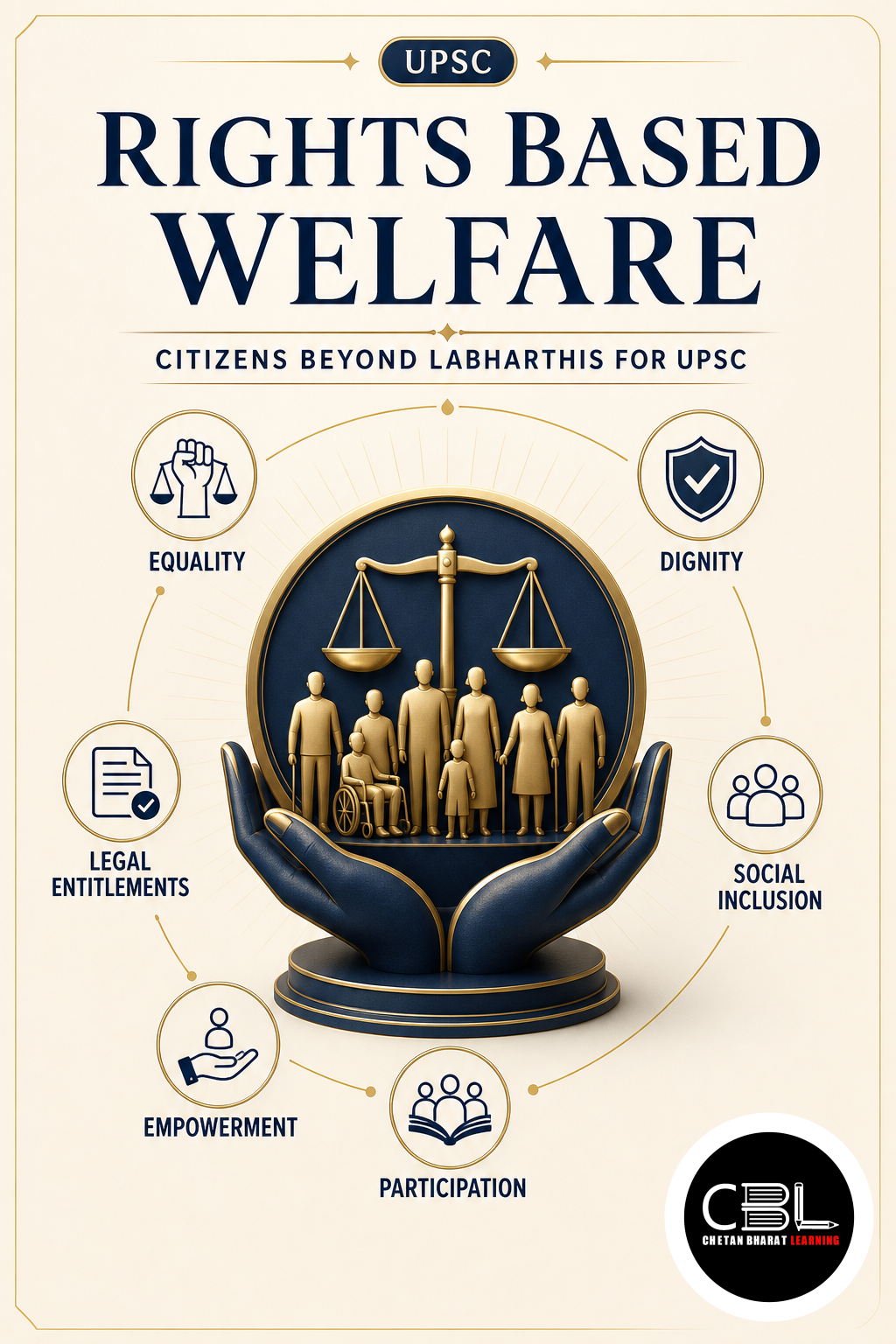
Rights Based Welfare is at the centre of debate after the passage argued that citizens should be viewed as rights holders rather than merely beneficiaries of government schemes. The article examines whether welfare should remain a constitutional commitment grounded in rights or gradually shift towards a beneficiary-oriented model driven by technology and targeted delivery.
Why in News
According to the passage, India’s welfare model is increasingly shifting from a rights-based approach towards a beneficiary-centric model because of the growing use of Direct Benefit Transfer (DBT), digital governance and efficiency-focused delivery mechanisms. The article raises concerns that this transition may weaken the constitutional vision of a welfare state.
Central Question
The passage asks whether welfare should be viewed as a constitutional right guaranteed through public services or merely as government assistance delivered efficiently through cash transfers and technology. It argues that efficiency alone cannot replace constitutional rights.
What is a Welfare State?
A welfare state aims to secure social justice and human development through public action in areas such as education, healthcare, nutrition, employment, social security and equal opportunity.
Constitutional Basis
The article links welfare policies to the Directive Principles of State Policy (DPSPs). It specifically highlights Article 38 (social order based on justice), Article 39 (equitable distribution of resources), Article 41 (right to work, education and public assistance), Article 42 (humane working conditions and maternity relief) and Article 47 (nutrition and public health) as the constitutional foundation for welfare.
Rights-Based Welfare
The passage describes rights-based welfare as a framework where welfare is treated as a legal entitlement rather than charity. Citizens become rights holders who can demand services, governments become accountable for delivery and legal remedies are available when rights are violated.
Examples cited include MGNREGA, the Right to Education Act, the National Food Security Act, 2013 and the Forest Rights Act.
The ‘Labharthi’ Model
The article contrasts this with a beneficiary-centred model where people receive welfare as beneficiaries rather than rights holders. Its features include direct cash transfers, technology-driven delivery, targeted schemes and reduced emphasis on public services.
Welfare may become transactional instead of rights-based if this approach dominates.
Direct Benefit Transfer and JAM Trinity
Direct Benefit Transfer (DBT) seeks to transfer benefits directly into beneficiaries’ bank accounts. It identifies the JAM Trinity—Jan Dhan accounts, Aadhaar and Mobile connectivity—as the technological foundation enabling digital payments and reducing leakages.
The article lists reduced corruption, quicker transfers, greater transparency, lower administrative costs and improved financial inclusion among the positive outcomes of DBT.
Concerns Raised
The passage also highlights concerns regarding declining social sector spending, digital exclusion, accessibility barriers, weakening of public institutions and the possibility that eligible individuals may be excluded due to internet access, Aadhaar authentication failures, banking issues or limited digital literacy.
Why Public Institutions Matter
According to the passage, institutions such as schools, hospitals, anganwadis, public distribution shops and MGNREGA worksites ensure equitable and universal access to welfare services. Universal public services are presented as essential rights rather than discretionary benefits.
Case Studies Mentioned
The article cites MGNREGA for legal employment guarantees and community asset creation, and PM POSHAN for improving nutrition, school attendance and educational outcomes through public provisioning.
Way Forward
Technology should strengthen constitutional welfare rather than replace it. It recommends preserving rights-based public services while using digital tools to improve transparency and delivery efficiency.
The central message is that citizens should remain rights holders even as welfare administration becomes more efficient through technology.
Prelims Package
- Which constitutional provisions provide the foundation for welfare policies according to the passage? Answer: Directive Principles of State Policy.
- What does JAM stand for? Answer: Jan Dhan, Aadhaar and Mobile.
- Rights-based welfare treats welfare primarily as: Answer: A legal entitlement.
- Which scheme is cited as providing a legal employment guarantee? Answer: MGNREGA.
- What is the central concern expressed in the article? Answer: Efficiency should not replace constitutional rights.
Mains Package
- Q1. Examine the distinction between rights-based welfare and a beneficiary-centred welfare model. (10 Marks)
- Q2. Discuss whether technology-driven welfare delivery should complement or replace universal public services in India. (15 Marks)
FAQs
- What is rights-based welfare? It is a welfare approach where citizens receive legal entitlements backed by constitutional values and government accountability.
- What is the JAM Trinity? According to the passage, it consists of Jan Dhan accounts, Aadhaar and Mobile connectivity that enable DBT.
- Why is this topic important for UPSC? It connects constitutional principles, governance reforms, welfare schemes and digital administration, making it relevant for GS Paper II and Prelims.
Related Current Affairs
Preparing for UPSC, PCS or HCS?
Talk to a mentor at Chetan Bharat Learning, Chandigarh. Free guidance on choosing the right exam and building a study plan.
Chat on WhatsAppCall 97793 53345UPSC / IAS / PCS coaching in Chandigarh · Trusted by aspirants across Punjab & Haryana
Leave a Reply
You must be logged in to post a comment.