

UPSC Mapping
| Prelims | Mains |
|---|---|
| Science & Technology | GS Paper 3 (Science & Technology & Energy) |
| Key Act | Licence Type | Liability |
|---|---|---|
| SHANTI Act, 2025 | Single composite licence | Strict, no-fault liability |
Article
What are SHANTI Rules 2026?
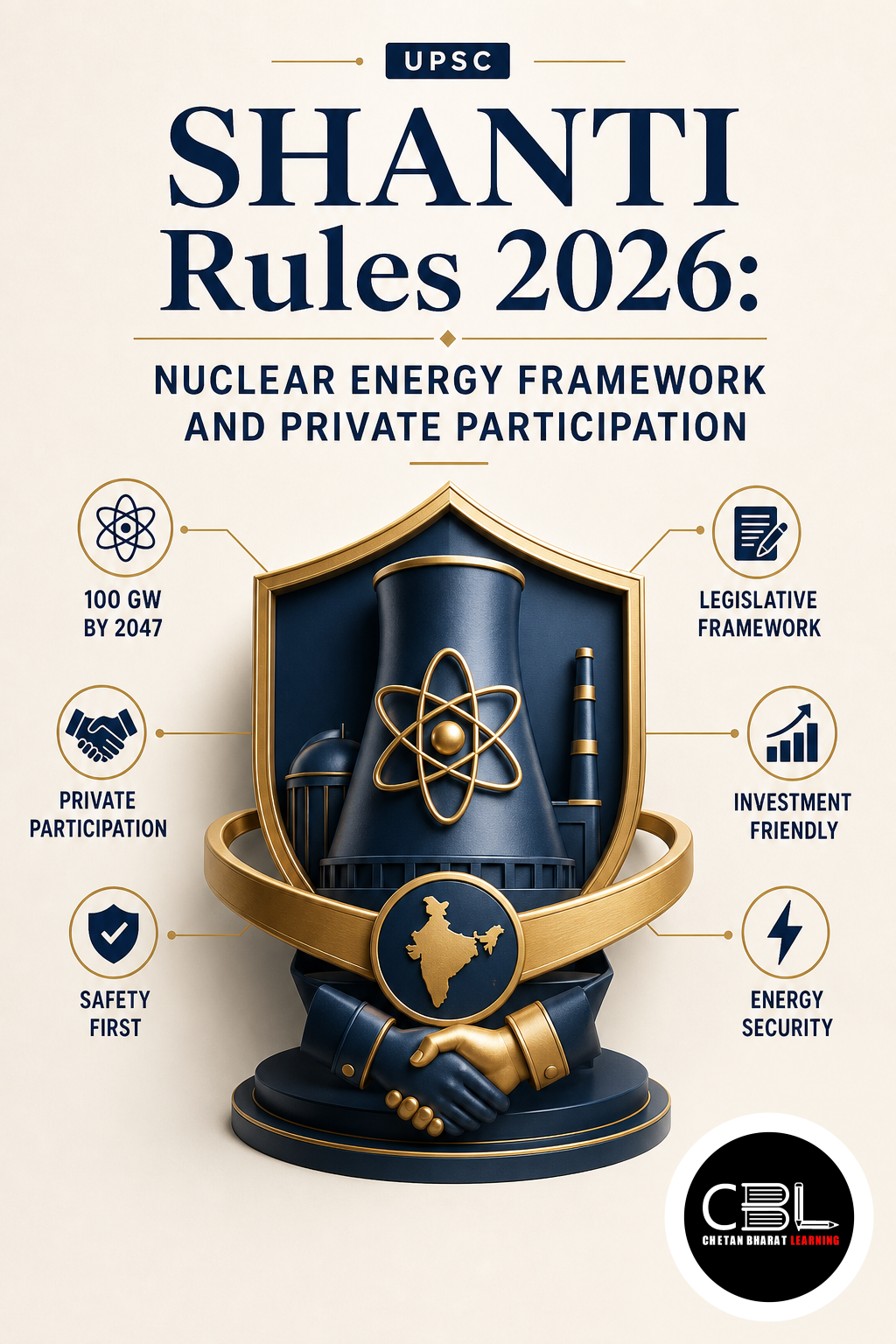
SHANTI Rules 2026 are the draft regulations issued by the Department of Atomic Energy to implement the SHANTI Act, 2025, which replaced the Atomic Energy Act, 1962 and the Civil Liability for Nuclear Damage Act, 2010. The rules introduce a single composite licence covering construction, ownership, operation, and decommissioning of nuclear installations. Operators bear strict no-fault liability for nuclear damage, including during transport of nuclear material.
Private entities can apply for nuclear licences, subject to prescribed financial, technical, and managerial capabilities. Applicants may seek in-principal approval even before finalising the site or reactor technology. Foreign reactor designs are permitted if certified by their home regulator and operational in their country of origin.
Why are SHANTI Rules 2026 in News?
SHANTI Rules 2026 are in the news because they mark a major shift in India’s nuclear energy policy, enabling private sector participation and introducing a modernised licensing framework. The rules are part of India’s push to expand nuclear capacity to 100 GW by 2047 and meet growing energy demands.
The rules also permit foreign reactor technology, provided it is certified and operational elsewhere, which could benefit Russian and other suppliers. However, the no-fault liability and insurance requirements may pose challenges for private investors.
Key Features of SHANTI Rules 2026
- Single Composite Licence: Covers construction, ownership, operation, and decommissioning.
- Strict No-Fault Liability: Operators are liable for nuclear damage regardless of fault.
- Private Sector Participation: Private entities can apply, subject to capability criteria.
- In-Principal Approval: Applicants can seek approval before site/technology finalisation.
- Foreign Technology: Permitted if certified by home regulator and operational elsewhere.
Challenges in SHANTI Rules 2026
- Insurance and Liability: The strict liability and insurance requirements may deter private investors.
- Technology Certification: Foreign reactor designs must be certified by their home regulator and operational, which may limit options.
- Regulatory Capacity: The Atomic Energy Regulatory Board (AERB) needs strengthening to handle increased licensing and oversight.
- Public Acceptance: Nuclear projects often face local opposition and environmental concerns.
- Capital Intensity: Nuclear power requires massive upfront investment and long gestation periods.
Way Forward for SHANTI Rules 2026
To ensure the success of SHANTI Rules 2026, the government should provide clarity on liability caps and insurance mechanisms to attract private investment. Building regulatory capacity and ensuring independent oversight are essential. Public engagement and transparent decision-making can build trust.
International collaborations for technology transfer and safety standards can accelerate deployment. The rules should be periodically reviewed to adapt to technological advancements and operational experience.
Prelims Practice Corner
- Q1. Which Act was replaced by the SHANTI Act, 2025?
(a) Atomic Energy Act, 1962 (b) Nuclear Liability Act, 2010 (c) Electricity Act, 2003 (d) Environment Protection Act
Answer: (a) The SHANTI Act replaced the Atomic Energy Act, 1962. - Q2. What type of licence does the SHANTI Rules propose?
(a) Multiple licences for each stage (b) Single composite licence (c) No licence required (d) Only for government entities
Answer: (b) The rules introduce a single composite licence covering all stages. - Q3. Can private companies apply for nuclear licences under the SHANTI Rules?
(a) No (b) Yes, subject to capability criteria (c) Only for small reactors (d) Only with foreign collaboration
Answer: (b) Private entities can apply, subject to prescribed capabilities. - Q4. What is the liability principle under the SHANTI Rules?
(a) Fault-based liability (b) Strict no-fault liability (c) No liability (d) Limited liability
Answer: (b) Operators bear strict no-fault liability. - Q5. What is the requirement for foreign reactor designs?
(a) Must be indigenous (b) Must be certified by home regulator and operational (c) No foreign designs allowed (d) Must be approved by the UN
Answer: (b) Foreign designs must be certified and operational in their home country or elsewhere.
Mains Practice Questions
-
Q1. Critically examine the SHANTI Rules, 2026, in the context of India’s nuclear energy expansion and the role of private sector participation. (250 words, 15 marks)
- Intro: Introduce SHANTI Rules and their objectives.
- Body: Discuss key features: single licence, private entry, no-fault liability. Analyse the benefits for energy security and the challenges of liability, financing, and public acceptance. Suggest measures for effective implementation.
- Conclusion: Emphasise the need for robust regulation and international cooperation.
-
Q2. What is the significance of the SHANTI Act for India’s energy security and climate goals? (150 words, 10 marks)
- Intro: Frame the SHANTI Act as a critical enabler for nuclear expansion.
- Body: Explain that nuclear power provides reliable, low-carbon baseload electricity. The SHANTI Act allows private investment, which can accelerate capacity addition and reduce fossil fuel dependence, contributing to India’s climate commitments.
- Conclusion: Conclude that the Act is pivotal for India’s energy transition.
FAQs on SHANTI Rules 2026
What are the SHANTI Rules 2026?
They are draft regulations to implement the SHANTI Act, 2025, introducing a single composite licence and private sector participation.
What is the liability regime under the rules?
Operators bear strict no-fault liability for nuclear damage, including during transport.
Can foreign technology be used?
Yes, foreign reactor designs are permitted if certified by their home regulator and operational elsewhere.
Related Current Affairs
Preparing for UPSC, PCS or HCS?
Talk to a mentor at Chetan Bharat Learning, Chandigarh. Free guidance on choosing the right exam and building a study plan.
Chat on WhatsAppCall 97793 53345UPSC / IAS / PCS coaching in Chandigarh · Trusted by aspirants across Punjab & Haryana
Leave a Reply
You must be logged in to post a comment.