
UPSC Mapping
| Prelims | Mains |
|---|---|
| Polity & Governance | GS Paper 2 (Polity & Governance) |
Key Directives (Quick Facts)
| Directive | Detail |
|---|---|
| Seizure Reporting | Within 24 hours |
| Investigation Deadline | 1 year |
| Tax Reporting Limit | ₹10 lakh |
What is Electoral Black Money?
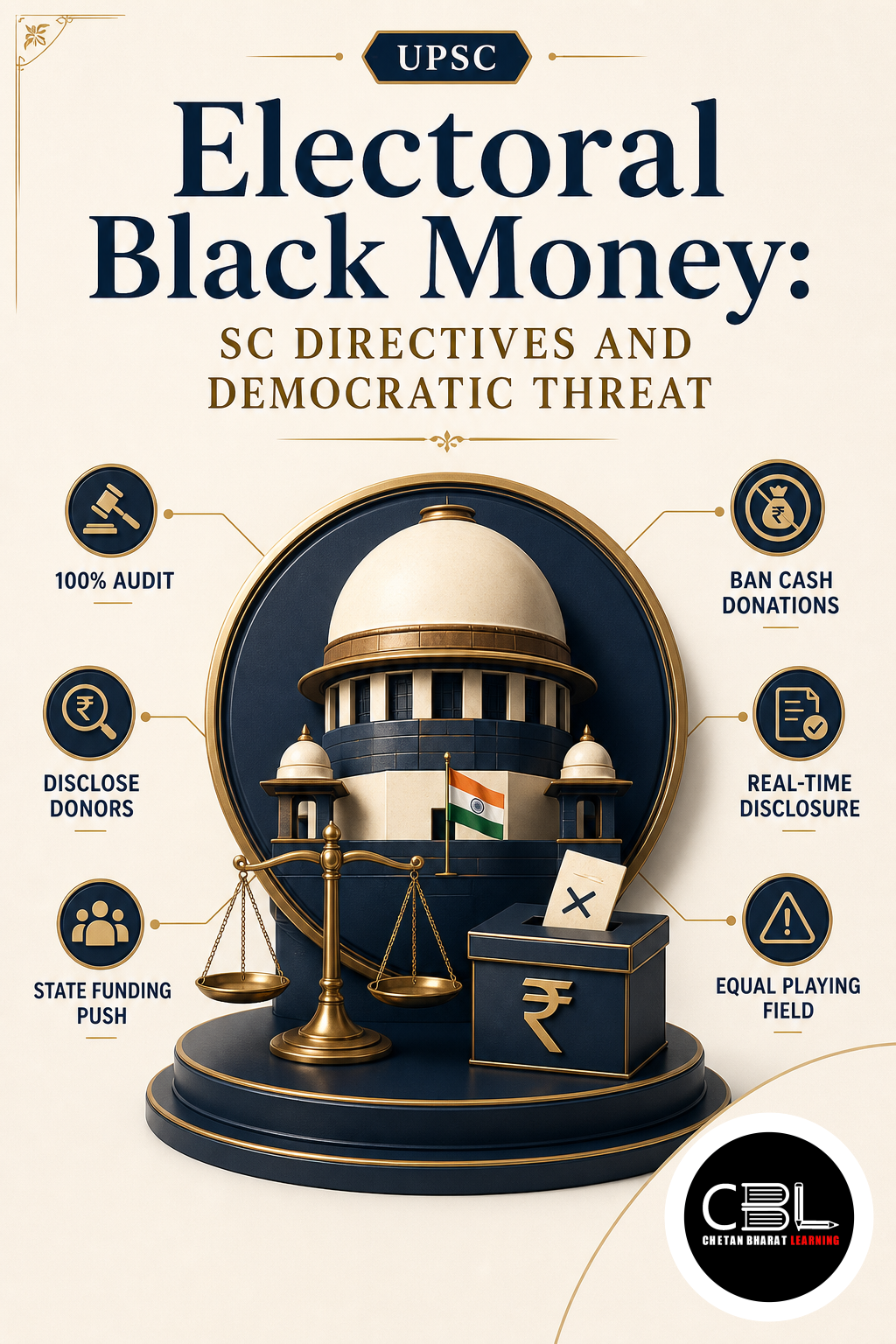
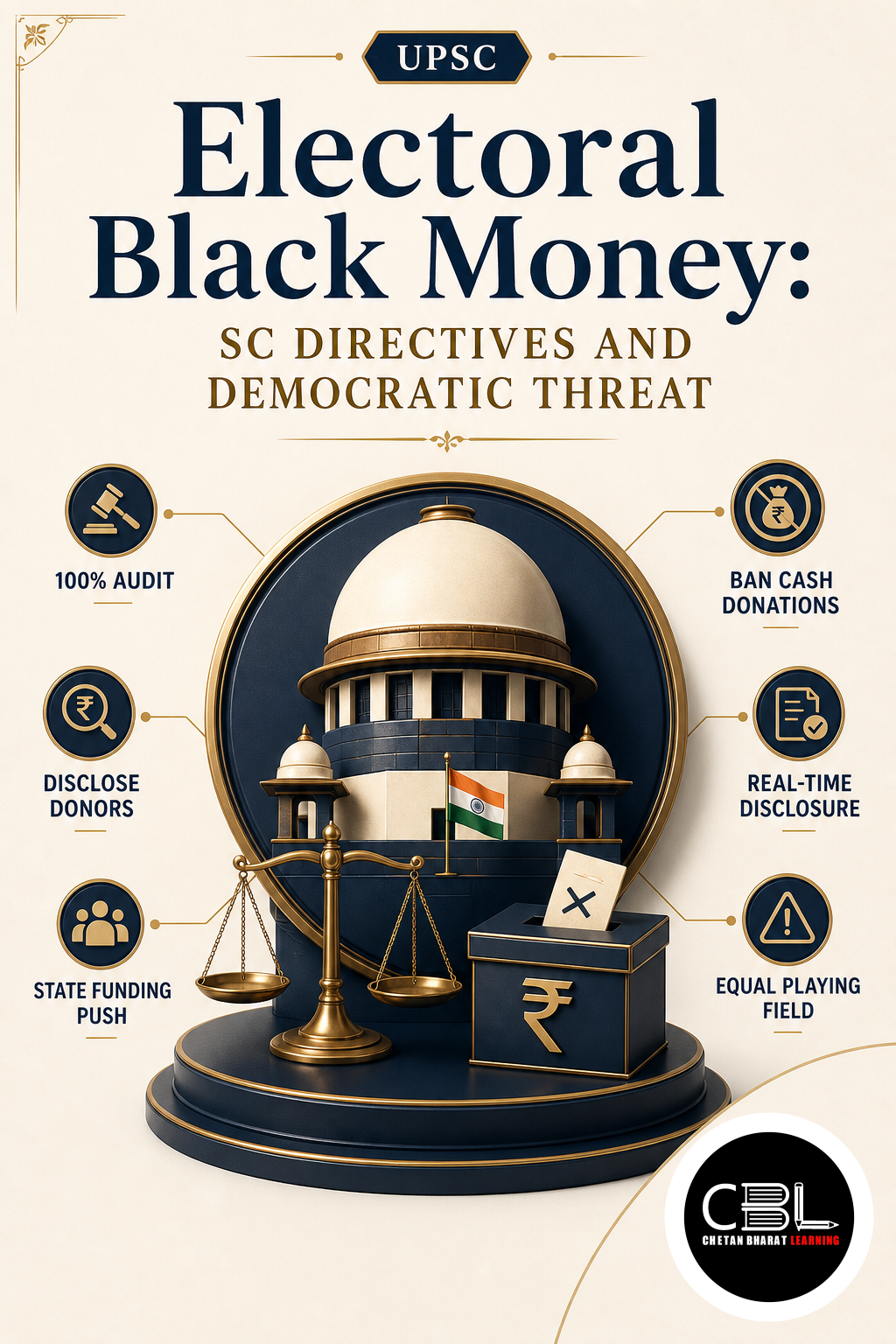
Electoral Black Money refers to unaccounted cash and illicit funds used to influence elections through voter bribery, intimidation, and illegal campaign financing. The Supreme Court ruled that eliminating such money is a core responsibility of the Election Commission of India (ECI), as it distorts free voter choice and undermines democratic principles under Article 326. The Court issued directives to strengthen enforcement, including mandatory reporting of seized cash to magistrates within 24 hours, completion of FIR investigations within one year, and coordination with the Income Tax Department for cash seizures exceeding ₹10 lakh.
The Court also directed High Courts to designate fast-track courts for election financial crimes and required state governments to obtain prior permission from the High Court before withdrawing any prosecution linked to an election cycle.
Why is Electoral Black Money in News?
Electoral Black Money is in the news following the Supreme Court’s landmark judgment that reaffirms the ECI’s constitutional duty under Article 324. The Court’s directives aim to plug loopholes in election funding and ensure timely prosecution of offenders. The judgment also highlights the need for greater transparency in political party funding, as current laws allow anonymous donations below ₹20,000 to avoid reporting.
The case underscores the persistent challenge of unaccounted wealth in Indian elections, which distorts the level playing field and enables criminal networks to influence politics. For more details, refer to this PIB release.
Key Features of Electoral Black Money
Electoral Black Money has several distinctive features:
- Voter Manipulation: Financial gratification distorts free voter choice, weakening universal adult suffrage under Article 326.
- Unequal Competition: Unaccounted wealth skews the electoral field, disadvantaging resource-poor candidates under Article 14.
- Policy Distortion: Illicit campaign funding creates post-election quid pro quo risks, allowing private financiers to influence policy.
- Crime Nexus: Large cash-distribution networks rely on criminal intermediaries, strengthening ties between crime, money power, and politics.
- Legal Framework: RPA, 1951; Income Tax Act; and Conduct of Elections Rules provide the legal framework.
Challenges in Combating Electoral Black Money
Combating Electoral Black Money faces several challenges:
- Legal Loophole: Section 77 of RPA limits candidate spending but not political parties’ independent election expenditure.
- Reporting Evasion: Parties split large anonymous donations into fractions under ₹20,000 to avoid reporting under Section 13A of the Income Tax Act.
- Digital Obfuscation: Unaccounted money is increasingly diverted into surrogate digital ads and paid news.
- Enforcement Deficit: ECI lacks statutory authority to deregister parties for financial irregularities.
- Prosecution Delays: Slow investigations and trials allow offenders to evade justice.
Way Forward for Electoral Black Money
To address Electoral Black Money, the government should close the legal loophole by capping party expenditure and mandating real-time disclosure of donations above a threshold. Strengthening the ECI’s enforcement powers and setting up a dedicated prosecution mechanism can improve accountability. The Supreme Court’s directives on fast-track courts and investigation timelines are positive steps.
Public funding of elections, as recommended by the Indrajit Gupta Committee, can reduce dependence on private money. For international best practices, refer to the International IDEA.
Prelims Practice Corner
Q1. Under which Article does the Election Commission derive its constitutional authority?
(a) Article 324 (b) Article 326 (c) Article 14 (d) Article 19
Answer: (a) Article 324 grants the ECI superintendence, direction, and control over elections.
Q2. What is the mandatory deadline for reporting seized cash in election-related cases?
(a) 12 hours (b) 24 hours (c) 48 hours (d) 72 hours
Answer: (b) The SC directed reporting within 24 hours.
Q3. What is the cash threshold for reporting to the Income Tax Department under the SC directive?
(a) ₹5 lakh (b) ₹10 lakh (c) ₹15 lakh (d) ₹20 lakh
Answer: (b) Seizures over ₹10 lakh must be reported to the IT Department.
Q4. Which Act exempts political parties from tax on voluntary contributions if they maintain records?
(a) Income Tax Act, 1961 (b) RPA, 1951 (c) Conduct of Elections Rules (d) Companies Act
Answer: (a) Section 13A of the Income Tax Act provides exemption subject to conditions.
Q5. Which committee recommended partial state funding of elections?
(a) Dinesh Goswami Committee (b) Vohra Committee (c) Indrajit Gupta Committee (d) Law Commission
Answer: (c) The Indrajit Gupta Committee recommended partial state funding.
Mains Practice Questions
Q1. Critically analyse the impact of electoral black money on Indian democracy and evaluate the Supreme Court’s directives to curb it. (250 words, 15 marks)
Answer Structure
- Intro: Introduce electoral black money and the SC judgment.
- Body: Discuss how black money threatens voter choice, political equality, and policy integrity. Analyse the SC directives: 24-hour reporting, one-year investigation, fast-track courts, and their feasibility. Suggest reforms: party expenditure cap, real-time donation disclosure, state funding.
- Conclusion: Emphasise the need for a multi-pronged approach involving law, technology, and public awareness.
Q2. What are the legal provisions governing election expenditure in India, and how do they address black money? (150 words, 10 marks)
Answer Structure
- Intro: Mention RPA, 1951 and Income Tax Act provisions.
- Body: Explain Section 77 (candidate expenditure limit), Section 13A (tax exemption for parties), and Rule 90 (expenditure limits). Highlight loopholes: party expenditure not capped, anonymous donations loophole.
- Conclusion: Conclude that legal provisions need strengthening to effectively curb black money.
FAQs on Electoral Black Money
What is electoral black money?
It is unaccounted cash and illicit funds used to influence elections through bribery, intimidation, and illegal campaign financing.
What are the key Supreme Court directives?
Mandatory 24-hour seizure reporting, one-year investigation deadline, fast-track courts, and prior HC permission for prosecution withdrawal.
How does electoral black money affect democracy?
It distorts voter choice, creates unequal competition, enables policy capture by private interests, and strengthens criminal-political nexus.
Related Current Affairs
Preparing for UPSC, PCS or HCS?
Talk to a mentor at Chetan Bharat Learning, Chandigarh. Free guidance on choosing the right exam and building a study plan.
Chat on WhatsAppCall 97793 53345UPSC / IAS / PCS coaching in Chandigarh · Trusted by aspirants across Punjab & Haryana
Leave a Reply
You must be logged in to post a comment.