UPSC Mapping
- Prelims: Polity & Social Justice
- Mains: GS Paper 2 (Social Justice & Governance)
Quick Facts
| Last Comprehensive Census | 1931 |
|---|---|
| 2011 SECC Entries | 46.7 lakh+ |
| SC List | 1,208 |
What is Caste Census India?
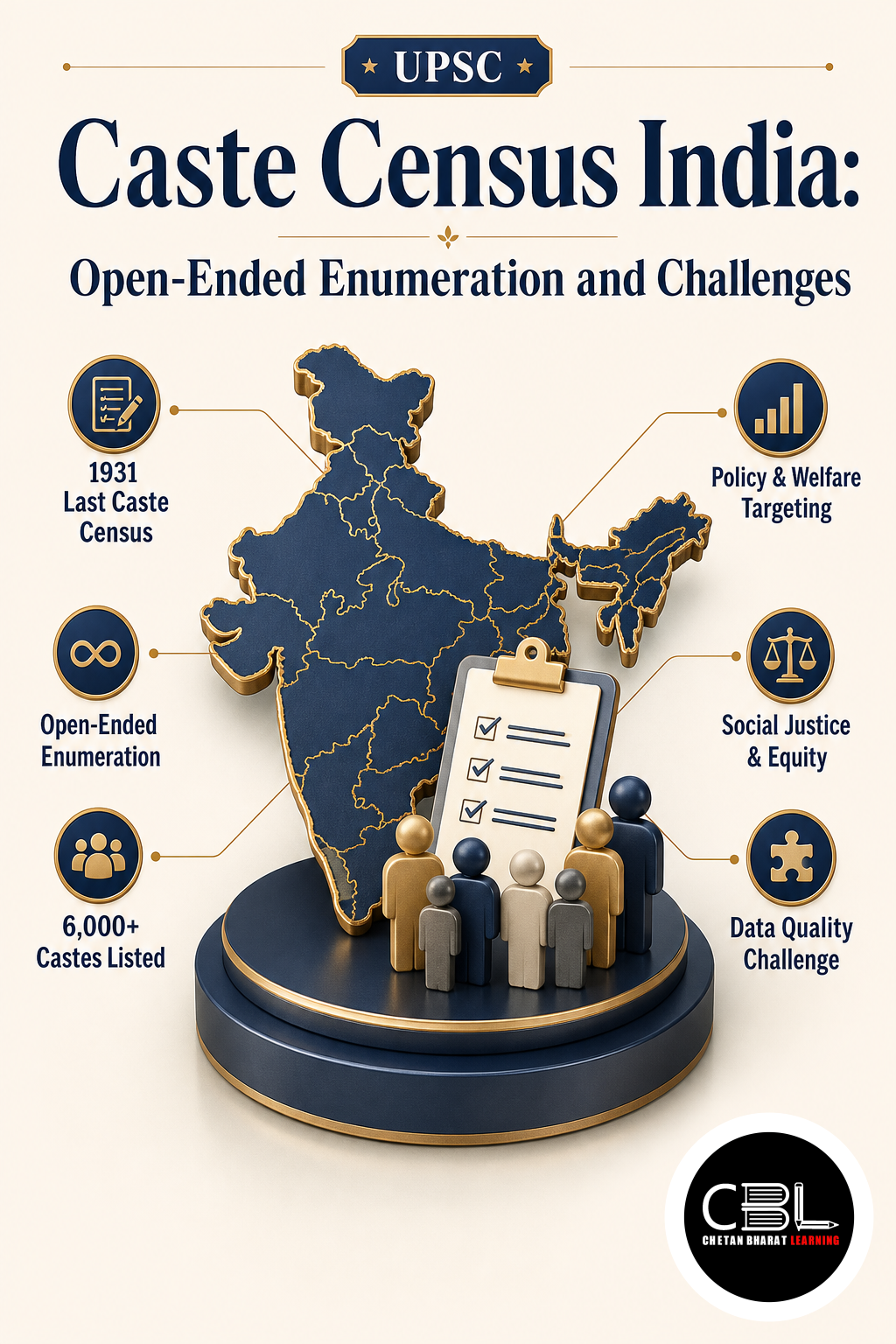
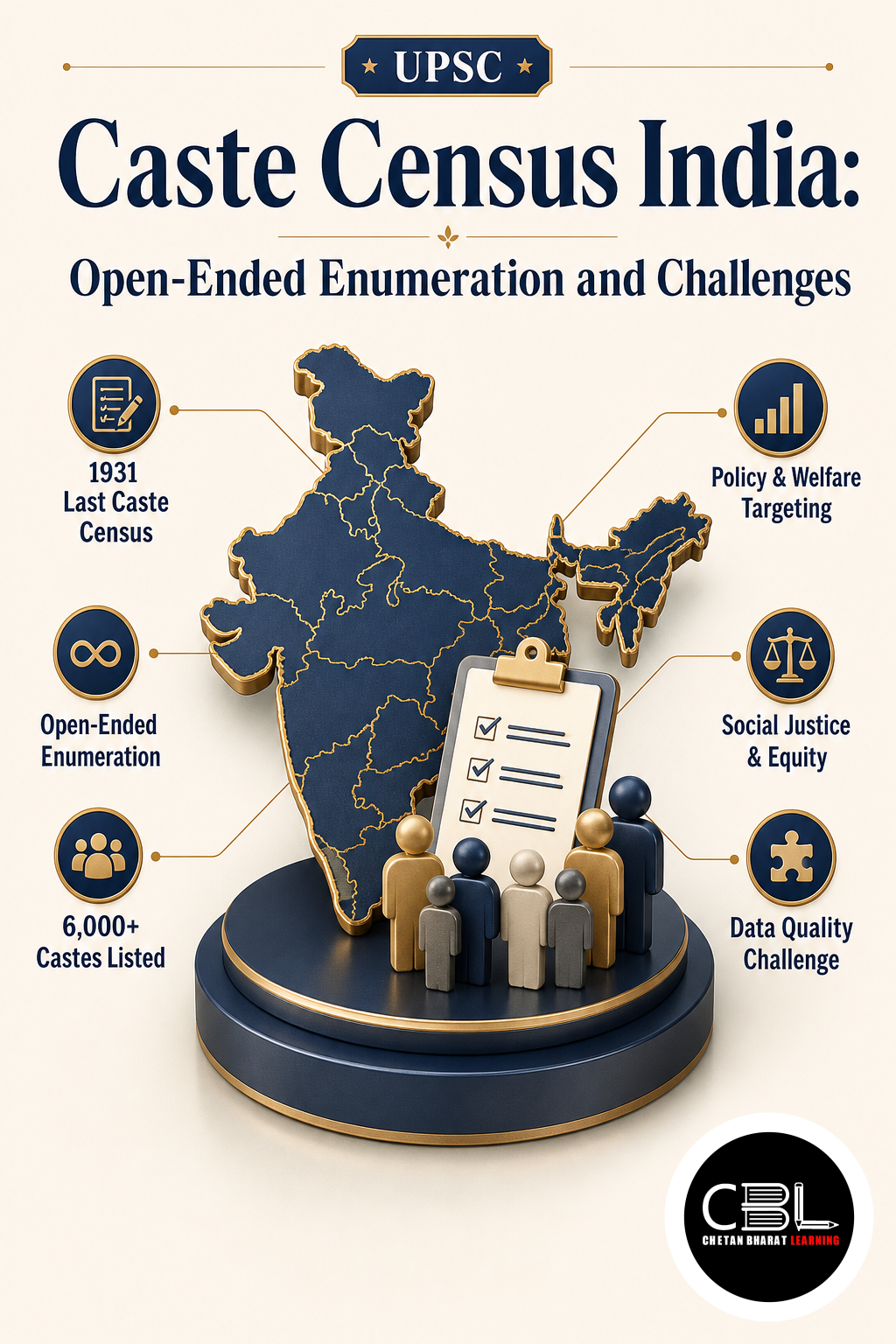
Caste Census India refers to the enumeration of caste identities in the national census. The upcoming census will use an open-ended question, allowing respondents to state their caste. This method was used in the 1931 Census, the last comprehensive caste census, which faced issues of community consolidation and creation of new identities. The 2011 SECC attempted caste enumeration but generated 46.7 lakh distinct caste names, making classification impossible.
The government has not yet finalised the methodology, but a predetermined list of castes (including general category) has been suggested to minimise errors. The Ministry of Social Justice lists 1,208 Scheduled Castes and 730 Scheduled Tribes, but OBC lists vary by state.
For more such polity updates, explore the polity and governance archive.
Why is Caste Census India in News?
Caste Census India is in the news because the Registrar General has decided to use an open-ended question, reigniting debate over the accuracy and utility of caste data. The 1931 Census showed that caste is not fixed—communities merged under broader identities or created new ones (e.g., Aad Dharmis in Punjab). The 2011 SECC’s failure due to unstandardised responses has led to calls for a pre-determined list.
Experts argue that a pre-determined list would reduce errors, while separate questionnaires for SCs and STs can capture distinct forms of exclusion. For more details, refer to this PIB release.
Key Features of Caste Census India
- Open-Ended Question: Respondents state their caste, leading to potential variations in spelling and classification.
- Historical Precedent: The 1931 Census used the same method but faced issues of identity consolidation and creation.
- 2011 SECC Failure: Recorded 46.7 lakh distinct caste names, making aggregation impossible.
- Existing Lists: SC/ST lists are fixed; OBC lists vary by state and are not fully consolidated.
- Expert Suggestion: A pre-determined exhaustive list (including general castes) can minimise errors.
Challenges in Caste Census India
- Identity Fluidity: Caste identities can consolidate, fragment, or transform, making enumeration difficult.
- Regional Variations: The same caste may have different names in different regions; the same name may refer to different groups.
- Spelling and Classification: Open-ended responses lead to numerous spelling variations and synonyms.
- Administrative Burden: Standardising millions of responses requires significant effort and expertise.
- Political Sensitivity: Caste enumeration is politically charged, with potential impacts on reservation policies. For more on social justice, visit the social justice section.
Way Forward for Caste Census India
To ensure a credible Caste Census India, the government should adopt a pre-determined, exhaustive list of castes based on existing state-wise OBC lists and general caste enumeration. Expert committees with sociologists and statisticians can design the questionnaire and classification methodology.
Separate questions for SCs and STs to capture specific exclusions (untouchability for SCs, geographical isolation for STs) can provide nuanced data. Piloting the methodology in select districts can identify and correct issues before full-scale implementation. For international best practices, refer to the UN.
Prelims Practice Corner
Q1. When was the last comprehensive caste census conducted in India?
(a) 1921 (b) 1931 (c) 1941 (d) 1951
Answer: (b) The last comprehensive caste census was in 1931.
Q2. How many distinct caste names were recorded in the 2011 SECC?
(a) 4,147 (b) 46.7 lakh (c) 1,208 (d) 730
Answer: (b) The 2011 SECC recorded nearly 46.7 lakh distinct caste names.
Q3. What is the number of Scheduled Castes listed by the Ministry of Social Justice?
(a) 730 (b) 1,208 (c) 4,147 (d) 46.7 lakh
Answer: (b) The list includes 1,208 Scheduled Castes.
Q4. What was the main problem with the 2011 caste enumeration?
(a) Lack of political will (b) Open-ended responses leading to huge unclassifiable data (c) Sample size too small (d) Privacy concerns
Answer: (b) The open-ended question generated millions of distinct responses, making classification impossible.
Q5. What is the proposed solution to avoid classification errors?
(a) Abolish caste census (b) Use a pre-determined exhaustive list of castes (c) Only count SC/ST (d) Use random sampling
Answer: (b) A pre-determined list, including general castes, can minimise errors.
Mains Practice Questions
Q1. Discuss the challenges in conducting a caste census in India and suggest a robust methodology for accurate enumeration. (250 words, 15 marks)
Answer Structure:
- Intro: Introduce the caste census debate and its historical context.
- Body: Discuss challenges: identity fluidity, regional variations, open-ended responses, political sensitivity. Suggest a pre-determined list, separate questionnaires for SC/ST, and pilot testing.
- Conclusion: Emphasise the need for scientific and transparent methodology.
Q2. What is the significance of the 1931 Census in the context of caste enumeration in India? (150 words, 10 marks)
Answer Structure:
- Intro: Frame 1931 as the last comprehensive caste census.
- Body: Explain its importance: it showed how communities consolidated under broader identities or created new ones, influencing social and political dynamics. It highlights the fluidity of caste and the challenges of enumeration.
- Conclusion: Conclude that the 1931 experience informs current methodology debates.
FAQs on Caste Census India
What is a caste census?
It is the enumeration of caste identities as part of the national census, used for welfare planning and policy.
Why was the 2011 caste census data unusable?
The open-ended question generated 46.7 lakh distinct caste names, making aggregation and classification impossible.
What is the proposed methodology for the 2026 caste census?
An open-ended question has been approved, but experts suggest a pre-determined exhaustive list to reduce errors.
Related Current Affairs
Preparing for UPSC, PCS or HCS?
Talk to a mentor at Chetan Bharat Learning, Chandigarh. Free guidance on choosing the right exam and building a study plan.
Chat on WhatsAppCall 97793 53345UPSC / IAS / PCS coaching in Chandigarh · Trusted by aspirants across Punjab & Haryana
Leave a Reply
You must be logged in to post a comment.