

UPSC Mapping
| Exam | Topic |
|---|---|
| Prelims | Polity & Criminal Law |
| Mains | GS Paper 2 (Constitutional & Criminal Law) |
Quick Facts
| Key Article | Article 22(1) – Informed Grounds |
|---|---|
| Magistrate Timeline | 24 hours (Article 22(2)) |
| Key Case | D.K. Basu v. State of West Bengal |
What are Arbitrary Arrest Safeguards?
Arbitrary Arrest Safeguards are fundamental to India’s constitutional democracy, with the Supreme Court in Vihaan Kumar v. State of Haryana (2025) reaffirming that grounds for arrest must be meaningfully communicated to every arrestee. The ruling strengthens the constitutional shield against arbitrary detention. For more such polity updates, explore the polity and governance archive.
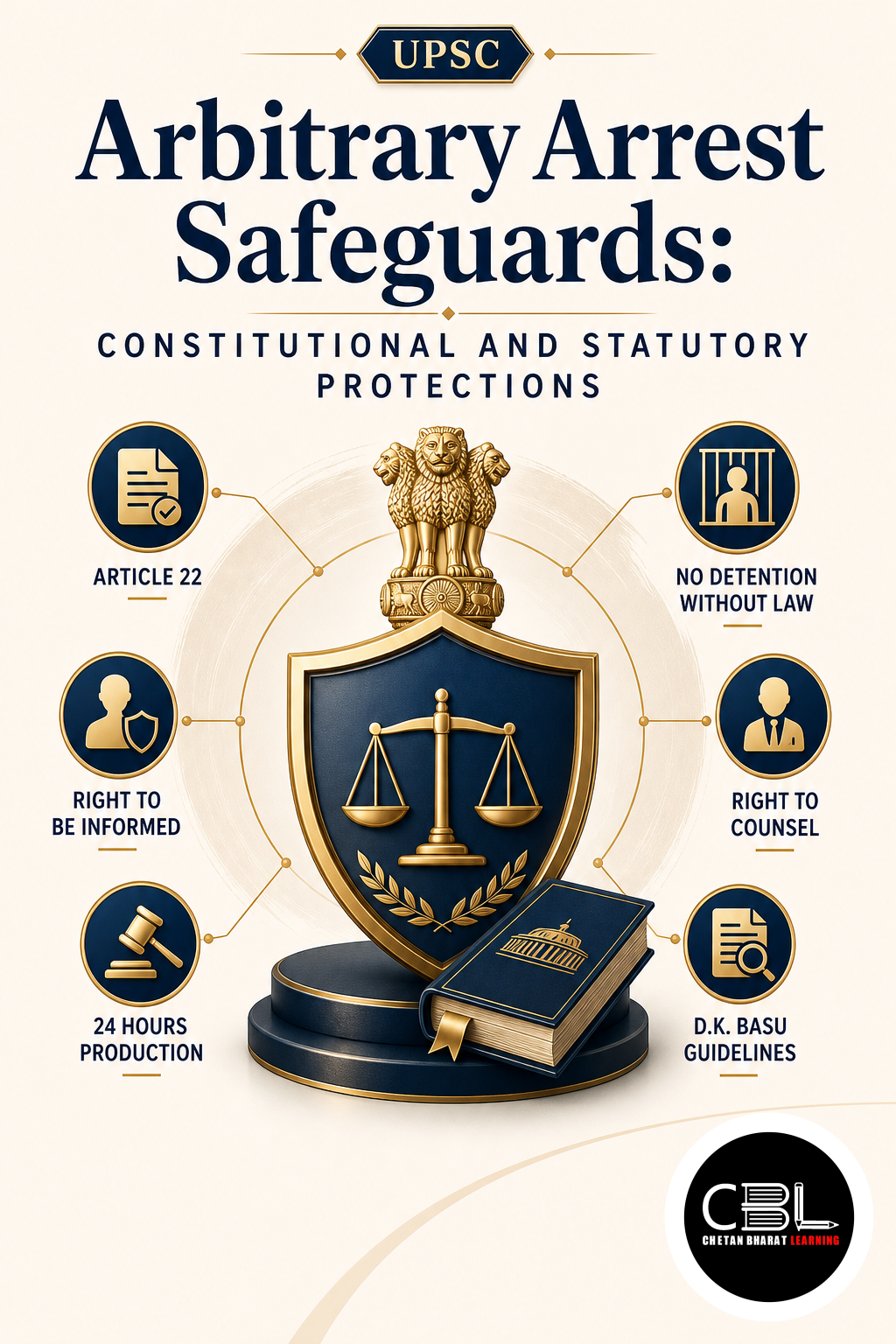
Arbitrary Arrest Safeguards are constitutional and statutory protections designed to prevent unlawful or unjustified detention. Under Article 21, no person can be deprived of personal liberty except through a fair, just, and reasonable procedure. Article 22(1) requires that every arrested person be informed immediately of the grounds of arrest and have the right to consult a legal practitioner.
Article 22(2) mandates production before a judicial magistrate within 24 hours, excluding travel time. The Bharatiya Nagarik Suraksha Sanhita (BNSS) reinforces these protections, requiring arrest records and allowing access to legal counsel during interrogation.
Why are Arbitrary Arrest Safeguards in News?
Arbitrary Arrest Safeguards are in the news following the Supreme Court’s ruling in Vihaan Kumar v. State of Haryana (2025), which required that grounds for arrest be meaningfully communicated. The Court has consistently expanded protection through cases like D.K. Basu (1997), Arnesh Kumar (2014), and Pankaj Bansal (2023).
Recent challenges include mechanical remands, misuse of preventive detention laws, and manipulation of the 24-hour clock. For more details, refer to this PIB release.
Key Features of Arbitrary Arrest Safeguards
- Constitutional Shield: Articles 21 and 22 combine to protect against arbitrary detention.
- Informed Grounds: Arrestee must be told the grounds immediately (Article 22(1)).
- Magisterial Oversight: Production before magistrate within 24 hours (Article 22(2)).
- Statutory Protections: BNSS Sections 35 (arrest necessities), 38 (advocate access), 58 (24-hour clock).
- Judicial Guidelines: D.K. Basu guidelines, Arnesh Kumar (arrest exception), Pankaj Bansal (written reasons).
Challenges in Enforcing Arbitrary Arrest Safeguards
- Mechanical Remands: Magistrates routinely authorise police custody without critical review.
- Due Process Bypass: Vague public-order grounds in preventive detention laws circumvent criminal procedure requirements.
- Defence Deprivation: Socio-economic marginalisation prevents arrestees from knowing rights or accessing legal aid within 24 hours.
- Clock Manipulation: Police backdate arrests and omit exact times to manipulate the 24-hour limit.
- Sovereign Immunity: Article 361 protects the President and Governors, creating exceptions. For more on criminal justice, visit the governance section.
Way Forward for Arbitrary Arrest Safeguards
To strengthen Arbitrary Arrest Safeguards, magistrates must apply the Arnesh Kumar principle—arrest should be an exception, not a rule. Mandatory video-recording of arrests and production can enhance accountability. Legal aid must be available at the police station level to ensure access to counsel.
Reforms to preventive detention laws to require stricter judicial scrutiny and time-bound review are essential. Training for police on constitutional safeguards and modern investigation techniques can reduce reliance on custodial interrogation. For international best practices, refer to the UNHRC.
Prelims Practice Corner
Q1. Under which Article must an arrestee be informed of the grounds of arrest?
- (a) Article 20
- (b) Article 21
- (c) Article 22(1)
- (d) Article 22(2)
Answer: (c) Article 22(1) requires immediate communication of grounds.
Q2. What is the maximum time limit for producing an arrestee before a magistrate?
- (a) 12 hours
- (b) 24 hours
- (c) 48 hours
- (d) 72 hours
Answer: (b) Article 22(2) mandates production within 24 hours.
Q3. Which landmark case established guidelines against custodial violence?
- (a) Arnesh Kumar v. State of Bihar
- (b) D.K. Basu v. State of West Bengal
- (c) Pankaj Bansal v. Union of India
- (d) Vihaan Kumar v. State of Haryana
Answer: (b) D.K. Basu set mandatory guidelines to prevent custodial violence.
Q4. What does the ‘connected shield doctrine’ state?
- (a) Procedural errors at arrest make detention illegal
- (b) Arrest is always valid
- (c) Preventive detention has no limits
- (d) Governors cannot be arrested
Answer: (a) Procedural errors at arrest render the entire detention illegal.
Q5. What is a key challenge in enforcing arrest safeguards?
- (a) Lack of laws
- (b) Mechanical remands by magistrates
- (c) Absence of police
- (d) Too many lawyers
Answer: (b) Magistrates often authorise custody without critical review.
Mains Practice Questions
Q1. Discuss the constitutional and statutory safeguards against arbitrary arrest in India. How effective are they in practice? (250 words, 15 marks)
Answer Structure:
- Intro: Introduce constitutional safeguards (Articles 21, 22) and statutory provisions (BNSS).
- Body: Discuss key safeguards: informed grounds, legal counsel, 24-hour magistrate oversight. Analyse challenges: mechanical remands, preventive detention misuse, clock manipulation. Suggest reforms: video-recording, legal aid, stricter judicial scrutiny.
- Conclusion: Emphasise the need for procedural rigour and accountability.
Q2. What is the significance of the Supreme Court’s ruling in Vihaan Kumar v. State of Haryana (2025) for arrest safeguards? (150 words, 10 marks)
Answer Structure:
- Intro: Frame the ruling as a reaffirmation of procedural rights.
- Body: Explain that the Court required grounds for arrest to be meaningfully communicated, strengthening the right under Article 22(1). This ensures arrestees can effectively exercise their right to legal counsel and challenge unlawful detention.
- Conclusion: Conclude that such rulings are vital for preventing arbitrary arrest and upholding the rule of law.
FAQs on Arbitrary Arrest Safeguards
What are the constitutional safeguards against arbitrary arrest?
Articles 21 (due process) and 22 (informed grounds, legal counsel, 24-hour magistrate oversight) provide constitutional protection.
What is the ‘connected shield doctrine’?
It states that Articles 21 and 22 act as a combined shield, where procedural errors at arrest make the entire detention illegal.
What is the Arnesh Kumar principle?
It directs magistrates not to automatically authorise detention for offences with sentences under seven years, making arrest an exception, not a routine.
Related Current Affairs
Preparing for UPSC, PCS or HCS?
Talk to a mentor at Chetan Bharat Learning, Chandigarh. Free guidance on choosing the right exam and building a study plan.
Chat on WhatsAppCall 97793 53345UPSC / IAS / PCS coaching in Chandigarh · Trusted by aspirants across Punjab & Haryana
Leave a Reply
You must be logged in to post a comment.