
UPSC Mapping
Prelims
Health & Traditional Medicine
Mains
GS Paper 2 (Health & Governance)
| Objective | Uniform quality standards |
|---|---|
| Focus | Medicinal herbs |
Article
What is One Herb Standard?
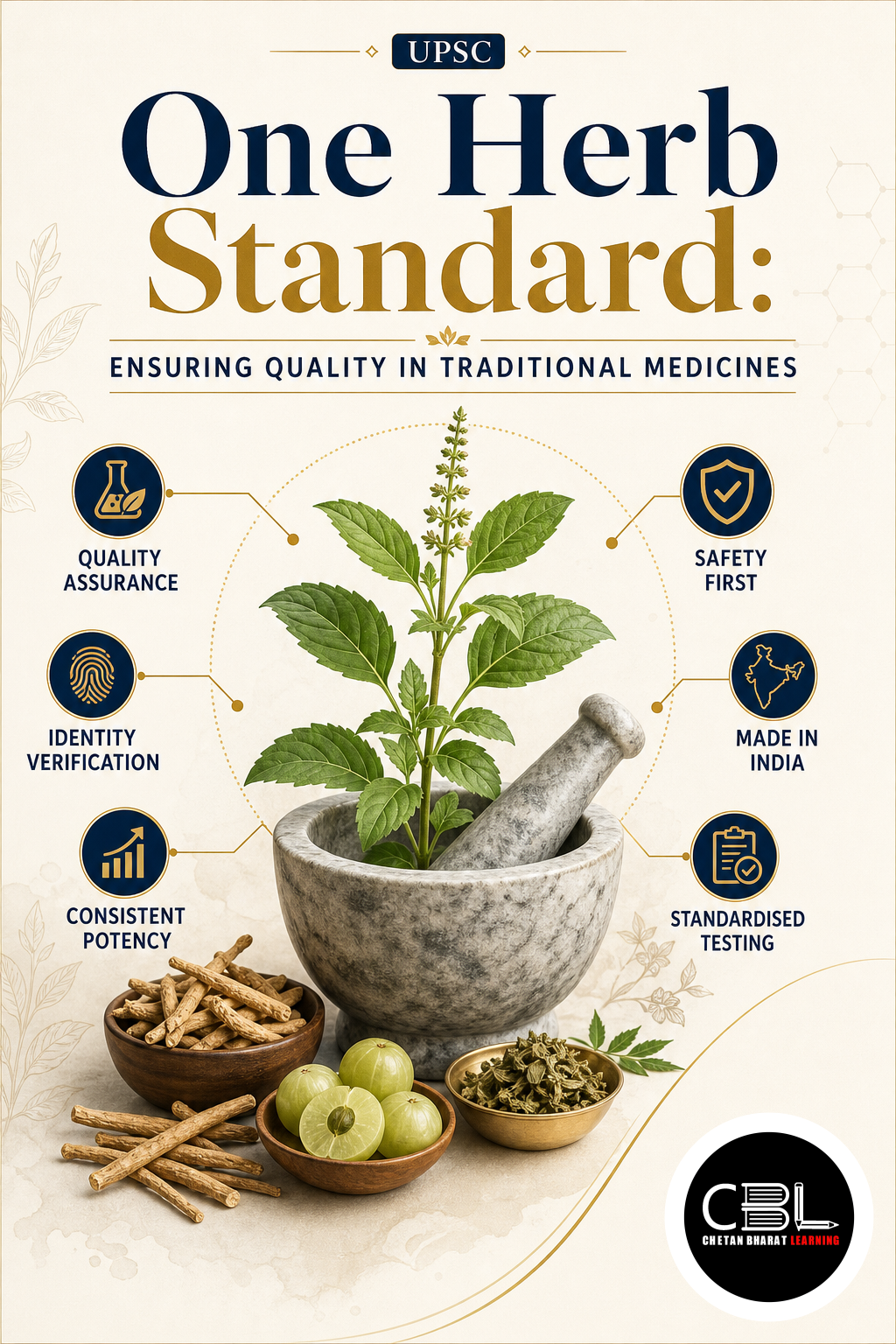
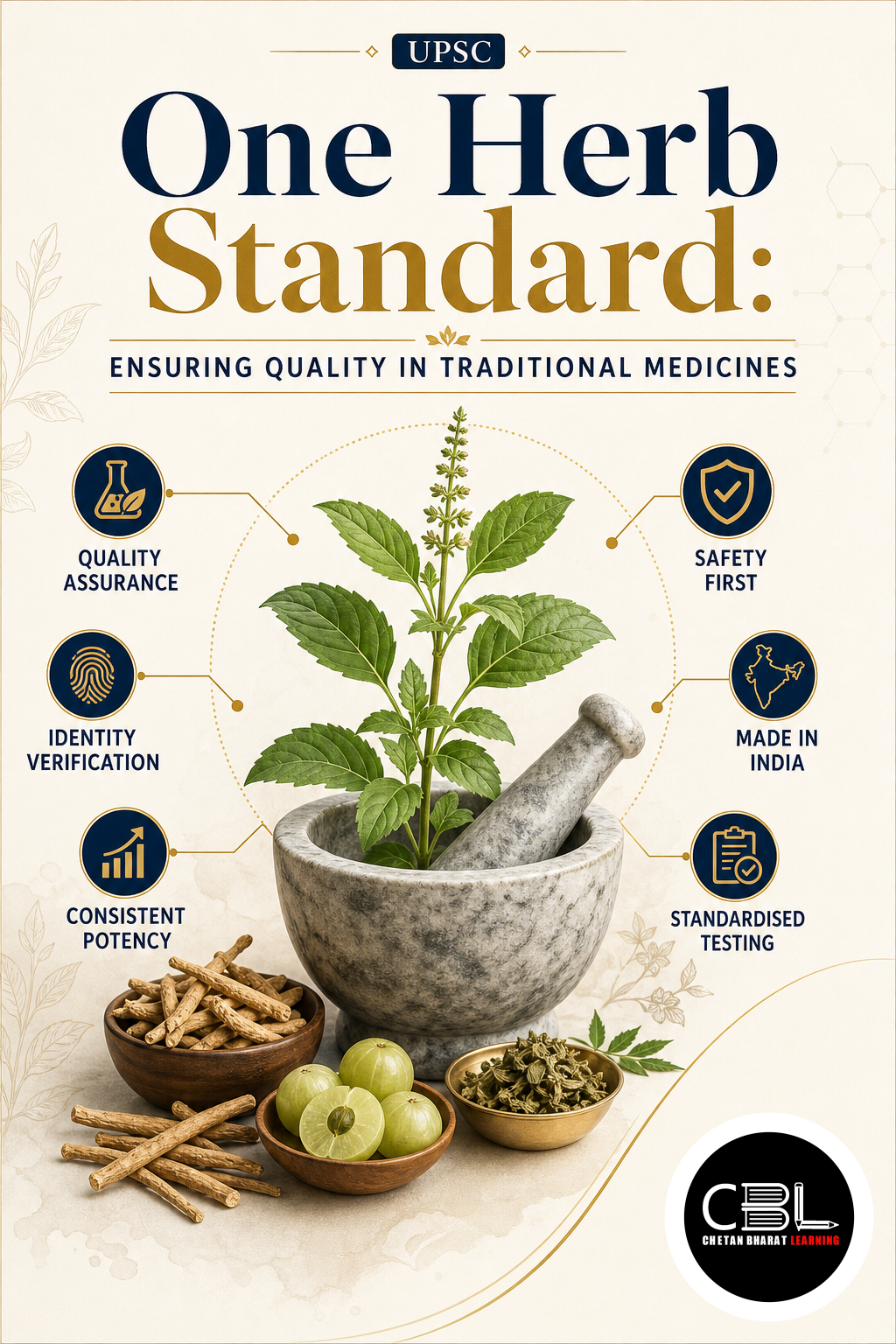
One Herb Standard is an initiative aimed at developing uniform quality standards for medicinal herbs used in traditional medicine systems such as Ayurveda, Unani, and Siddha. The initiative was formalised through a Memorandum of Understanding (MoU) to ensure that herbs meet prescribed quality, safety, and consistency benchmarks.
The initiative addresses the challenge of varying quality due to factors like geographical origin, harvesting practices, and processing methods. Standardisation will enhance the credibility of Indian traditional medicines, boost exports, and ensure patient safety.
Why is One Herb Standard in News?
One Herb Standard is in the news because a MoU has been signed for its implementation, marking a significant step towards strengthening India’s traditional medicine sector. The initiative aligns with the government’s push to promote Ayush systems and harness the potential of medicinal plants.
Standardisation is expected to increase export opportunities, as many international markets require stringent quality certifications for herbal products.
Key Features of One Herb Standard
- Uniform Quality Benchmarks: Standardised parameters for identity, purity, and potency of medicinal herbs.
- Scientific Validation: Use of modern analytical techniques to verify phytochemical profiles and active ingredients.
- Supply Chain Traceability: Traceability from cultivation to processing to ensure authenticity.
- Regulatory Compliance: Alignment with international pharmacopoeias and regulatory requirements for exports.
- Capacity Building: Training for stakeholders on quality cultivation, harvesting, and processing practices.
Challenges in One Herb Standard Implementation
- Variability of Herbs: Natural variation in chemical composition due to climate, soil, and geography makes standardisation complex.
- Infrastructure: Requirement for advanced testing laboratories and skilled analysts.
- Cost: Potential increase in costs for small-scale farmers and manufacturers.
- Adoption: Resistance from traditional practitioners who rely on empirical knowledge.
- Enforcement: Ensuring compliance across a vast and fragmented herbal supply chain.
Way Forward for One Herb Standard
To successfully implement One Herb Standard, the government should establish a centralised repository of quality standards and provide financial support for laboratories and certification agencies. Engaging farmers and traditional knowledge holders in the standardisation process can enhance acceptance.
Public awareness campaigns about the benefits of standardised herbs can build consumer trust. International collaborations with pharmacopoeial authorities can facilitate global acceptance of Indian herbal standards.
Prelims Practice Corner
Q1. What is the primary objective of the One Herb Standard initiative?
(a) To increase herb cultivation
(b) To develop uniform quality standards for medicinal herbs
(c) To promote organic farming
(d) To ban traditional medicines
Answer: (b) To develop uniform quality standards for medicinal herbs.
Q2. Which traditional medicine systems will benefit from this initiative?
(a) Only Ayurveda
(b) Ayurveda, Unani, Siddha
(c) Only Homeopathy
(d) Only Allopathy
Answer: (b) Ayurveda, Unani, Siddha, and other traditional systems.
Q3. How does standardisation help exports?
(a) By making products more expensive
(b) By ensuring compliance with international quality requirements
(c) By reducing the variety of herbs
(d) By eliminating competition
Answer: (b) Standardisation ensures compliance with international regulatory requirements, boosting exports.
Q4. What is a major challenge in standardising herbs?
(a) Lack of demand
(b) Natural variability in chemical composition
(c) Government opposition
(d) Excessive supply
Answer: (b) Natural variability due to climate, soil, and geography makes standardisation complex.
Q5. The initiative is implemented through which instrument?
(a) Law
(b) Memorandum of Understanding
(c) Presidential order
(d) Supreme Court directive
Answer: (b) A MoU was signed for its implementation.
Mains Practice Questions
Q1. Discuss the importance of standardisation in traditional medicine systems like Ayurveda and its implications for public health and exports. (250 words, 15 marks)
Intro: Introduce One Herb Standard and its objectives.
Body: Discuss the need for standardisation: quality consistency, safety, credibility. Highlight benefits: enhanced exports, patient safety, research support. Analyse challenges and suggest measures.
Conclusion: Emphasise the role of standardisation in mainstreaming traditional medicine.
Q2. What are the challenges in ensuring the quality and safety of herbal medicines in India, and how can the One Herb Standard initiative address them? (150 words, 10 marks)
Intro: Note the importance of herbal medicine quality.
Body: Discuss challenges: variability, adulteration, lack of standards. Explain how One Herb Standard will address these through uniform benchmarks, scientific validation, and traceability.
Conclusion: Conclude that standardisation is key to global recognition.
FAQs on One Herb Standard
What is One Herb Standard?
It is an initiative to develop uniform quality standards for medicinal herbs used in traditional medicine, aiming to enhance safety, consistency, and credibility.
Why is standardisation needed?
To address variability, adulteration, and ensure patient safety, while also facilitating export by meeting international quality requirements.
Who will benefit from this initiative?
Manufacturers, exporters, and consumers of traditional medicines will benefit, along with healthcare systems that rely on herbal products.
Related Current Affairs
Preparing for UPSC, PCS or HCS?
Talk to a mentor at Chetan Bharat Learning, Chandigarh. Free guidance on choosing the right exam and building a study plan.
Chat on WhatsAppCall 97793 53345UPSC / IAS / PCS coaching in Chandigarh · Trusted by aspirants across Punjab & Haryana
Leave a Reply
You must be logged in to post a comment.