
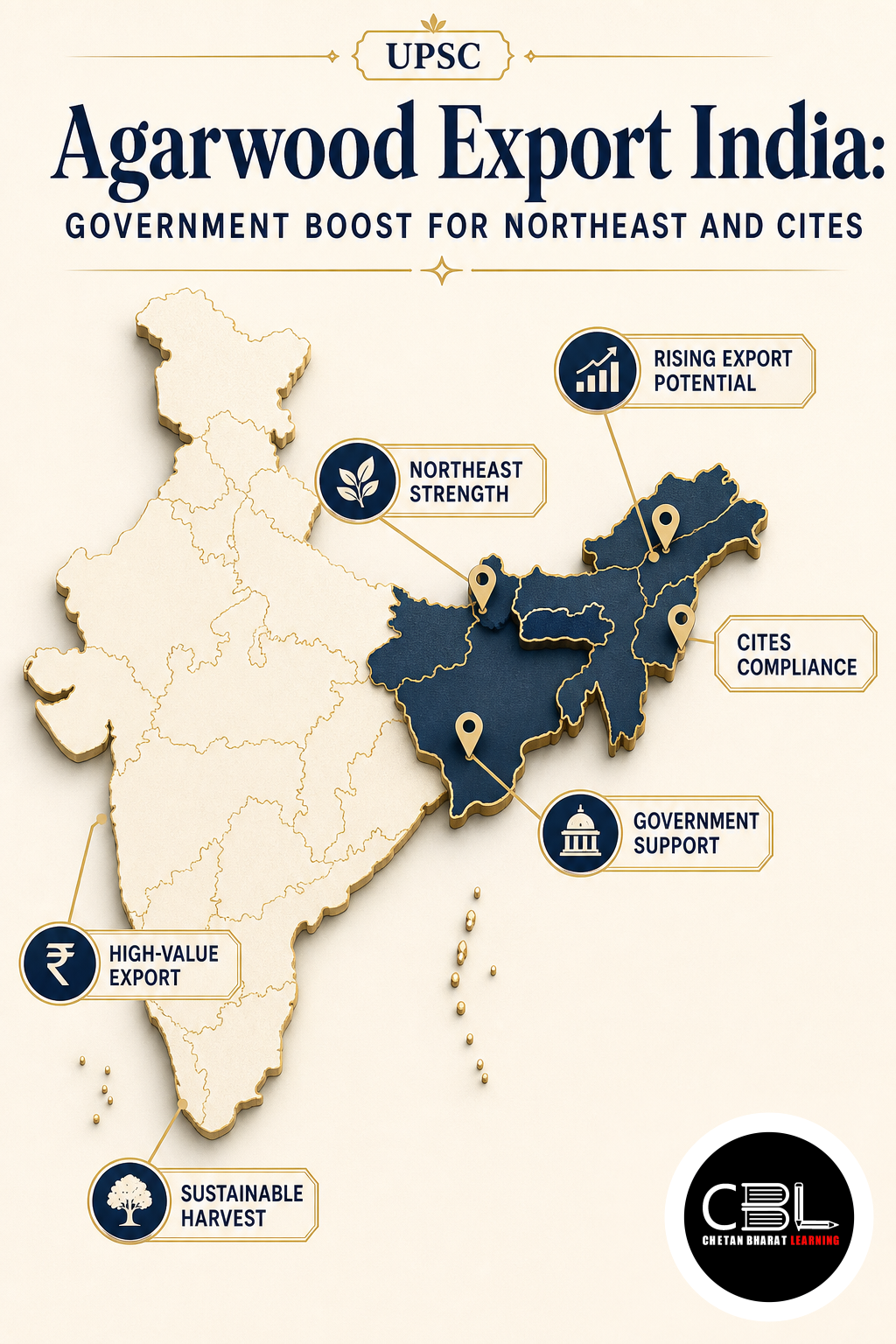
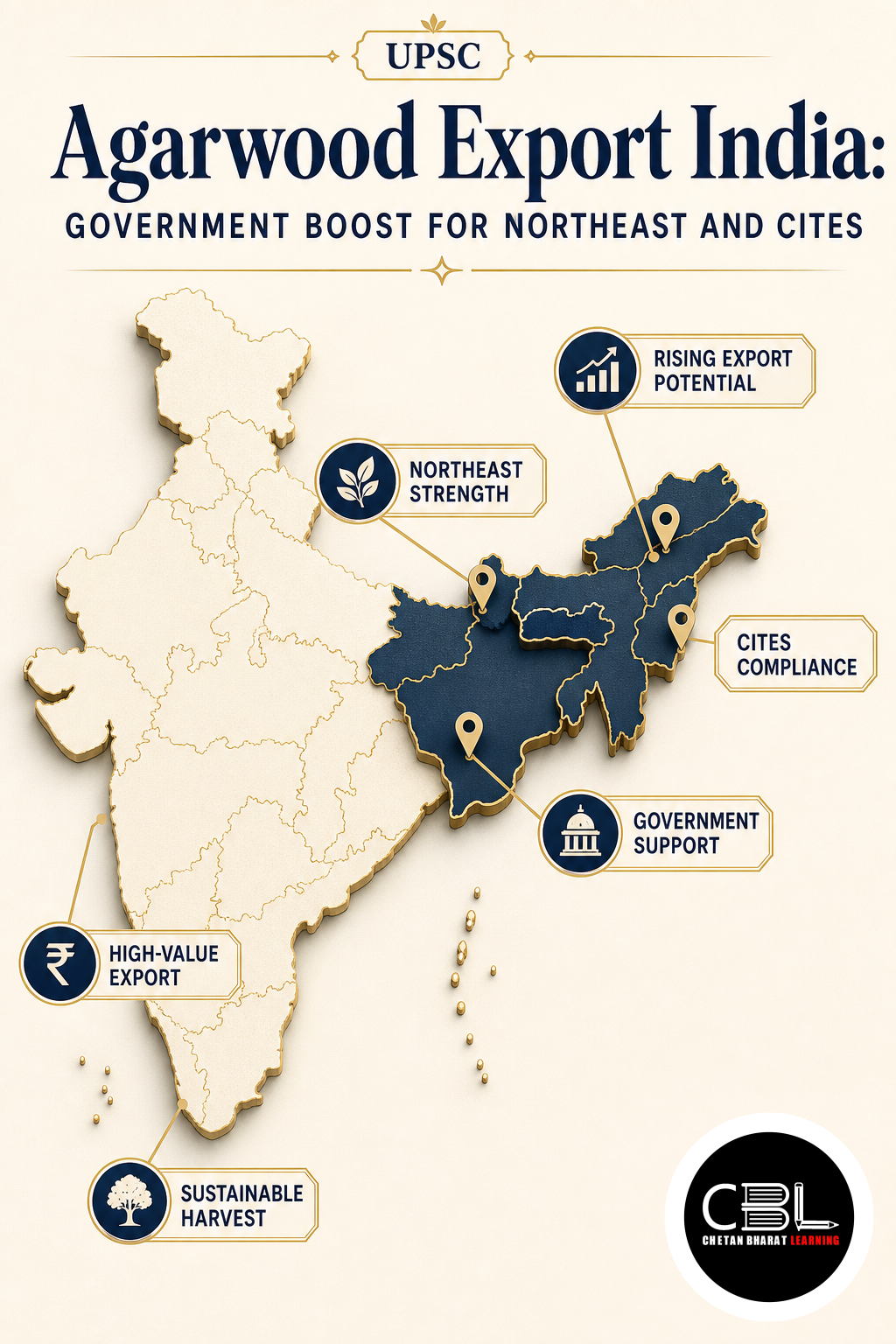
Agarwood Export India is receiving a significant boost as the Centre steps up efforts to promote agarwood and agarwood oil exports from the North Eastern Region. The government is supporting value addition and market infrastructure through the Agarwood Cluster Development Project in Assam and Tripura under PM-DevINE. For more such environmental and economic updates, explore the environment current affairs archive.
What is Agarwood Export India?
Agarwood Export India refers to the trade of resinous aromatic wood and its oil derived from Aquilaria species, known globally as Oud, Gaharu, or Agar. India is estimated to have around 139.89 million agarwood trees, with the North Eastern Region accounting for approximately 96.6% of this resource base.
Assam has about 114.3 million trees, while Tripura has around 15.15 million. Agarwood is prized as the world’s most valuable incense and is used in perfumery, traditional medicine, and religious ceremonies. The government is now promoting cultivation in South Indian states like Kerala, Tamil Nadu, and Telangana to expand the resource base.
Why is Agarwood Export India in News?
Agarwood Export India is in the news because the government has stepped up efforts to promote exports from the Northeast, establishing an Agarwood International Trade and Research Centre in Agartala. The Agarwood Cluster Development Project in Assam and Tripura under PM-DevINE supports value addition and market infrastructure.
Additionally, India submitted a Non-Discretionary Finding (NDF) to CITES to prevent inclusion of agarwood in the Review of Significant Trade (RST), enabling India to announce a new export quota and regulate trade. The government has also taken measures to prevent collection from wild populations. For more details, refer to this PIB release.
Key Features of Agarwood Export India
Agarwood Export India has several distinctive features:
- Resource Base: Northeast India hosts 96.6% of the country’s agarwood trees, with Assam leading at 114.3 million trees.
- Value Products: Processed into agarwood chips and agar oil, used in perfumery, incense, and traditional medicines.
- Cultural Significance: Used in Hinduism, Islam, Christianity, Buddhism, and mentioned in ancient texts like Charaka Samhita and Kalidasa’s poetry.
- Phytochemicals: Contains over 150 compounds, including sesquiterpenoids and chromones, with anti-inflammatory and anti-diabetic properties.
- Export Markets: Strong demand in Gulf markets, Europe, the United States, and East Asia.
Challenges in Agarwood Export India
Despite its potential, Agarwood Export India faces several challenges:
- Unsustainable Harvesting: Wild trees take nearly a decade to mature, and traditional cutting for resin damages populations and ecosystems.
- CITES Regulations: Listed in Appendix II, requiring strict regulation to prevent over-exploitation.
- Value Addition: Limited processing infrastructure in the Northeast reduces the value of raw exports.
- Market Access: Small growers lack direct access to international markets, relying on intermediaries.
- Conservation Concerns: Collection from protected areas and reserved forests threatens wild populations. For more on such conservation issues, visit the biodiversity section.
Way Forward for Agarwood Export India
To sustainably grow Agarwood Export India, the government should focus on promoting scientific cultivation and artificial resin induction to reduce pressure on wild populations. Strengthening value-addition infrastructure in the Northeast, including distilleries and processing units, can increase export earnings.
Ensuring compliance with CITES through traceability systems and certification will build buyer confidence. Expanding cultivation to South Indian states can diversify the resource base. Providing training and market linkages to small growers, especially tribal communities, can enhance livelihoods while conserving the species. For international trade guidelines, refer to the CITES.
FAQs on Agarwood Export India
What is Agarwood Export India?
It refers to the trade of resinous agarwood and its oil, primarily from Northeast India, used in perfumery, incense, and traditional medicine.
Why is agarwood listed in CITES?
It is listed in Appendix II due to international concern over dwindling wild populations from unsustainable harvesting, requiring regulated trade.
What government initiatives support agarwood export?
Initiatives include the Agarwood Cluster Development Project under PM-DevINE, an Agarwood International Trade and Research Centre in Agartala, and promotion of cultivation in South Indian states.
Related Current Affairs
Preparing for UPSC, PCS or HCS?
Talk to a mentor at Chetan Bharat Learning, Chandigarh. Free guidance on choosing the right exam and building a study plan.
Chat on WhatsAppCall 97793 53345UPSC / IAS / PCS coaching in Chandigarh · Trusted by aspirants across Punjab & Haryana
Leave a Reply
You must be logged in to post a comment.