
UPSC Mapping
| Prelims | Freedom Fighters, National Flag, Modern Indian History |
|---|---|
| Mains | GS Paper I – Modern Indian History and Freedom Struggle |
Quick Facts
| Born | 1876 |
|---|---|
| Birthplace | Bhatlapenumarru, Andhra Pradesh |
| Popular Name | Jhanda Venkayya |
| Known For | Original Indian National Flag Design |
What is Pingali Venkayya?
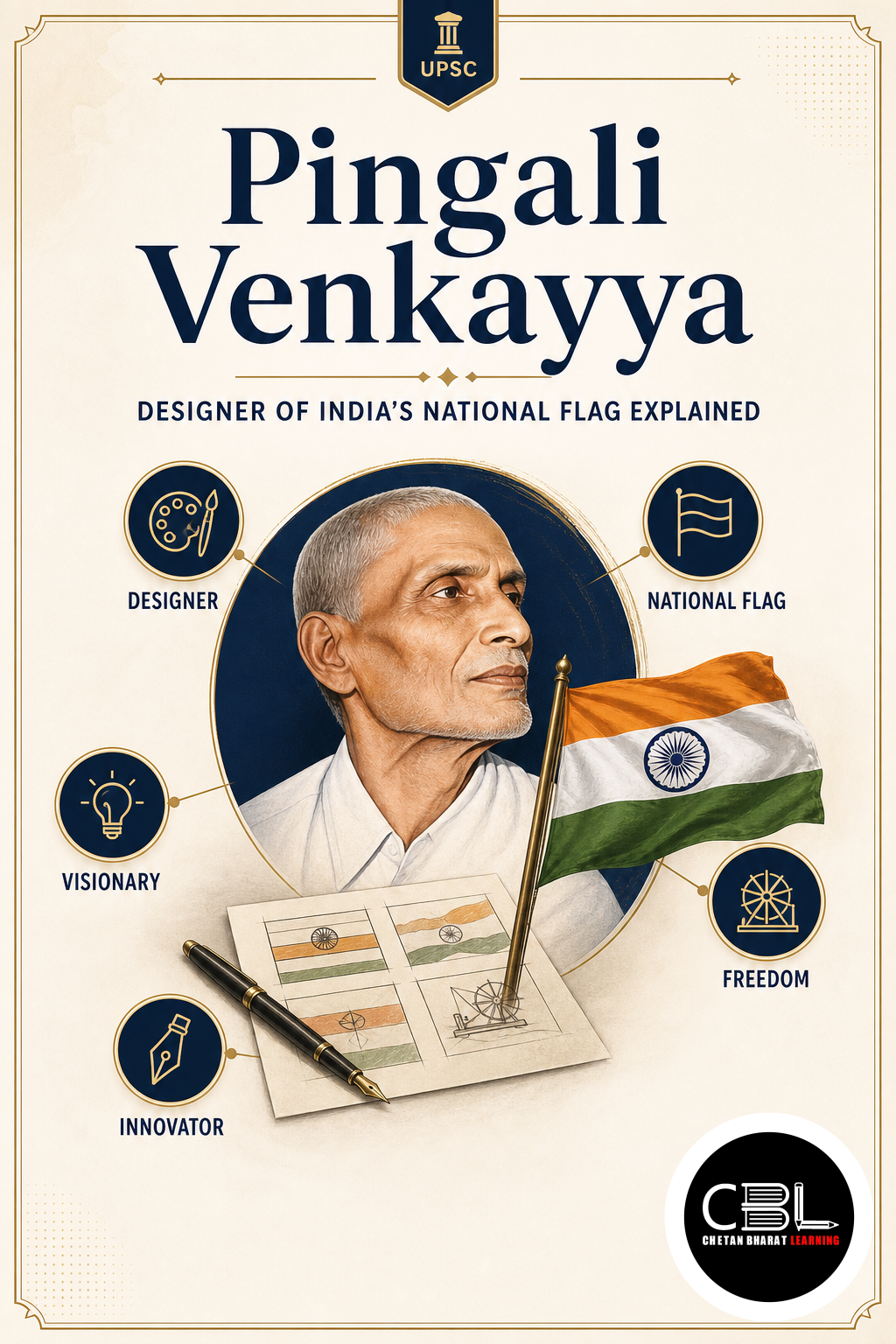
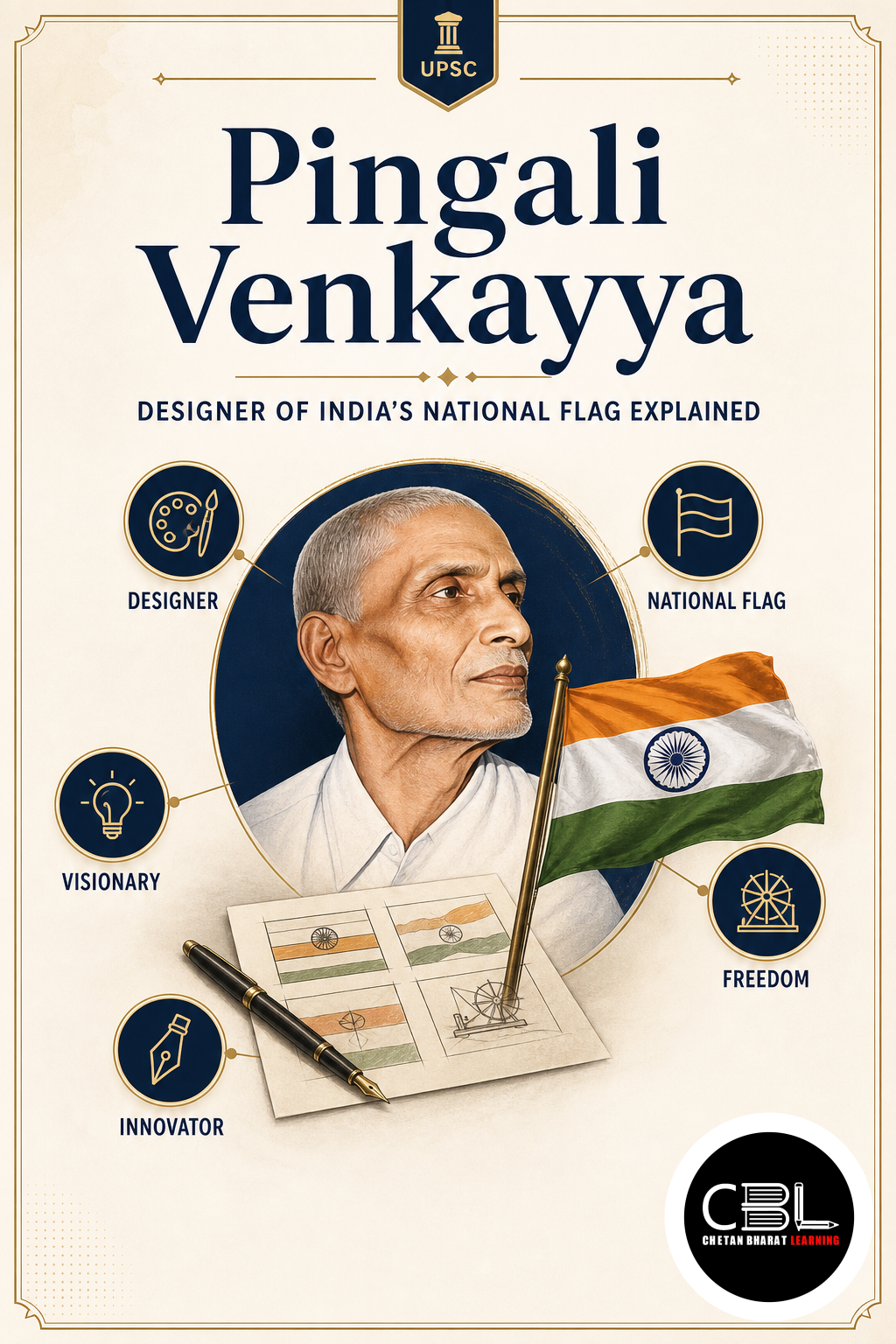
Pingali Venkayya (1876–1963) was an Indian freedom fighter, educationist, linguist and the designer of the original Indian National Flag. Born in Bhatlapenumarru village in present-day Andhra Pradesh, he became popularly known as ‘Jhanda Venkayya’.
He was a committed nationalist and a firm believer in Gandhian principles. During his service in the British Army, he met Mahatma Gandhi in Africa, an interaction that influenced his later contributions to the freedom movement.
Why is Pingali Venkayya in News?
Pingali Venkayya is in the news because the Prime Minister paid tributes to him on his 150th birth anniversary, recognising his contribution to India’s freedom struggle and the National Flag.
His legacy remains significant in understanding the evolution of India’s national symbols and the contributions of freedom fighters.
Key Features
- Freedom movement: Participated in the Vande Mataram Movement, Home Rule Movement and Andhrodyam between 1906 and 1922.
- National Flag: Presented several flag designs before the Indian National Congress; in 1921, Gandhi endorsed his design during the Congress session at Vijayawada.
- Final National Flag: On 22 July 1947, the Constituent Assembly adopted the present National Flag by replacing the Charkha with the Ashoka Chakra while retaining the tricolour design inspired by Venkayya’s original concept.
- Scholar and researcher: Earned recognition as ‘Diamond Venkayya’ for setting a record in diamond mining and authored the book ‘The Mother of Diamonds’ in 1955.
- Andhrodyam: Supported the political campaign seeking a separate state for Telugu-speaking people in British India.
Challenges
- Historical awareness: Many important personalities receive limited public attention despite their significant contributions.
- Documentation: Continued research and dissemination help preserve the legacy of freedom fighters.
- Cultural education: Greater awareness strengthens understanding of India’s national symbols.
- UPSC relevance: Personalities associated with the National Flag and freedom movement are frequently asked in examinations.
- Revision: Aspirants should regularly revise important personalities through the History current affairs section.
Way Forward
Remembering the contributions of Pingali Venkayya strengthens appreciation for India’s freedom struggle and the evolution of its national symbols. Educational initiatives and public commemorations can ensure that future generations remain aware of such contributions.
For UPSC, candidates should remember his role in designing the original National Flag, Gandhi’s endorsement in 1921, the Constituent Assembly’s adoption of the present flag in 1947 and his association with the Andhrodyam movement.
Prelims Practice Corner
Q1. Pingali Venkayya is best known as the:
- a) First President of INC
- b) Designer of the original Indian National Flag
- c) Founder of the Home Rule League
- d) First Governor-General of India
Answer: b) Designer of the original Indian National Flag
Q2. Pingali Venkayya was popularly known as:
- a) Andhra Kesari
- b) Jhanda Venkayya
- c) Deshbandhu
- d) Lokmanya
Answer: b) Jhanda Venkayya
Q3. Mahatma Gandhi endorsed Pingali Venkayya’s flag design during the INC session held at:
- a) Karachi
- b) Lahore
- c) Vijayawada
- d) Nagpur
Answer: c) Vijayawada
Q4. The Constituent Assembly adopted the present form of the National Flag on:
- a) 15 August 1947
- b) 26 January 1950
- c) 22 July 1947
- d) 9 December 1946
Answer: c) 22 July 1947
Q5. Which symbol replaced the Charkha in the National Flag adopted by the Constituent Assembly?
- a) Lion Capital
- b) Ashoka Chakra
- c) Lotus
- d) Dharma Wheel of Konark
Answer: b) Ashoka Chakra
Mains Practice Questions
Q1. Discuss the contribution of Pingali Venkayya to India’s freedom struggle and the evolution of the National Flag. (10 Marks)
Answer Structure
- Intro: Introduce Pingali Venkayya.
- Body: Role in the freedom movement, flag design, Gandhi’s endorsement and Constituent Assembly adoption.
- Conclusion: Highlight his enduring contribution to India’s national identity.
Q2. Explain the significance of national symbols in strengthening unity and constitutional values in India. (15 Marks)
Answer Structure
- Intro: Define national symbols.
- Body: Historical evolution, constitutional importance, role in nation-building and civic values.
- Conclusion: Emphasise preservation of national heritage.
FAQs on Pingali Venkayya
Who was Pingali Venkayya?
Pingali Venkayya was an Indian freedom fighter, educationist, linguist and the designer of the original Indian National Flag.
Why is Pingali Venkayya called ‘Jhanda Venkayya’?
He earned the popular title because of his pioneering contribution to designing the original Indian National Flag.
When was the present National Flag adopted?
The Constituent Assembly adopted the present form of the National Flag on 22 July 1947 by replacing the Charkha with the Ashoka Chakra while retaining the tricolour design inspired by Pingali Venkayya.
Related Current Affairs
Preparing for UPSC, PCS or HCS?
Talk to a mentor at Chetan Bharat Learning, Chandigarh. Free guidance on choosing the right exam and building a study plan.
Chat on WhatsAppCall 97793 53345UPSC / IAS / PCS coaching in Chandigarh · Trusted by aspirants across Punjab & Haryana
Leave a Reply
You must be logged in to post a comment.