
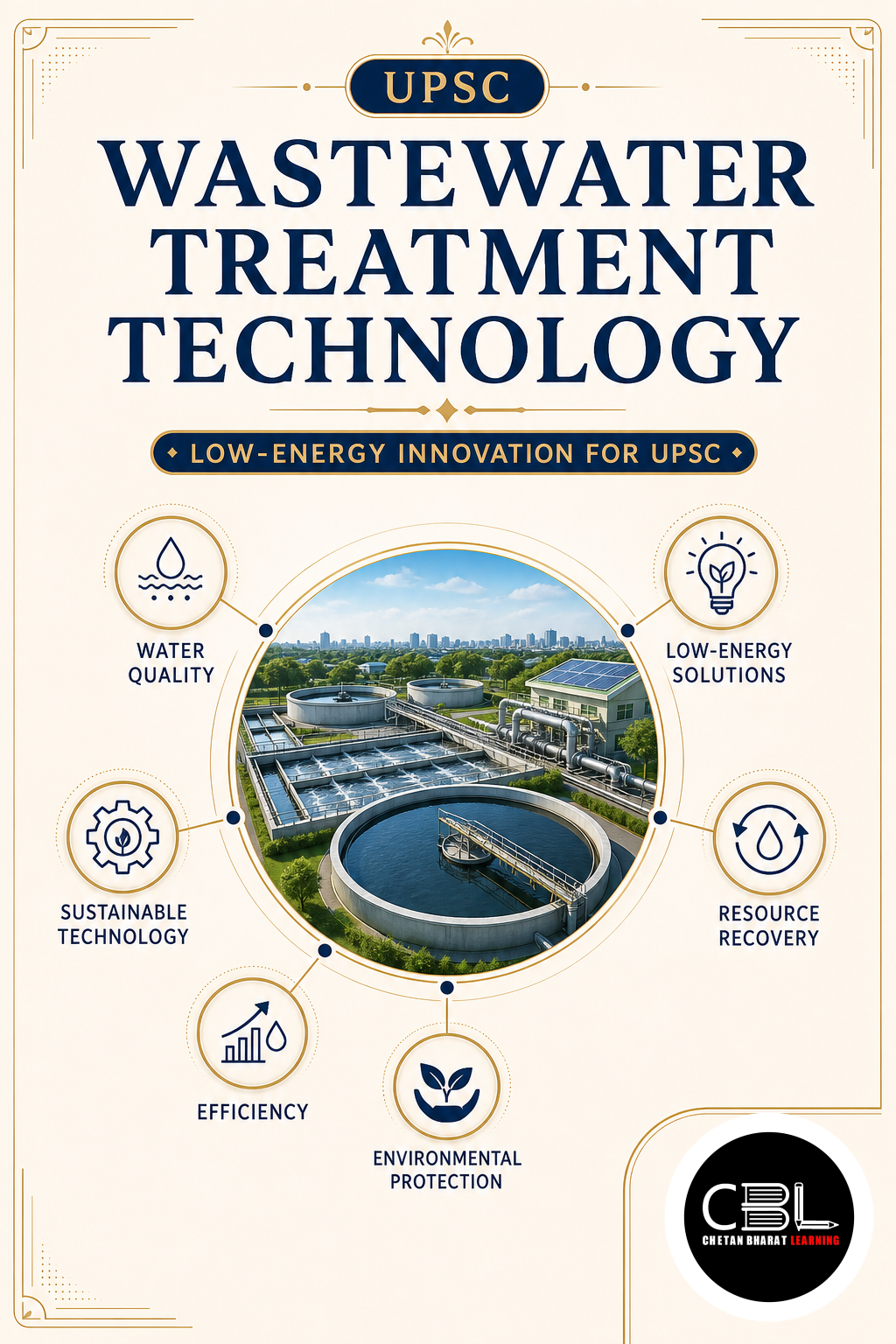

UPSC Mapping
| Exam | Topics |
|---|---|
| Prelims | PEF, SBR, iSTAR Reactor, Water Technology Initiative |
| Mains | GS Paper III – Science & Technology, Environmental Conservation |
Article
What is Wastewater Treatment Technology?
Wastewater Treatment Technology is a low-energy integrated treatment system developed by BITS Pilani, Hyderabad for treating complex wastewater generated during biopharmaceutical and vaccine manufacturing. It replaces conventional chemical treatment and steam autoclaving with a more energy-efficient process.
The technology combines three complementary treatment stages that eliminate harmful microorganisms, remove organic pollutants and convert residual sludge into renewable energy.
Why is it in the News?
Researchers at BITS Pilani, Hyderabad recently developed this indigenous low-energy wastewater treatment system for pharmaceutical industries, aiming to reduce energy consumption, improve wastewater treatment efficiency and promote sustainable industrial practices in India.
Key Features
- Pulsed Electric Field (PEF): Applies high-voltage electrical pulses to eliminate live production bacteria and destroy antibiotic-resistant genes without relying on energy-intensive chemical or steam sterilisation.
- Sequencing Batch Reactor (SBR): Uses naturally occurring microorganisms together with membrane filtration to remove the remaining organic pollutants from wastewater.
- iSTAR Reactor: A patented anaerobic reactor that converts about 85% of the remaining sludge into methane-rich biogas capable of powering the treatment facility.
- Low-energy process: Replaces conventional chemical treatment and steam autoclaving, reducing operational energy requirements.
- Industrial application: Specifically designed for complex effluents generated by biopharmaceutical and vaccine manufacturing industries.
Significance
- Energy efficiency: Reduces dependence on expensive, energy-intensive treatment methods.
- Pollution control: Effectively removes harmful microorganisms, antibiotic-resistant genes and organic pollutants.
- Resource recovery: Produces methane-rich biogas from sludge, improving energy self-sufficiency.
- Indigenous innovation: Demonstrates India’s growing capability to develop advanced water-treatment technologies.
Water Technology Initiative (WTI)
The Water Technology Initiative is a demand-driven research and development programme under the Department of Science & Technology (DST).
- Objective: Develop indigenous technological solutions to address water scarcity and water contamination.
- Approach: Supports research, innovation and deployment of advanced water treatment and conservation technologies.
- Funding: The BITS Pilani wastewater treatment project is supported under this initiative.
Way Forward
Scaling indigenous low-energy wastewater treatment technologies can reduce industrial pollution while improving resource efficiency. Wider adoption across pharmaceutical and biotechnology sectors will strengthen sustainable manufacturing practices.
Continued support for research under the Water Technology Initiative and collaboration between academia, industry and government can accelerate the deployment of innovative water treatment solutions. Official information is available through the Department of Science & Technology and BITS Pilani.
Prelims Practice Corner
- Q1. The low-energy wastewater treatment technology was developed by?
Answer: BITS Pilani, Hyderabad. - Q2. Which stage eliminates live bacteria and antibiotic-resistant genes?
Answer: Pulsed Electric Field (PEF). - Q3. The Sequencing Batch Reactor (SBR) primarily uses?
Answer: Natural microorganisms and membrane filtration. - Q4. Approximately what percentage of residual sludge is converted into methane-rich biogas by the iSTAR reactor?
Answer: 85%. - Q5. The Water Technology Initiative operates under which ministry/department?
Answer: Department of Science & Technology.
Mains Practice Questions
- Q1. Discuss the significance of indigenous low-energy wastewater treatment technologies in promoting sustainable industrial development in India. (10 marks)
Answer Structure:- Intro: Explain the need for industrial wastewater treatment.
- Body: Technology features, environmental benefits, energy efficiency and resource recovery.
- Conclusion: Emphasise innovation-led sustainable development.
- Q2. Examine the role of research and development in addressing India’s water scarcity and industrial pollution challenges. (15 marks)
Answer Structure:- Intro: Highlight water security challenges.
- Body: Indigenous innovation, DST initiatives, wastewater treatment technologies and policy support.
- Conclusion: Stress the importance of technology-driven water sustainability.
FAQs on Wastewater Treatment Technology
- What is the new wastewater treatment technology developed by BITS Pilani?
It is a low-energy three-stage integrated system that combines Pulsed Electric Field (PEF), Sequencing Batch Reactor (SBR) and the patented iSTAR reactor to treat complex industrial wastewater. - What is the function of the iSTAR reactor?
The patented anaerobic iSTAR reactor converts about 85% of residual sludge into methane-rich biogas, which can be used to power the treatment facility. - What is the Water Technology Initiative?
The Water Technology Initiative is a demand-driven research and development programme under the Department of Science & Technology that supports indigenous technologies to address water scarcity and contamination.
Related Current Affairs
Preparing for UPSC, PCS or HCS?
Talk to a mentor at Chetan Bharat Learning, Chandigarh. Free guidance on choosing the right exam and building a study plan.
Chat on WhatsAppCall 97793 53345UPSC / IAS / PCS coaching in Chandigarh · Trusted by aspirants across Punjab & Haryana
Leave a Reply
You must be logged in to post a comment.