
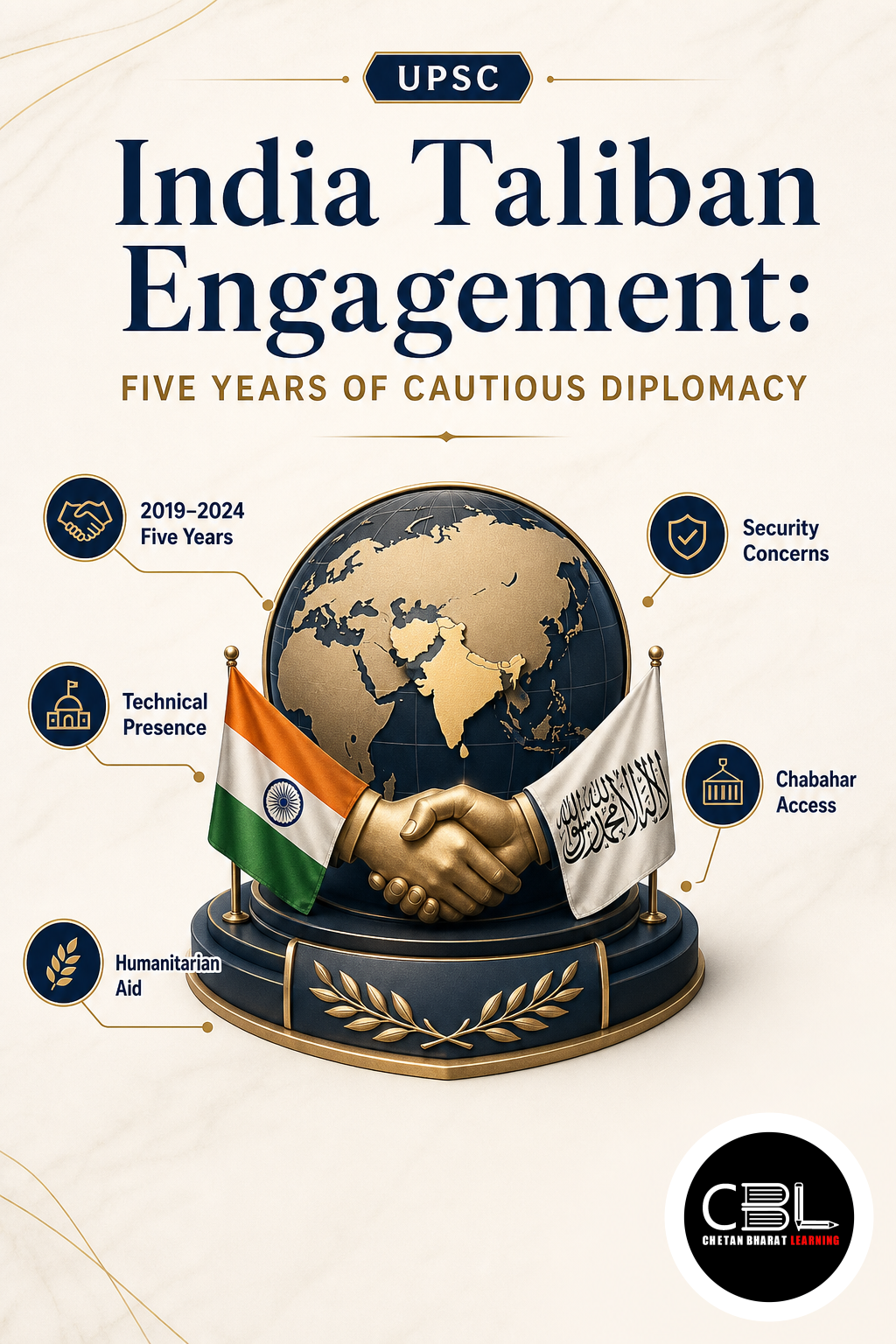
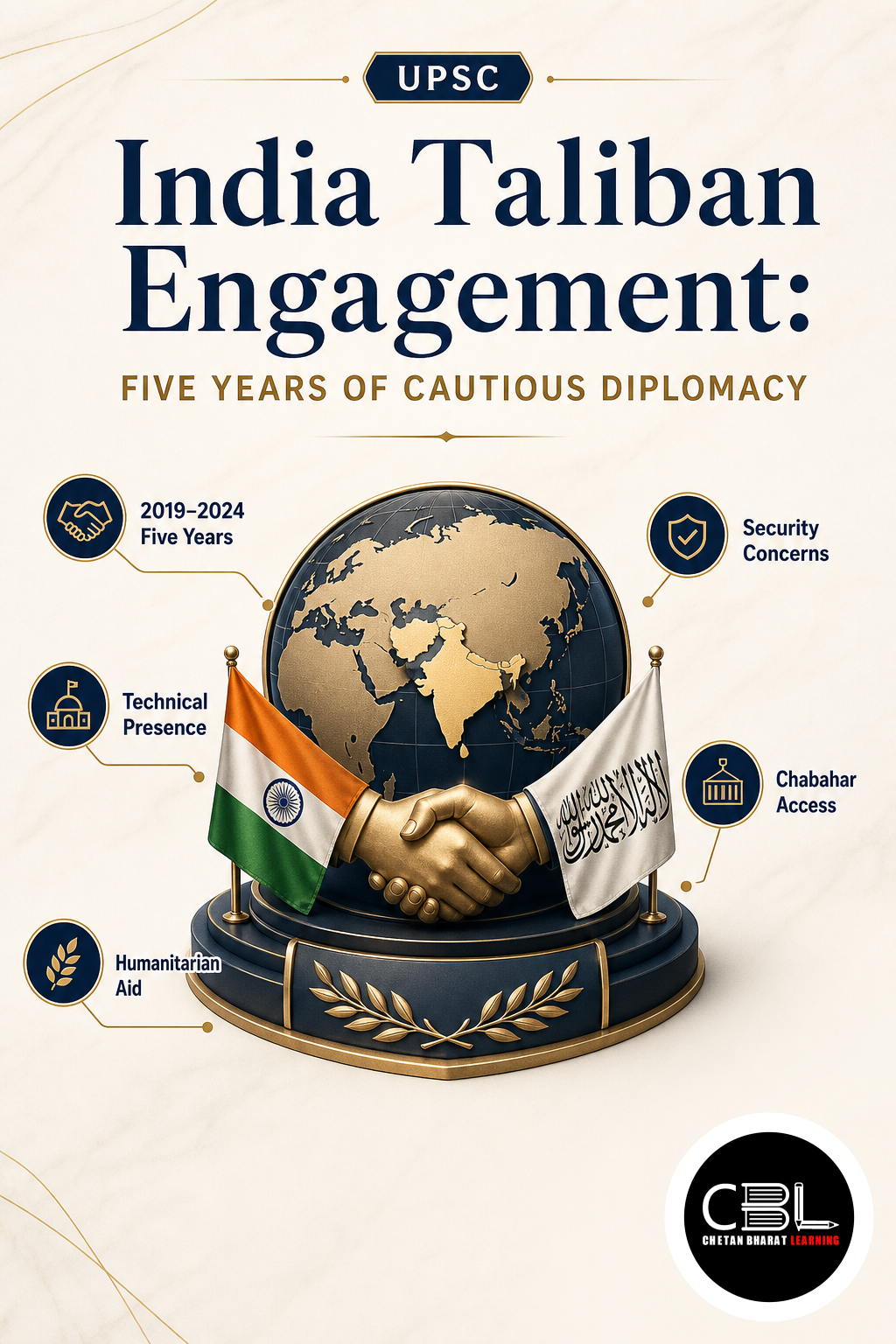
India Taliban Engagement has deepened five years after the Taliban’s return to power in August 2021, with India conducting business with the Islamic regime without granting official diplomatic recognition. The ‘victory day’ celebration at the Afghan embassy in New Delhi, attended by Indian and foreign diplomats, marks a significant shift in the India-Taliban relationship.
UPSC Mapping
Prelims
- International Relations
Mains
- GS Paper 2 (International Relations & Foreign Policy)
Quick Facts
| Key Event | Taliban victory day (Aug 15) |
|---|---|
| India’s Status | No formal recognition |
What is India Taliban Engagement?
India Taliban Engagement refers to India’s diplomatic, humanitarian, and strategic interactions with the Taliban regime in Afghanistan, which returned to power in August 2021. India has not granted formal diplomatic recognition to the Taliban but has maintained a working relationship, conducting business with the Islamic regime. The Afghan embassy in New Delhi has been under Taliban control since 2021, and Taliban Foreign Minister Amir Khan Muttaqi made a high-profile visit to New Delhi in October 2023.
India’s engagement is driven by several factors: the reality of Taliban control, security concerns (terrorism and anti-India groups), humanitarian assistance, and connectivity through Chabahar Port. India has provided wheat, medicines, and other aid to Afghanistan.
Why is India Taliban Engagement in News?
India Taliban Engagement is in the news because the Afghan embassy in New Delhi celebrated ‘victory day’ on August 15, marking the Taliban’s takeover five years ago. The event, attended by Indian diplomats and about two dozen foreign diplomats, signals that the India-Taliban relationship is increasingly moving away from the shadows.
While Indian officials have called this a case of ‘cautious engagement,’ others have criticised it as ‘opportunistic.’ The debate highlights India’s strategic dilemma: balancing its values (human rights, democracy) with its interests (security, connectivity, counter-terrorism).
Key Features of India Taliban Engagement
- No Formal Recognition: India has not granted de jure recognition but conducts de facto engagement.
- Humanitarian Assistance: India has provided wheat, medicines, and other aid.
- Counter-Terrorism: Engagement aims to prevent Afghan territory from being used for anti-India activities.
- Connectivity: Chabahar Port is crucial for access to Afghanistan and Central Asia.
- Strategic Balancing: India engages with the Taliban while maintaining relations with other regional actors.
Challenges in India Taliban Engagement
- Human Rights Concerns: Taliban restrictions on women’s education and employment create a values vs interests dilemma.
- Terrorism: Afghanistan must not become a base for anti-India terrorism.
- Pakistan Factor: The Taliban’s historical links with Pakistan worry India.
- China Factor: China is expanding its security and economic interests in Afghanistan.
- Diplomatic Dilemma: Balancing strategic interests with democratic values and human rights concerns.
Way Forward for India Taliban Engagement
To navigate India Taliban Engagement, India should maintain calibrated engagement, keeping communication channels open. Humanitarian assistance should continue to build people-centric goodwill. Counter-terrorism must remain a red line—no Afghan territory for anti-India activities. Strengthening Chabahar connectivity and coordinating with regional partners (Iran, Central Asian states) is essential.
India should maintain a human-rights dialogue without endorsing the regime. Monitoring China-Pakistan dynamics and protecting strategic autonomy are critical.
Prelims Practice Corner
Q1. When did the Taliban return to power in Afghanistan?
- (a) 2019
- (b) 2020
- (c) 2021
- (d) 2022
Answer
(c) The Taliban returned to power in August 2021.
Q2. Has India formally recognised the Taliban?
- (a) Yes
- (b) No
- (c) Partial recognition
- (d) Recognition through UN
Answer
(b) India has not granted formal recognition.
Q3. What is Chabahar Port’s significance for India’s Afghanistan engagement?
- (a) It is in Afghanistan
- (b) It provides connectivity to Afghanistan and Central Asia
- (c) It is a military base
- (d) It is a trade agreement
Answer
(b) Chabahar provides connectivity to Afghanistan and Central Asia.
Q4. What is a key concern in India’s Taliban engagement?
- (a) Trade deficit
- (b) Afghanistan becoming a base for anti-India terrorism
- (c) Cultural differences
- (d) Language barriers
Answer
(b) Preventing Afghanistan from becoming a base for anti-India terrorism is a key concern.
Q5. What is the difference between de facto and de jure recognition?
- (a) De jure is diplomatic; de facto is military
- (b) De facto is engagement without formal recognition; de jure is formal recognition
- (c) Both are the same
- (d) De facto is recognition by the UN
Answer
(b) De facto is engagement without formal recognition; de jure is formal recognition.
Mains Practice Questions
Q1. Critically analyse India’s policy of engagement with the Taliban regime in Afghanistan. (250 words, 15 marks)
- Intro: Introduce India’s engagement with the Taliban.
- Body: Discuss the rationale: security, connectivity, humanitarian aid. Analyse the challenges: human rights, terrorism, Pakistan factor. Suggest a calibrated approach.
- Conclusion: Emphasise the need to balance interests with values.
Q2. What is the difference between de facto and de jure recognition in international relations? (150 words, 10 marks)
- Intro: Define the two terms.
- Body: De facto recognition is engagement without formal recognition; de jure recognition is formal recognition of a government. India’s Taliban policy is an example of de facto engagement.
- Conclusion: Conclude that de facto engagement allows for operational interactions.
FAQs on India Taliban Engagement
Why is India engaging with the Taliban?
For security, humanitarian assistance, and connectivity interests.
Has India recognised the Taliban?
No, India has not granted formal diplomatic recognition but engages de facto.
What are the risks of India’s engagement?
Risks include legitimising a regime with poor human rights records and the possibility of Afghanistan becoming a base for anti-India terrorism.
Related Current Affairs
Preparing for UPSC, PCS or HCS?
Talk to a mentor at Chetan Bharat Learning, Chandigarh. Free guidance on choosing the right exam and building a study plan.
Chat on WhatsAppCall 97793 53345UPSC / IAS / PCS coaching in Chandigarh · Trusted by aspirants across Punjab & Haryana
Leave a Reply
You must be logged in to post a comment.