
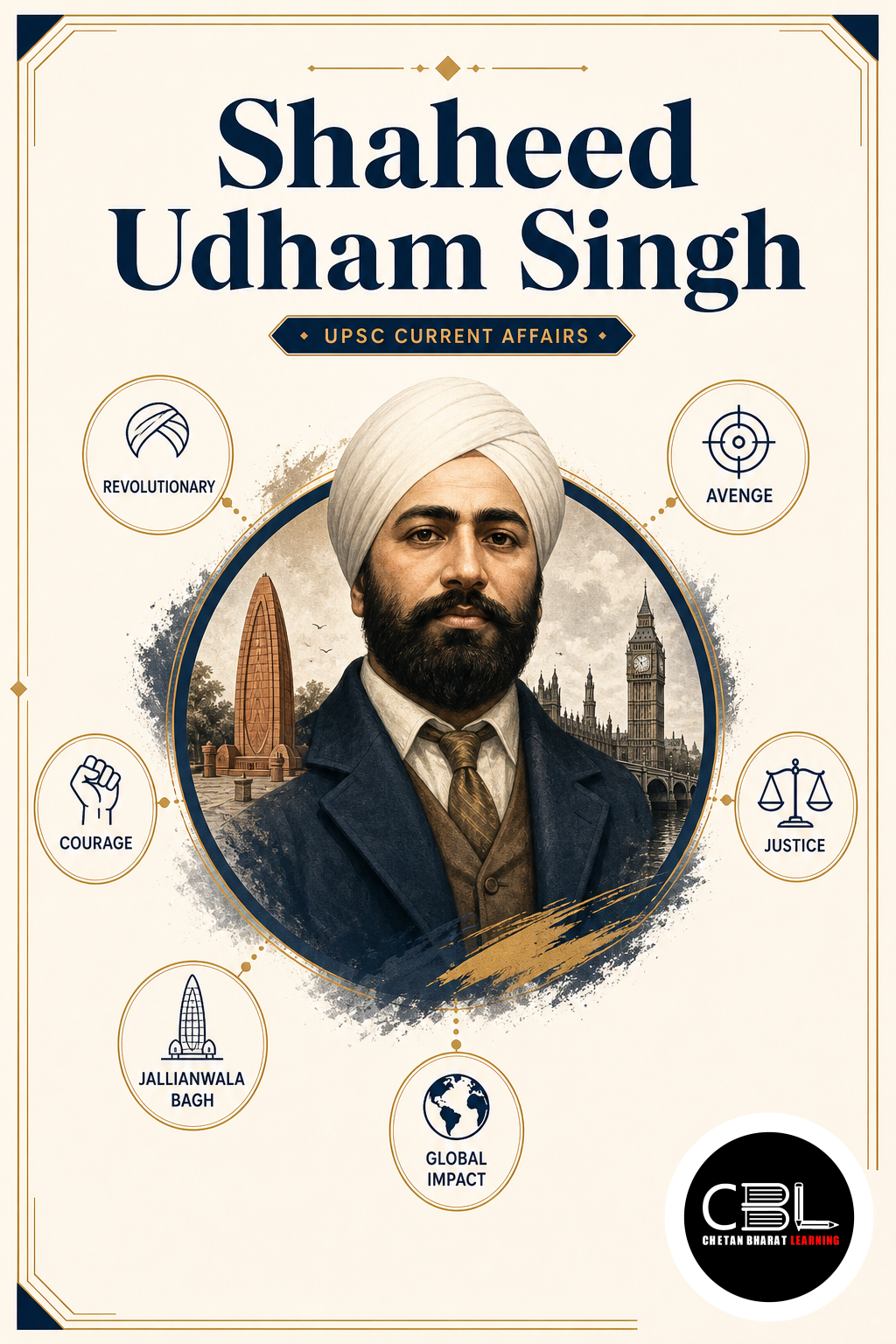

UPSC Mapping
Prelims
- Revolutionary Movement
- Jallianwala Bagh
- Ghadar Party
Mains
- GS Paper I – Modern Indian History
Quick Facts
| Born | 1899, Sunam (Punjab) |
|---|---|
| Martyrdom | 31 July 1940 |
| Known For | Avenging the Jallianwala Bagh Massacre |
Shaheed Udham Singh is remembered as one of India’s most courageous revolutionaries who sacrificed his life to avenge the 1919 Jallianwala Bagh massacre. On his martyrdom day, Prime Minister Narendra Modi paid tribute to his courage and sacrifice, highlighting his enduring legacy in India’s freedom movement. Aspirants can also explore the daily current affairs archive for more Modern Indian History topics.
What is the significance of Shaheed Udham Singh?
Shaheed Udham Singh (1899–1940) was an Indian revolutionary who avenged the Jallianwala Bagh massacre by assassinating Michael O’Dwyer, the former Lieutenant Governor of Punjab, in London in March 1940. He regarded O’Dwyer as responsible for supporting the brutal massacre of unarmed civilians at Amritsar in 1919.
His actions became a symbol of resistance against British colonial rule and inspired generations of Indians in the struggle for independence.
Why is Shaheed Udham Singh in News?
Prime Minister Narendra Modi paid tribute to Shaheed Udham Singh on his martyrdom day, describing his life as an enduring example of courage, patriotism and sacrifice.
The occasion has renewed public interest in his contribution to India’s revolutionary movement and the legacy of the Jallianwala Bagh massacre.
Key Features
Udham Singh’s life reflects determination, sacrifice and national unity.
- Early life: Born as Sher Singh in Sunam, Punjab; he was raised at the Central Khalsa Orphanage in Amritsar, where he was renamed Udham Singh.
- Jallianwala Bagh impact: The 1919 massacre deeply influenced him and shaped his resolve to fight British colonial rule.
- Revolutionary associations: He joined the Ghadar Party to mobilise overseas Indians and later worked with the Hindustan Socialist Republican Association (HSRA), influenced by Bhagat Singh.
- Caxton Hall assassination: In March 1940, he assassinated Michael O’Dwyer at Caxton Hall, London, as an act of retribution for the Jallianwala Bagh massacre.
- Symbol of unity: During imprisonment, he adopted the name Ram Mohammad Singh Azad, symbolising unity among Hindus, Muslims and Sikhs in the anti-colonial struggle.
Martyrdom and Legacy
After his arrest, Udham Singh undertook a 42-day hunger strike in Brixton Prison. He was executed by hanging at Pentonville Prison on 31 July 1940.
- Martyrdom: Executed for the assassination of Michael O’Dwyer.
- Repatriation: His mortal remains were brought back to India in 1974.
- National inspiration: He remains an enduring symbol of sacrifice, justice and resistance against colonial oppression.
Read more Modern History topics in the current affairs section.
Way Forward
Studying the lives of revolutionaries such as Shaheed Udham Singh helps understand the diverse streams of India’s freedom movement, including constitutional, revolutionary and mass-based struggles. His life also highlights the importance of national unity and sacrifice in the fight against colonialism.
For UPSC aspirants, Shaheed Udham Singh should be studied alongside the Jallianwala Bagh massacre, Ghadar Party, HSRA and Bhagat Singh as interconnected themes of Modern Indian History. Official information is available through the Azadi Ka Amrit Mahotsav.
Prelims Practice Corner
Q1. Shaheed Udham Singh assassinated whom in 1940?
- a) General Dyer
- b) Michael O’Dwyer
- c) Lord Irwin
- d) Lord Reading
Answer: (b) He assassinated Michael O’Dwyer at Caxton Hall, London.
Q2. Shaheed Udham Singh was born with which name?
- a) Udham Singh
- b) Sher Singh
- c) Ram Singh
- d) Kartar Singh
Answer: (b) Sher Singh.
Q3. Udham Singh was associated with which revolutionary organisation after returning to India in 1927?
- a) Anushilan Samiti
- b) HSRA
- c) Forward Bloc
- d) Indian National Army
Answer: (b) HSRA.
Q4. The name ‘Ram Mohammad Singh Azad’ symbolised?
- a) Provincial autonomy
- b) Religious harmony and national unity
- c) Separate electorates
- d) Constitutional reforms
Answer: (b) Religious harmony and national unity.
Q5. Shaheed Udham Singh was executed at?
- a) Cellular Jail
- b) Brixton Prison
- c) Pentonville Prison
- d) Lahore Central Jail
Answer: (c) Pentonville Prison.
Mains Practice Questions
Q1. Assess the contribution of Shaheed Udham Singh to the revolutionary phase of India’s freedom struggle. (10 marks)
Answer Structure:
- Intro: Introduce Udham Singh and his historical context.
- Body: Jallianwala Bagh, revolutionary organisations, assassination of Michael O’Dwyer and symbolism.
- Conclusion: Highlight his enduring legacy in India’s freedom movement.
Q2. Discuss the role of revolutionary nationalism in India’s struggle for independence with special reference to Shaheed Udham Singh. (15 marks)
Answer Structure:
- Intro: Explain revolutionary nationalism.
- Body: Objectives, organisations, methods, contributions and limitations.
- Conclusion: Place revolutionary movements within the broader freedom struggle.
FAQs on Shaheed Udham Singh
Why is Shaheed Udham Singh remembered?
He is remembered for assassinating Michael O’Dwyer in 1940 to avenge the Jallianwala Bagh massacre and for his unwavering commitment to India’s freedom struggle.
What was the significance of the name ‘Ram Mohammad Singh Azad’?
The name symbolised unity among India’s major religions—Hinduism, Islam and Sikhism—along with the ideal of freedom (‘Azad’) during the anti-colonial struggle.
Which revolutionary organisations was Shaheed Udham Singh associated with?
He was associated with the Ghadar Party and later worked with the Hindustan Socialist Republican Association (HSRA), drawing inspiration from Bhagat Singh.
Related Current Affairs
Preparing for UPSC, PCS or HCS?
Talk to a mentor at Chetan Bharat Learning, Chandigarh. Free guidance on choosing the right exam and building a study plan.
Chat on WhatsAppCall 97793 53345UPSC / IAS / PCS coaching in Chandigarh · Trusted by aspirants across Punjab & Haryana
Leave a Reply
You must be logged in to post a comment.