

UPSC Mapping
| Prelims | Arms Act, 1959, Arms Rules 2016, Crowd Control Measures |
|---|---|
| Mains | GS Paper II – Governance, Human Rights and Police Reforms |
| Weapon Type | Non-lethal Crowd Control Weapon |
|---|---|
| Recent Context | Supreme Court Observation |
| Primary Use | Crowd Control |
| Constitutional Link | Article 21 |
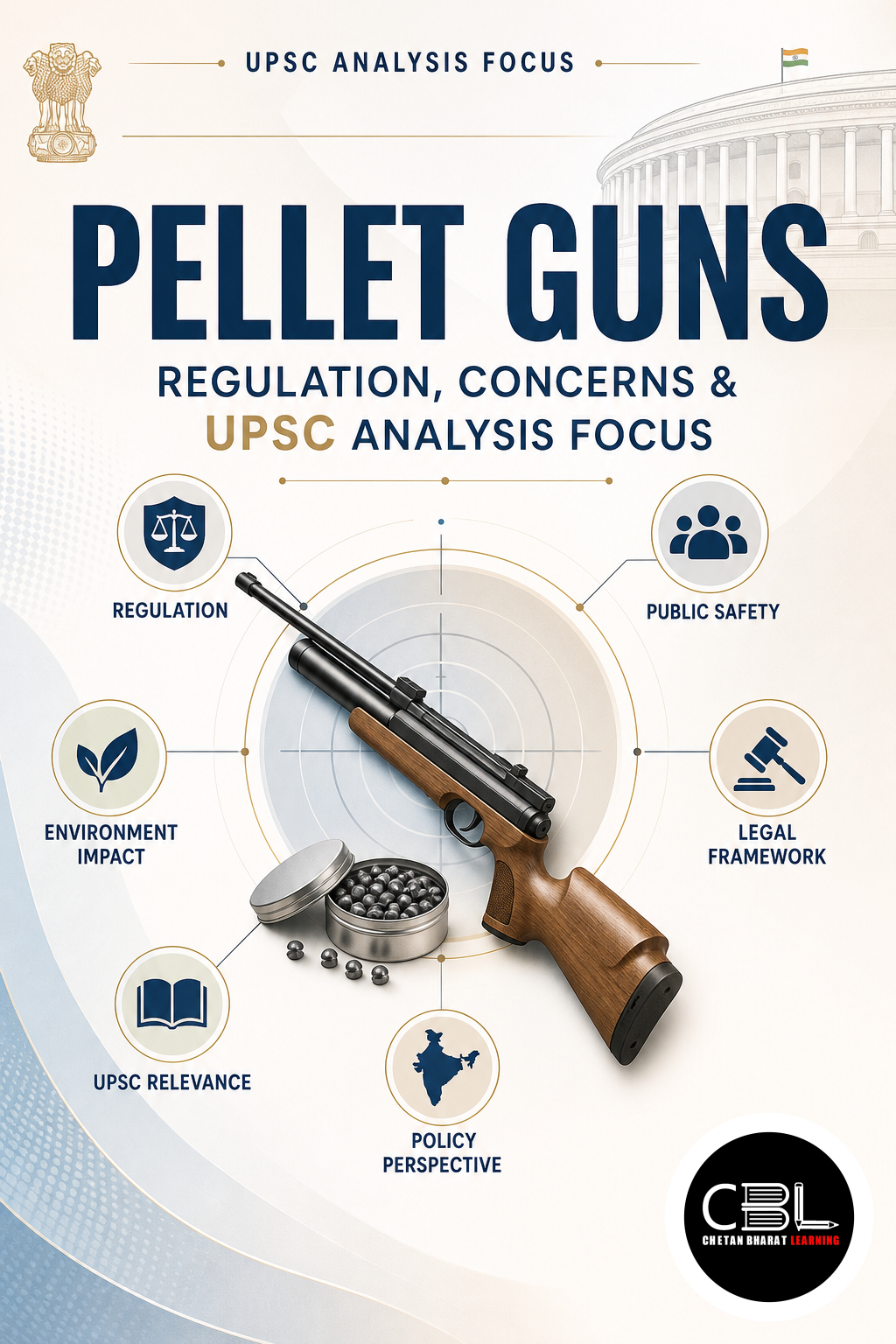
What are Pellet Guns?
Pellet Guns are a special form of air guns designed as less-lethal weapons for crowd control. They are used by police and security forces in several countries to disperse violent gatherings while avoiding the use of conventional firearms.
A pellet gun cartridge contains hundreds of small lead pellets. When fired, the cartridge bursts and disperses these pellets over a wide area from a single point, making it effective for crowd dispersal but also increasing the risk of multiple injuries.
Why are Pellet Guns in News?
The Supreme Court recently observed that pellet guns cannot be prohibited as long as the existing government advisory permits their deployment in exceptional situations for crowd control. The Court clarified that any attempt to prohibit their use must challenge the legal provisions permitting such deployment as violating Article 21 of the Constitution.
The judgment has renewed debate regarding the balance between maintaining public order and protecting fundamental rights. Details of court proceedings can be accessed through the Supreme Court of India.
Legal Status of Pellet Guns
Pellet Guns are treated as non-lethal crowd-control equipment under India’s policing framework, although their deployment remains subject to operational guidelines.
The Rapid Action Force (RAF) manual includes pellet guns among non-lethal deterrents along with tear gas, rubber bullets and smoke grenades. They were introduced in Jammu and Kashmir in 2010 for crowd management, while plastic bullets were used during the 2021 farmers’ agitation.
Regulation of Pellet Guns in India
The use and regulation of pellet guns are influenced by multiple legal and administrative frameworks.
- Indian Arms Act, 1959: Regulates the manufacture, possession, sale and use of arms and ammunition across India.
- Arms Rules, 2016: Exempt air rifles and air pistols with muzzle energy up to 20 joules from licensing requirements.
- BPR&D Standard Operating Procedures (2011): Require force to be proportionate and used only when absolutely necessary.
- Crowd control guidance: The SOPs do not specifically recommend pellet guns among approved non-lethal weapons but mention plastic pellet anti-riot guns.
- Operational deployment: Security agencies are expected to follow established command procedures before using force.
Concerns Regarding Pellet Guns
The deployment of pellet guns has generated significant legal, humanitarian and human rights concerns.
- Human rights implications: Injuries caused by pellet guns have raised concerns regarding the right to life and personal liberty under Article 21.
- International standards: The United Nations Guidance on Less-Lethal Weapons emphasises necessity, proportionality and reasonableness in law enforcement.
- Serious injuries: Pellet impacts may result in permanent eye injuries, disability and long-term health consequences.
- Public trust: Excessive or indiscriminate use may weaken confidence in democratic policing and law enforcement institutions.
- Operational ambiguity: Variations in deployment practices create uncertainty regarding accountability and proportional use of force.
Way Forward
A graduated use-of-force framework should ensure that pellet guns are deployed only as a measure of last resort after exhausting negotiation, water cannons, tear smoke and other less harmful crowd-control methods.
Comprehensive Standard Operating Procedures, command-level authorisation, regular training and independent review mechanisms can strengthen accountability while protecting public safety and constitutional rights. Periodic policy review with inputs from police experts, human rights institutions and civil society can improve crowd-control practices.
Prelims Practice Corner
- Q1. Pellet guns are primarily classified as:
- (a) Assault weapons
- (b) Less-lethal crowd-control weapons
- (c) Automatic firearms
- (d) Explosive devices
Answer: (b) Less-lethal crowd-control weapons.
- Q2. Which legislation governs the manufacture and possession of arms in India?
- (a) Police Act, 1861
- (b) Arms Act, 1959
- (c) CrPC
- (d) National Security Act
Answer: (b) Arms Act, 1959.
- Q3. The constitutional provision most closely associated with the recent Supreme Court observation is:
- (a) Article 14
- (b) Article 19
- (c) Article 21
- (d) Article 32
Answer: (c) Article 21.
- Q4. Which organisation issued the 2011 Standard Operating Procedures on use of force by police?
- (a) NCRB
- (b) BPR&D
- (c) NIA
- (d) NHRC
Answer: (b) Bureau of Police Research and Development.
- Q5. Pellet guns were introduced in Jammu and Kashmir for crowd control in:
- (a) 2008
- (b) 2010
- (c) 2014
- (d) 2016
Answer: (b) 2010.
Mains Practice Questions
- Q1. Examine the legal and human rights issues associated with the use of pellet guns for crowd control in India. (10 marks)
- Intro: Define pellet guns and their role in crowd control.
- Body: Legal framework, Supreme Court observations, human rights concerns, international standards and reforms.
- Conclusion: Emphasise balancing public order with constitutional rights.
- Q2. Discuss the need for a proportionate use-of-force framework in democratic policing while ensuring effective crowd management. (15 marks)
- Intro: Explain the principle of proportional use of force.
- Body: Necessity, proportionality, SOPs, accountability, human rights safeguards and police reforms.
- Conclusion: Highlight humane, lawful and effective crowd-control mechanisms.
FAQs on Pellet Guns
What are Pellet Guns?
Pellet guns are less-lethal air guns that discharge multiple small pellets and are used by security forces for crowd-control operations in exceptional situations.
Why are Pellet Guns controversial?
They have been criticised because their use may result in severe injuries, raise human rights concerns and trigger debates regarding proportionality and constitutional protections.
Why are Pellet Guns important for UPSC?
The topic is relevant for governance, police reforms, human rights, Article 21, internal security and GS Paper II.
Related Current Affairs
Preparing for UPSC, PCS or HCS?
Talk to a mentor at Chetan Bharat Learning, Chandigarh. Free guidance on choosing the right exam and building a study plan.
Chat on WhatsAppCall 97793 53345UPSC / IAS / PCS coaching in Chandigarh · Trusted by aspirants across Punjab & Haryana
Leave a Reply
You must be logged in to post a comment.