

UPSC Mapping
- Prelims: Climatology, IMD, Extreme Weather Events
- Mains: GS Paper I – Physical Geography and GS Paper III – Disaster Management
Quick Facts
| Defined By | India Meteorological Department (IMD) |
|---|---|
| Rainfall Threshold | 10 cm or more in one hour |
| Typical Area | 20–30 sq. km |
| Common Region | Hilly Areas |
Cloudburst: Formation, Causes & UPSC Analysis
What is Cloudburst?
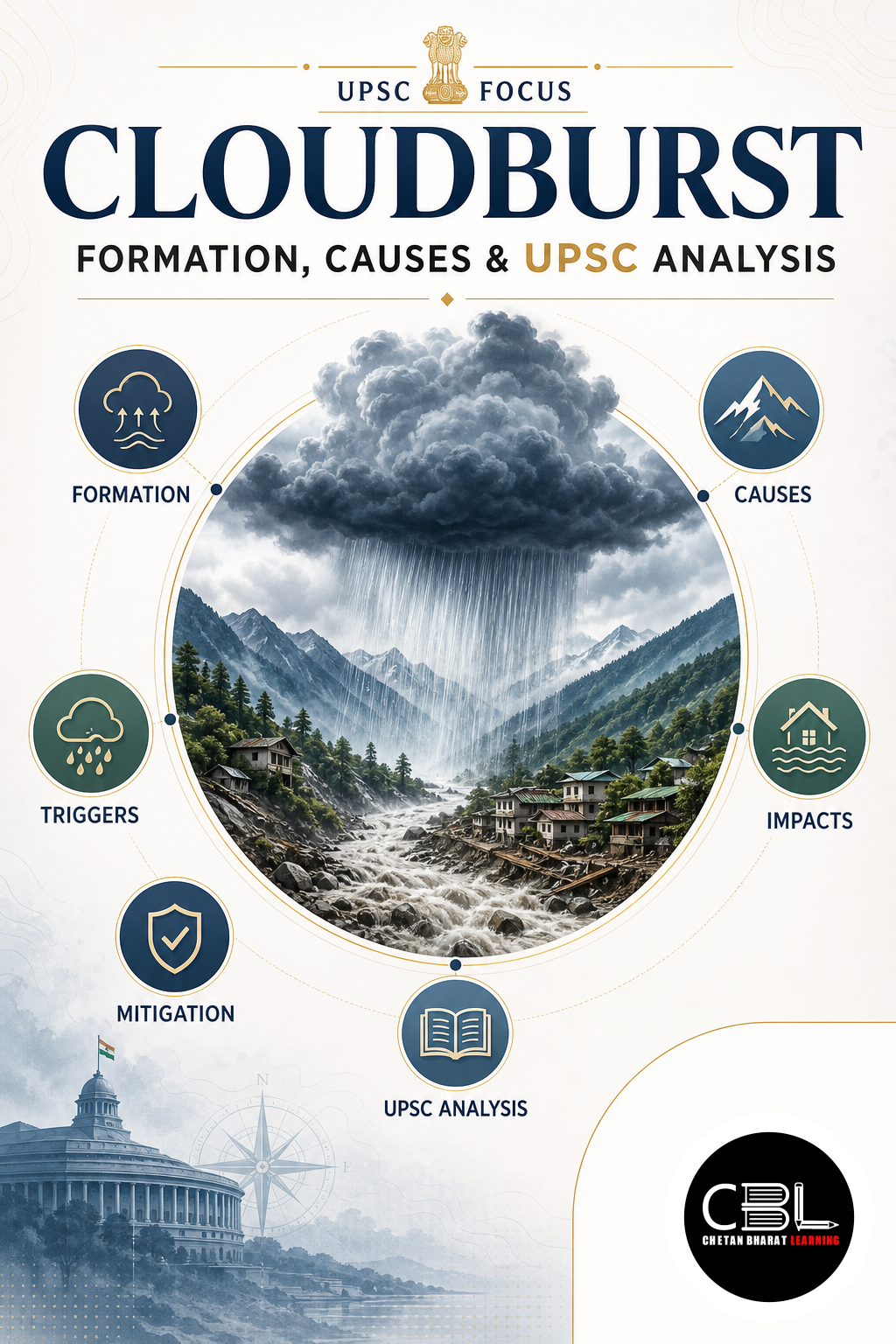
Cloudburst is an extreme weather phenomenon characterised by an intense and sudden spell of rainfall over a very small geographical area. According to the India Meteorological Department (IMD), a cloudburst occurs when a region of about 20–30 square kilometres receives 10 cm or more rainfall within one hour.
Although cloudbursts can occur over plains, they are most frequently observed in mountainous regions such as the Himalayas. The combination of steep terrain and moist monsoon winds makes these areas particularly vulnerable to intense localised rainfall.
Why is Cloudburst in News?
The India Meteorological Department recently clarified that the floods in Upper Assam were not caused by cloudbursts. It rejected media reports suggesting that cloudbursts in Assam and Nagaland had triggered the flooding.
The clarification emphasises the scientific distinction between a cloudburst and widespread heavy rainfall associated with monsoon systems. Official weather advisories are available through the India Meteorological Department.
How Does Cloudburst Form?
Cloudburst develops through a combination of atmospheric instability, abundant moisture and strong upward air currents.
The process generally begins when warm, moist air rises rapidly due to convection. In mountainous regions, this upward movement is enhanced through orographic lifting, where monsoon winds are forced to ascend steep mountain slopes.
As the air rises, it cools and condenses into towering cumulonimbus clouds, which may extend up to about 15 km in height. Water droplets continue growing inside these clouds while strong updrafts keep them suspended.
Eventually, the water droplets become too heavy for the upward air currents to support, or the updrafts weaken. The accumulated moisture then falls suddenly as an intense downpour over a limited area, producing a cloudburst.
Key Features of Cloudburst
- Highly localised rainfall: Rainfall occurs over a very small geographical area, generally around 20–30 sq. km.
- Extremely intense precipitation: Rainfall exceeds 10 cm within one hour according to IMD criteria.
- Short duration: The event usually lasts for a brief period but produces enormous rainfall intensity.
- Mountain association: Most cloudbursts occur in hilly regions because of orographic lifting.
- Rapid onset: The phenomenon develops suddenly, providing little warning for affected communities.
Impacts of Cloudburst
- Flash floods: Sudden rainfall rapidly increases surface runoff, triggering flash floods.
- Landslides: Saturated mountain slopes become unstable, leading to slope failures.
- Loss of life and property: Settlements located in valleys and river channels are highly vulnerable.
- Infrastructure damage: Roads, bridges and communication networks may be severely affected.
- Agricultural losses: Crops and fertile topsoil can be damaged by intense runoff.
Cloudburst vs Heavy Rainfall
Cloudbursts differ from ordinary heavy rainfall in both intensity and spatial extent. Heavy rainfall generally covers larger regions and may continue for several hours or days, whereas a cloudburst is confined to a very small area and occurs over a short duration.
This distinction is important for accurate weather forecasting, disaster response and public communication. Aspirants should revise related concepts through the geography and environment section.
Way Forward
Improving high-resolution weather forecasting, strengthening early warning systems and expanding Doppler Weather Radar coverage can reduce the impact of cloudbursts. Vulnerability mapping and resilient infrastructure are equally important in mountainous regions.
Greater coordination among meteorological agencies, disaster management authorities and local governments can improve preparedness and response to extreme weather events. Additional information is available through the National Disaster Management Authority.
Prelims Practice Corner
-
Q1. According to IMD, a cloudburst occurs when rainfall exceeds:
- (a) 5 cm in one hour
- (b) 10 cm in one hour
- (c) 20 cm in two hours
- (d) 30 cm in three hours
Answer: 10 cm or more in one hour.
-
Q2. Cloudbursts are most common in:
- (a) Coastal plains
- (b) Desert regions
- (c) Hilly regions
- (d) Plateaus
Answer: Hilly regions.
-
Q3. Orographic lifting refers to:
- (a) Air descending mountains
- (b) Air forced upward by mountains
- (c) Ocean currents
- (d) Cyclone formation
Answer: Air forced upward by mountains.
-
Q4. Cloudbursts are commonly associated with which cloud type?
- (a) Cirrus
- (b) Stratus
- (c) Cumulonimbus
- (d) Altostratus
Answer: Cumulonimbus.
-
Q5. Which organisation defines the operational criteria for cloudbursts in India?
- (a) ISRO
- (b) NDMA
- (c) IMD
- (d) CWC
Answer: India Meteorological Department.
Mains Practice Questions
-
Q1. Explain the mechanism of cloudburst formation and discuss its implications for disaster management in India. (10 marks)
Answer Structure
- Intro: Define cloudburst.
- Body: Formation process, causes, impacts, forecasting challenges and mitigation.
- Conclusion: Emphasise resilient disaster preparedness.
-
Q2. Discuss why Himalayan regions are particularly vulnerable to cloudbursts and suggest measures to reduce disaster risk. (15 marks)
Answer Structure
- Intro: Introduce Himalayan vulnerability.
- Body: Orographic lifting, fragile terrain, flash floods, early warning systems and climate resilience.
- Conclusion: Highlight integrated disaster management.
FAQs on Cloudburst
What is a cloudburst?
A cloudburst is an extremely intense rainfall event over a small area, typically involving 10 cm or more rain within one hour.
Why do cloudbursts occur mostly in mountainous regions?
Mountain ranges force moist air to rise through orographic lifting, promoting rapid cloud formation and intense localised rainfall.
Why is Cloudburst important for UPSC?
Cloudburst is relevant for climatology, disaster management, extreme weather events, Himalayan geography and GS Paper I and III.
Related Current Affairs
Preparing for UPSC, PCS or HCS?
Talk to a mentor at Chetan Bharat Learning, Chandigarh. Free guidance on choosing the right exam and building a study plan.
Chat on WhatsAppCall 97793 53345UPSC / IAS / PCS coaching in Chandigarh · Trusted by aspirants across Punjab & Haryana
Leave a Reply
You must be logged in to post a comment.