
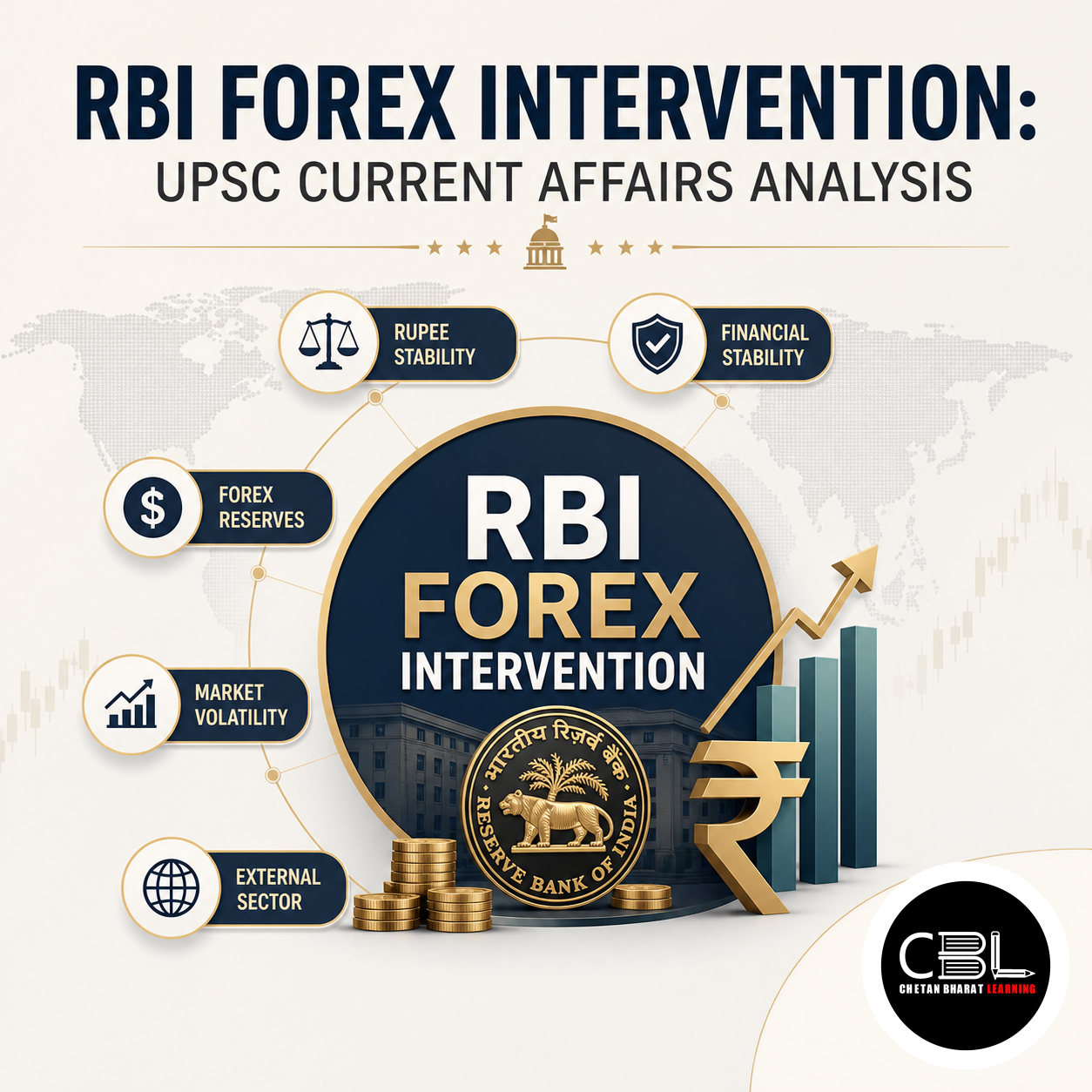

RBI forex intervention has become a key policy discussion after experts argued that the Reserve Bank of India should focus on maintaining macroeconomic stability rather than defending a specific exchange rate. The issue is important for UPSC because it covers monetary policy, exchange rate management and the external sector of the Indian economy. Explore similar topics in the daily current affairs archive.
What is RBI forex intervention?
RBI forex intervention refers to the Reserve Bank of India’s purchase or sale of foreign currencies in the foreign exchange market to reduce excessive volatility in the value of the Indian rupee. The objective is not to maintain a fixed exchange rate but to ensure orderly market conditions.
The RBI primarily intervenes by buying or selling US dollars using India’s foreign exchange reserves. Such interventions help smooth abrupt currency movements caused by capital flows, geopolitical events or global financial uncertainty.
Why is RBI forex intervention in News?
The passage discusses the view that the RBI should avoid aggressively defending a particular value of the rupee. Instead, it should allow market forces to determine the exchange rate while intervening only to curb excessive volatility.
The article highlights that capital outflows, stronger US dollar movements and global uncertainty have influenced the rupee in recent years. It also notes the importance of adequate foreign exchange reserves and instruments such as FCNR deposits during periods of financial stress. Official policy documents are available on the Reserve Bank of India website.
Key Features
The RBI follows a managed floating exchange rate system.
- Orderly market conditions: Intervention aims to reduce excessive exchange rate volatility rather than target a fixed value.
- Foreign exchange reserves: The RBI uses reserves comprising foreign currency assets, gold, SDRs and reserve position with the IMF.
- Capital flow management: Foreign Portfolio Investment (FPI) inflows and outflows significantly influence the rupee.
- FCNR deposits: Foreign Currency Non-Resident deposits can strengthen foreign exchange reserves during periods of stress.
- Macroeconomic stability: Exchange rate management supports inflation control, trade and financial stability.
Challenges
Managing the exchange rate requires balancing multiple economic objectives.
- Global uncertainty: Oil prices, wars and geopolitical tensions increase exchange rate volatility.
- Capital outflows: Sudden FPI withdrawals can weaken the rupee.
- Imported inflation: Currency depreciation raises the cost of imports, especially crude oil.
- Reserve adequacy: Excessive intervention may reduce foreign exchange reserves.
- Policy trade-offs: Maintaining stability while preserving market flexibility remains challenging.
Read more economy-related analysis in the UPSC Economy archive.
Way Forward
India should continue maintaining adequate foreign exchange reserves, strengthen macroeconomic fundamentals and encourage stable long-term capital inflows. Exchange rate flexibility should remain consistent with the managed float framework.
Structural reforms that improve exports, productivity and investor confidence will reduce pressure on the rupee over the long term. Additional information is available from the RBI.
FAQs on RBI forex intervention
Why does the RBI intervene in the forex market?
The RBI intervenes to reduce excessive volatility and ensure orderly market conditions rather than maintain a fixed exchange rate.
What are FCNR deposits?
Foreign Currency Non-Resident deposits allow NRIs to maintain deposits in designated foreign currencies with Indian banks.
Why are foreign exchange reserves important?
They support exchange rate stability, facilitate imports, strengthen investor confidence and help the economy withstand external shocks.
Related Current Affairs
Preparing for UPSC, PCS or HCS?
Talk to a mentor at Chetan Bharat Learning, Chandigarh. Free guidance on choosing the right exam and building a study plan.
Chat on WhatsAppCall 97793 53345UPSC / IAS / PCS coaching in Chandigarh · Trusted by aspirants across Punjab & Haryana
Leave a Reply
You must be logged in to post a comment.