

UPSC Mapping
| Exam | Topics |
|---|---|
| Prelims | SVEP, DAY-NRLM, Soil Health Card Scheme, Natural Farming |
| Mains | GS Paper II – Rural Development; GS Paper III – Agriculture & Environment |
What is Start-up Village Entrepreneurship Programme?
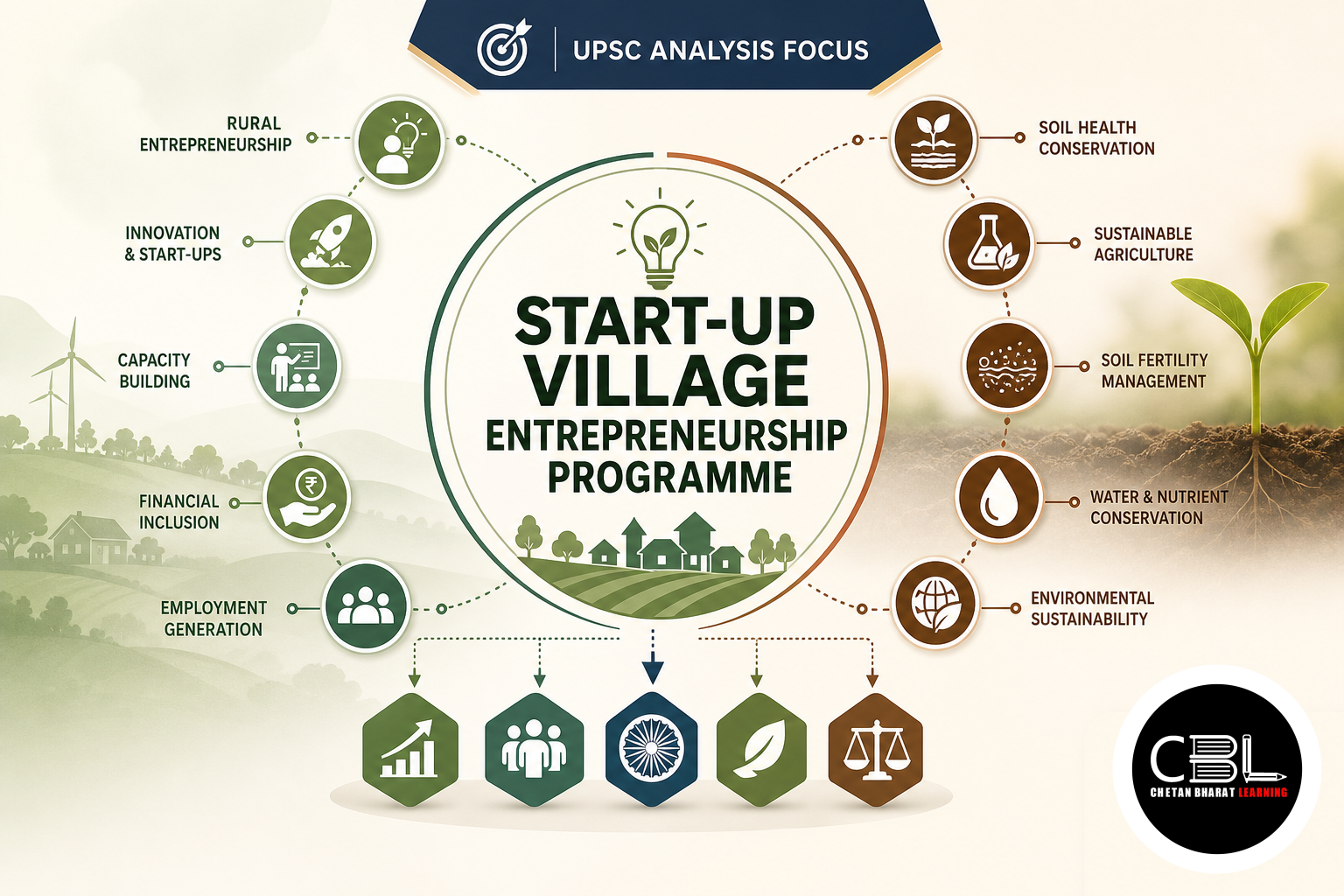
Start-up Village Entrepreneurship Programme (SVEP) is a centrally sponsored sub-scheme of the Deendayal Antyodaya Yojana – National Rural Livelihoods Mission (DAY-NRLM) under the Ministry of Rural Development. It promotes sustainable non-farm rural enterprises by supporting Self-Help Group (SHG) households with finance, mentoring and business development services.
The programme follows a decentralised implementation model through State Rural Livelihood Missions. It relies on Block Resource Centres, Community Resource Persons–Enterprise Promotion (CRP-EP), Block Enterprise Promotion Committees and the Community Enterprise Fund to nurture village-level entrepreneurship.
Why is Start-up Village Entrepreneurship Programme in News?
The Ministry of Rural Development reported that SVEP has supported more than 4.32 lakh rural enterprises since 2016, with an average investment of ₹27,083 per enterprise. Women constitute at least 60% of beneficiaries, reinforcing the programme’s focus on inclusive entrepreneurship and rural livelihoods.
The scheme also strengthens community institutions, reduces rural-to-urban migration and promotes locally driven enterprise ecosystems. Official information is available through the Ministry of Rural Development website.
Key Features
SVEP combines financial assistance with community-based enterprise support.
- Community-led Model: SHG institutions identify beneficiaries and mentor entrepreneurs.
- Business Support: CRP-EPs provide end-to-end guidance from enterprise selection to market linkage.
- Credit Access: Community Enterprise Fund bridges the initial financing gap.
- Women’s Empowerment: At least 60% of beneficiaries and CRP-EPs are women.
- Rural Employment: Encourages local enterprises and diversifies rural income beyond agriculture.
Soil Health Conservation in India
Healthy soil is essential for sustainable agriculture, food security, climate resilience and rural livelihoods. Soil degradation reduces productivity, increases dependence on external inputs and weakens long-term agricultural sustainability.
- Soil Health Card Scheme: Provides soil testing and customised nutrient recommendations.
- National Mission on Natural Farming: Promotes nature-based farming and improves Soil Organic Carbon using bio-inputs such as Beejamrit and Jeevamrit.
- Rainfed Area Development: Supports integrated farming systems and soil conservation under the National Mission for Sustainable Agriculture.
- Green India Mission: Encourages afforestation and ecosystem restoration to reduce soil erosion.
- Digital Agriculture Mission: Uses AgriStack, soil profile mapping and geospatial advisories for scientific land management.
Challenges
Despite policy support, significant challenges remain.
- Limited Market Linkages: Rural enterprises require better access to markets and value chains.
- Credit Constraints: Many micro-enterprises still face financing barriers.
- Soil Degradation: Excessive fertiliser use, erosion and salinity continue to affect productivity.
- Climate Change: Extreme weather accelerates soil degradation and agricultural risks.
- Awareness: Wider adoption of sustainable farming practices remains necessary.
Way Forward
Strengthening rural entrepreneurship requires better digital access, affordable finance, skill development and stronger market integration. Community-led institutions should continue to play a central role in enterprise promotion.
For agriculture, India should expand scientific soil testing, natural farming, carbon-smart agriculture and digital advisory systems while encouraging sustainable land management. More information is available through the Ministry of Agriculture & Farmers Welfare website.
Prelims Practice Corner
Q1. SVEP is a sub-scheme of:
- a) PMEGP
- b) DAY-NRLM
- c) PM-KISAN
- d) MGNREGA
Answer: b
Q2. Which ministry implements SVEP?
- a) Ministry of MSME
- b) Ministry of Rural Development
- c) Ministry of Agriculture
- d) Ministry of Finance
Answer: b
Q3. The Soil Health Card Scheme was launched in:
- a) 2012
- b) 2014
- c) 2015
- d) 2018
Answer: c
Q4. Soil Organic Carbon is important because it:
- a) Increases salinity
- b) Stores atmospheric carbon
- c) Causes erosion
- d) Reduces biodiversity
Answer: b
Q5. National Mission on Natural Farming primarily promotes:
- a) Chemical-intensive farming
- b) Nature-based farming
- c) Deep-sea fishing
- d) Plantation forestry
Answer: b
Mains Practice Questions
Q1. Evaluate the role of the Start-up Village Entrepreneurship Programme in promoting inclusive rural development and women’s economic empowerment. (10 Marks)
Answer Structure:
- Intro: Explain SVEP under DAY-NRLM.
- Body: Community institutions, finance, women-led enterprises, employment, challenges.
- Conclusion: Highlight sustainable rural entrepreneurship.
Q2. Discuss the importance of soil health conservation for sustainable agriculture and climate resilience in India. (15 Marks)
Answer Structure:
- Intro: Define soil health.
- Body: Soil degradation, government initiatives, natural farming, carbon sequestration, digital agriculture.
- Conclusion: Emphasise long-term agricultural sustainability.
FAQs on Start-up Village Entrepreneurship Programme
What is the Start-up Village Entrepreneurship Programme?
It is a centrally sponsored sub-scheme under DAY-NRLM that supports SHG households in establishing sustainable non-farm rural enterprises through finance, mentoring and community institutions.
Why is soil health important?
Healthy soil improves crop productivity, stores carbon, conserves water, reduces fertiliser dependence and strengthens climate resilience.
Why is this topic important for UPSC?
It integrates rural development, SHGs, sustainable agriculture, climate action and government schemes, making it highly relevant for both Prelims and Mains.
Related Current Affairs
Preparing for UPSC, PCS or HCS?
Talk to a mentor at Chetan Bharat Learning, Chandigarh. Free guidance on choosing the right exam and building a study plan.
Chat on WhatsAppCall 97793 53345UPSC / IAS / PCS coaching in Chandigarh · Trusted by aspirants across Punjab & Haryana
Leave a Reply
You must be logged in to post a comment.