

UPSC Syllabus Mapping
- GS Paper: GS-III
- Subject: Infrastructure, Civil Aviation, Investment Models and Regional Connectivity
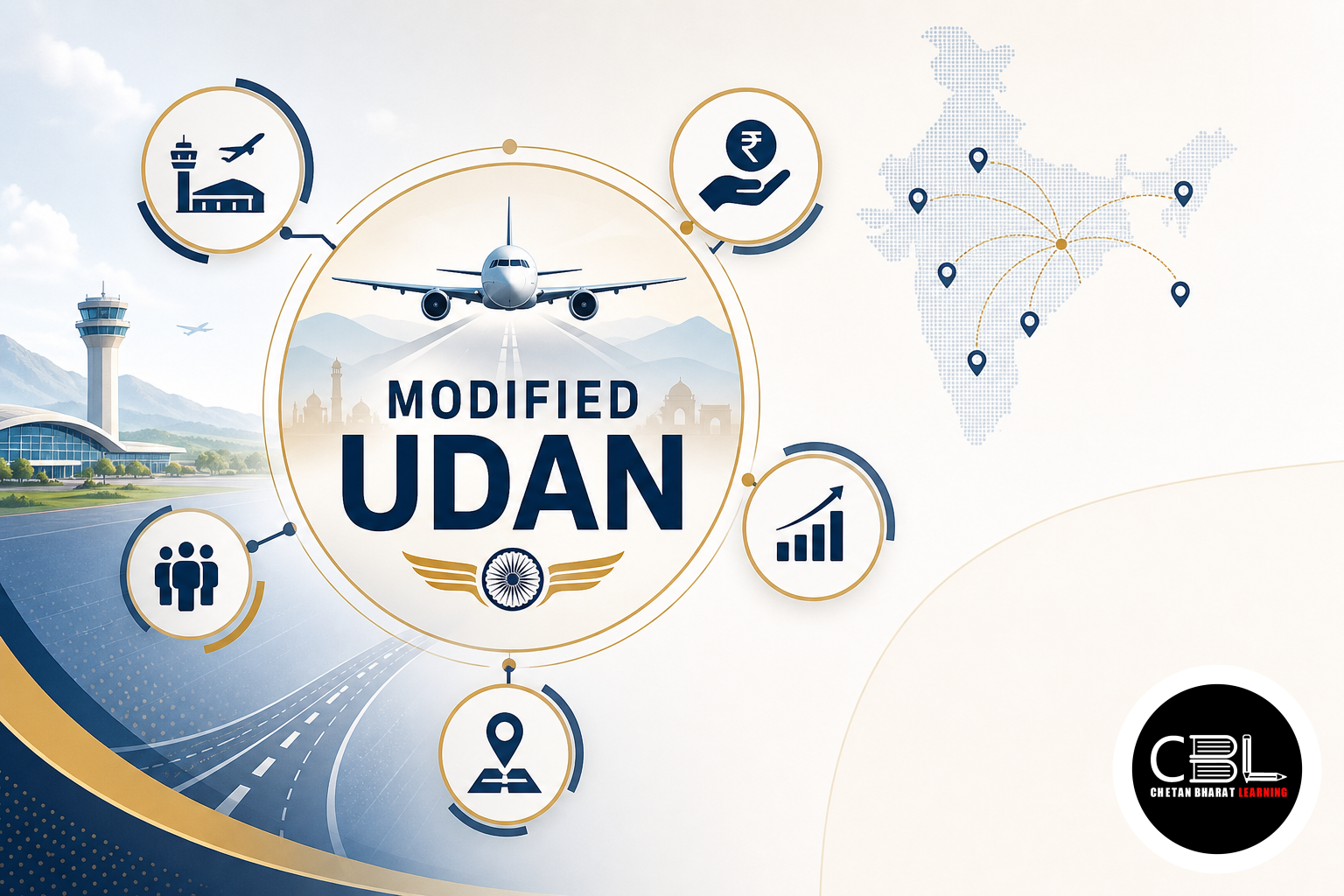
What is Modified UDAN?
UDAN stands for Ude Desh ka Aam Nagrik and originated as India’s Regional Connectivity Scheme in 2016. Its central objective is to make air services accessible on routes that airlines may otherwise consider commercially unattractive. The programme connects unserved and underserved airports with larger aviation networks, seeking to reduce geographical inequality in access to fast transport.
The original model relied significantly on Viability Gap Funding to support selected regional services. Airlines received temporary financial assistance because thin routes may not initially generate enough passenger revenue, while the programme ensured affordable connectivity for smaller cities. The long-term objective remained the development of routes that could eventually function with declining public support.
The new framework broadens this approach by emphasising physical infrastructure as well as airline viability. It proposes development of airports from currently unserved airstrips and expansion of helicopter infrastructure. Moreover, longer tapered financial support can give new routes additional time to develop a stable passenger base, reflecting the recognition that aviation markets sometimes require several years to mature.
Regional aviation also produces benefits beyond passenger travel. Better connectivity can support tourism, investment, emergency access and movement of high-value goods. Improved air cargo services help remote producers reach distant markets quickly; the economic case for regional aviation therefore depends partly on these wider network effects rather than ticket revenue alone.
Nevertheless, infrastructure cannot guarantee viable airline operations by itself. Airports need reliable passenger demand, suitable aircraft and workable schedules, while airlines must manage fuel, crew and maintenance costs. Sustainable connectivity therefore requires simultaneous development of airports, routes, aviation skills and local economic activity.
Why is Modified UDAN in News?
The government has approved a new phase of the regional aviation programme for the decade beginning in FY 2026-27. The programme allocates ₹28,840 crore towards strengthening regional aviation infrastructure, aiming to develop 100 airports from unserved airstrips and establish 200 helipads. It thus moves beyond reopening individual routes towards creating a deeper regional aviation network.
Another significant reform concerns Viability Gap Funding. The support period can extend from the earlier three-year model to five years with tapering assistance, providing airlines additional time to build passenger demand while gradually reducing dependence on subsidies. However, longer assistance will work only if routes eventually develop a credible commercial or strategic justification.
The reform follows substantial expansion in India’s aviation footprint. Operational airports have more than doubled since 2014, and the regional connectivity programme has brought hundreds of routes into operation. Smaller airports increasingly support express cargo as e-commerce spreads beyond metropolitan markets, making regional aviation part of India’s broader logistics infrastructure.
Yet experience has exposed weaknesses in the subsidy-led model. A significant share of regional routes has struggled to continue after financial assistance ends due to thin demand, expensive fuel and aircraft availability. The new framework therefore attempts to improve both the infrastructure and economics supporting regional connectivity.
The Ministry of Civil Aviation provides the institutional framework for India’s civil aviation policies and regional connectivity initiatives. For UPSC, the new scheme should be studied alongside airport expansion, aviation regulation, logistics and balanced regional development, illustrating how public support can address infrastructure gaps while attempting to create commercially sustainable markets.
Key Features
Infrastructure Creation: Developing unserved airstrips expands the reach of scheduled aviation, while helipads improve connectivity in mountainous, island and remote regions.
Longer and Tapered Viability Support: Temporary assistance compensates airlines while new routes develop passenger demand, with gradual reduction testing commercial viability.
Krishi Udan Integration: Agricultural air logistics benefit producers of perishable and high-value commodities, reducing spoilage and connecting farmers to distant markets.
Navigation Technology: India’s GAGAN satellite-based augmentation system supports safer operations without requiring expensive ground navigation infrastructure at every airport.
Hub-and-Spoke Networks: Aggregating passengers through regional hubs feeding major airports can improve route viability more effectively than isolated city-pair services.
Challenges
Route Mortality: Services that attract passengers only while subsidies last may fail once support ends, requiring realistic demand assessment over inauguration counts.
Fuel Costs: Variations in state ATF taxation and fuel-price volatility can undermine the thin margins of regional services operating smaller aircraft over short distances.
Aircraft Availability: Global shortages of engines and components can constrain fleet deployment, with airlines prioritising more profitable routes.
Aviation Workforce: Trained pilots, engineers and ground personnel are essential; training capacity must expand alongside network growth.
Infrastructure Quality: Airports lacking night-landing capability or instrument procedures face restricted operations and lower aircraft utilisation.
Way Forward
Evaluate regional routes through economic ecosystems—tourism, medical connectivity, cargo demand and local industry—rather than passenger numbers alone. Coordinate surface transport with airport development for better first- and last-mile connectivity. Prioritise upgrades to night-landing capabilities and navigation facilities, complementing with satellite-based procedures where suitable.
Expand the aviation skills pipeline—pilots, maintenance engineers and instructors—alongside fleet and airport growth. Encourage domestic aircraft leasing through policy support such as GIFT City to improve access to capital-intensive assets.
Integrate environmental sustainability into airport planning: use renewable electricity, efficient terminals and ground operations, and assess land use and local ecology before facility approval. Measure success through sustained connectivity rather than routes launched, leveraging the Airports Authority of India for infrastructure and navigation support.
Prelims Practice Corner
-
UDAN is primarily associated with:
- (a) Inland waterways
- (b) Regional air connectivity
- (c) High-speed rail
- (d) Coastal shipping
Answer: (b) UDAN is India’s Regional Connectivity Scheme for aviation.
-
GAGAN is best described as:
- (a) A regional aircraft manufacturing company
- (b) A satellite-based augmentation system for navigation
- (c) An aviation fuel subsidy
- (d) A military aircraft
Answer: (b) GAGAN is India’s satellite-based augmentation system supporting navigation applications, including civil aviation.
-
Viability Gap Funding is generally used to:
- (a) Support projects or services that are socially useful but initially face commercial viability gaps
- (b) Finance only defence imports
- (c) Replace all private investment
- (d) Regulate international airspace
Answer: (a) VGF helps bridge financial viability gaps in projects or services that have wider economic or social value.
-
Consider the following regarding regional aviation:
1. Night-landing capability can increase scheduling flexibility.
2. Satellite navigation can support aviation operations.
3. High fuel costs can affect the commercial viability of thin routes.Which statements are correct?
- (a) 1 only
- (b) 1 and 2 only
- (c) 2 and 3 only
- (d) 1, 2 and 3
Answer: (d) All three statements are correct.
-
Krishi Udan primarily seeks to improve:
- (a) Agricultural produce transportation through aviation logistics
- (b) Manufacture of fighter aircraft
- (c) Urban metro connectivity
- (d) Coastal tourism alone
Answer: (a) The initiative supports air transportation and logistics for agricultural products, particularly where speed matters.
Mains Practice Questions
-
Regional aviation infrastructure can act as a multiplier for balanced economic development, but connectivity cannot remain permanently subsidy-dependent. Discuss. (10 marks)
Outline: Explain regional connectivity; discuss tourism, logistics, agriculture and accessibility benefits; examine route mortality, fuel costs and weak demand; suggest tapered support, hub-and-spoke networks and demand-based planning.
-
Examine the major structural constraints facing India’s regional aviation network. How can the next phase of UDAN address them? (15 marks)
Outline: Discuss route viability, ATF costs, fleet shortages, aviation workforce gaps and underutilised airports; assess longer VGF and infrastructure development; recommend GAGAN, airport upgrades, skills development, cargo integration and sustainable aviation.
FAQs on Regional Aviation
How does the new UDAN framework differ from the earlier approach?
The new phase places greater emphasis on long-term regional infrastructure while extending tapered viability support. It therefore seeks to build sustainable aviation networks rather than depend mainly on short-duration route subsidies.
Why do some regional routes fail after subsidies end?
Passenger demand may remain too low to cover fuel, aircraft, crew and airport-related costs. Fleet constraints and weak scheduling flexibility can further reduce commercial viability.
Why is GAGAN important for regional connectivity?
GAGAN improves satellite-navigation performance and can support precise navigation procedures. Consequently, it can help strengthen aviation access while complementing conventional ground-based navigation infrastructure.
Related Current Affairs
Preparing for UPSC, PCS or HCS?
Talk to a mentor at Chetan Bharat Learning, Chandigarh. Free guidance on choosing the right exam and building a study plan.
Chat on WhatsAppCall 97793 53345UPSC / IAS / PCS coaching in Chandigarh · Trusted by aspirants across Punjab & Haryana
Leave a Reply
You must be logged in to post a comment.