
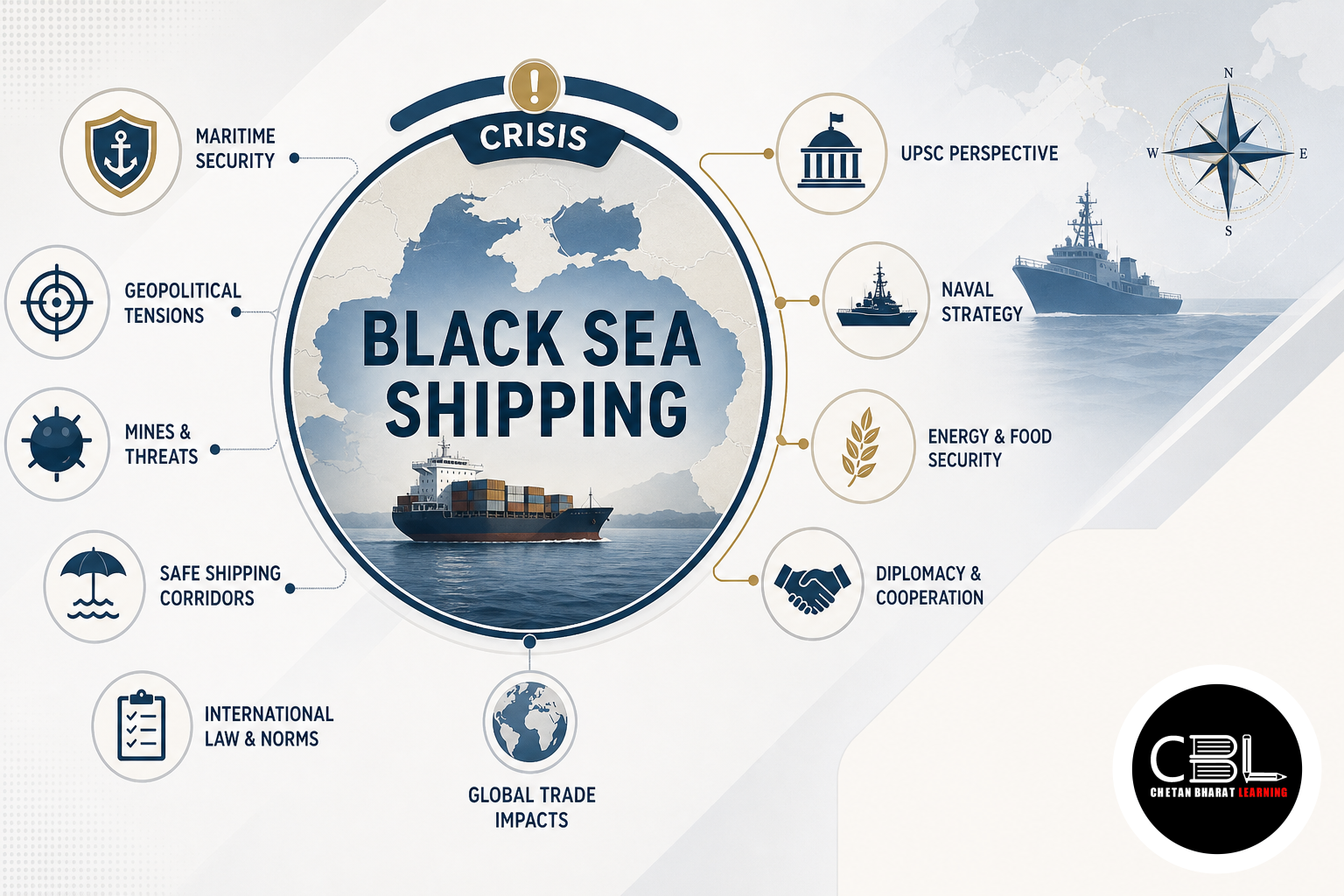

UPSC Syllabus Mapping
GS Paper: GS-II and GS-III
Subject: International Relations, Maritime Security and Food Security
What is Black Sea Shipping?
The term describes commercial maritime movement through the Black Sea and its connected waterways. The sea borders Ukraine, Russia, Georgia, Türkiye, Bulgaria and Romania. Moreover, the Turkish Straits connect it with the Mediterranean system through the Bosporus, Sea of Marmara and Dardanelles. This geography makes the region strategically important for Europe, Eurasia and global trade.
Commercial vessels transport grain, vegetable oils, energy products, metals and other bulk commodities through the region. Ukraine relies heavily on its southern ports for access to overseas markets. Notably, Odesa and nearby ports form major nodes in this maritime network. Consequently, insecurity around port approaches can affect ships even when they carry civilian cargo.
The Black Sea also has major military significance because Russia and Ukraine remain engaged in conflict. Naval operations, missiles, drones and sea mines create risks for merchant vessels. In addition, shipowners must assess changing security conditions before entering high-risk waters. Insurers and cargo owners also factor these dangers into commercial decisions.
The Montreux Convention of 1936 adds an important static dimension for UPSC preparation. Türkiye regulates passage of naval vessels through the Turkish Straits under the convention. However, merchant shipping and warship passage operate under different legal conditions. Therefore, aspirants should distinguish commercial navigation from the strategic rules governing naval access to the Black Sea.
Why is Black Sea Shipping in News?
Recent attacks on merchant vessels around Ukraine have renewed concern over civilian maritime safety. A July 2026 attack on the cargo vessel Golden Leo near Odesa killed several people, including Indian nationals. India condemned attacks that endanger civilian crews and impede freedom of navigation and commerce. The incident brought the human cost of maritime conflict into sharper focus.
The incident also involved another vessel with Indian crew members and reports an advisory concerning Indian seafarers. Consequently, the issue has moved beyond a distant European conflict for India. It now involves consular protection, employment risks and the safety of Indian maritime professionals. Aspirants can track official diplomatic developments through the Ministry of External Affairs.
The wider escalation matters because repeated attacks can discourage shipowners from calling at Ukrainian ports. Moreover, companies may reroute vessels when they judge the threat unacceptable. Such decisions reduce available shipping capacity and can raise transport costs. As a result, a regional security crisis can produce commercial consequences across international markets.
Black Sea Shipping also matters because Ukrainian ports remain closely connected with agricultural exports. The earlier UN-backed Black Sea Grain Initiative demonstrated the global importance of safe maritime access from Ukrainian ports. That arrangement ended in July 2023, but its experience remains relevant to understanding food security. Therefore, renewed attacks on port infrastructure and commercial ships revive concerns about reliable agricultural supply routes.
Key Features
First, geography shapes the strategic value of this maritime space. The Black Sea connects Eastern Europe and the Caucasus with wider maritime markets. Türkiye controls the only natural maritime gateway towards the Mediterranean. Therefore, regional security and Turkish control of the Straits influence the movement of ships.
Second, the region combines military competition with commercial navigation. Civilian bulk carriers may operate close to areas affected by missile, drone and naval activity. Furthermore, sea mines can remain dangerous beyond the immediate location of combat. Merchant captains must therefore combine navigational planning with continuous security assessment.
Third, food trade gives the region global economic significance. Ukraine has long supplied grain and vegetable oils to international markets. Consequently, reliable port operations matter to import-dependent countries as well as Ukrainian producers. Disruptions can affect shipping schedules, storage, freight rates and the confidence of commodity traders.
Finally, maritime labour gives the issue a distinct Indian dimension. India has a large pool of trained seafarers working on internationally flagged vessels. These workers may serve on ships owned, registered and operated across several jurisdictions. Therefore, a crisis involving an Indian crew member can require coordination among shipowners, flag states, coastal authorities and Indian diplomatic missions.
Challenges
The first challenge involves distinguishing civilian commerce from military logistics during an active conflict. Belligerents may suspect that vessels or port facilities support military operations. However, attacks on civilian shipping can endanger non-combatants and undermine confidence in international navigation. Clear identification and credible communication therefore remain essential for merchant safety.
A second challenge concerns insurance and commercial risk. Shipowners may avoid ports when expected losses exceed commercial returns. Meanwhile, insurers can demand higher premiums for voyages into conflict-affected waters. Higher operating costs can then travel through supply chains and influence commodity prices. The effect can continue even without a formal blockade.
Food security forms another important challenge. The Black Sea Grain Initiative previously created a monitored mechanism for exports from designated Ukrainian ports. The United Nations states that the arrangement facilitated more than 32 million tonnes of grain and food exports before ending in 2023. Therefore, the initiative provides an important example of how diplomacy can protect essential commerce during conflict.
India must also protect citizens employed in global shipping without controlling the security environment in which they work. Consequently, timely advisories, employer verification and communication with missions abroad become important safeguards. Aspirants can connect this dimension with diaspora protection and consular diplomacy in our UPSC current affairs library. Black Sea Shipping therefore links individual safety with wider questions of foreign policy and maritime governance.
Way Forward
Countries should prioritise the protection of civilian crews and clearly identified commercial vessels. Moreover, reliable communication channels can reduce misidentification and provide timely information about hazardous areas. Shipping companies should conduct route-specific risk assessments before accepting voyages. Crews must also receive clear emergency procedures for operations near conflict zones.
Diplomatic mechanisms remain important because commercial navigation cannot rely on private precautions alone. The earlier grain arrangement showed that adversaries can create limited maritime mechanisms when broader negotiations remain difficult. Therefore, future arrangements could focus narrowly on civilian shipping, food exports and humanitarian needs. Such mechanisms would require credible monitoring and sustained political support.
India can strengthen preventive support for its seafarers through advisories and consular coordination. Furthermore, employers should provide transparent information about routes, insurance and security risks before deployment. Seafarers should verify contractual conditions and maintain contact details for Indian missions. These steps cannot eliminate wartime danger, but they can improve preparedness and emergency response.
Finally, the international community must treat food corridors and civilian maritime commerce as important elements of economic security. The United Nations Black Sea Grain Initiative resources provide useful background on earlier arrangements for safe food exports. Black Sea Shipping will remain significant for UPSC because it connects geopolitics, international law, food security and maritime commerce. Above all, the issue shows how a regional war can transmit risks through global supply chains.
Prelims Practice Corner
-
1. The Black Sea is directly connected to the Sea of Marmara through which strait?
- (a) Strait of Hormuz
- (b) Bosporus
- (c) Bab-el-Mandeb
- (d) Kerch Strait
Answer: (b) Bosporus. The Bosporus connects the Black Sea with the Sea of Marmara.
-
2. Which country controls the Bosporus and Dardanelles?
- (a) Greece
- (b) Bulgaria
- (c) Türkiye
- (d) Romania
Answer: (c) Türkiye. Both straits lie within Turkish territory.
-
3. The Montreux Convention is primarily associated with:
- (a) Arctic navigation
- (b) Turkish Straits
- (c) Suez Canal
- (d) South China Sea
Answer: (b) Turkish Straits. The 1936 convention regulates passage through the Straits, including rules concerning warships.
-
4. Which of the following participated in the 2022 Black Sea Grain Initiative?
1. Ukraine
2. Russian Federation
3. Türkiye
4. United NationsSelect the correct answer using the code below:
- (a) 1 and 2 only
- (b) 1, 2 and 3 only
- (c) 1, 3 and 4 only
- (d) 1, 2, 3 and 4
Answer: (d) The initiative involved Ukraine, Russia and Türkiye, with the United Nations playing a central facilitating role.
-
5. Odesa is located on the coast of:
- (a) Baltic Sea
- (b) Adriatic Sea
- (c) Black Sea
- (d) Caspian Sea
Answer: (c) Black Sea. Odesa is a major Ukrainian port on its north-western coast.
Mains Practice Questions
-
1. Examine how conflict in the Black Sea can affect global food security and maritime commerce. (10 marks)
Outline: Begin with the strategic geography of the region. Discuss Ukrainian agricultural exports, risks to merchant vessels, insurance and freight costs, supply-chain effects and the experience of the grain initiative. Conclude with the need for protected civilian navigation and diplomatic mechanisms.
-
2. Recent attacks on merchant vessels demonstrate the growing connection between geopolitical conflicts and the safety of Indian seafarers. Discuss. (15 marks)
Outline: Explain India’s global maritime workforce, conflict-zone risks and consular responsibilities. Examine freedom of navigation, flag-state complexities, employer obligations and diplomatic coordination. Conclude with preventive advisories, risk disclosure and stronger international protection for civilian crews.
FAQs on Black Sea Maritime Security
-
Why is the Black Sea important for UPSC?
It combines strategic geography, the Russia-Ukraine conflict, maritime trade, food security and international law. It also offers important map-based facts for Prelims.
-
Why are Indian seafarers relevant to the current developments?
Indian nationals work extensively in international merchant shipping. Recent attacks involving Indian crew members have therefore made seafarer safety, consular protection and maritime security directly relevant to India.
-
What was the Black Sea Grain Initiative?
It was a 2022 arrangement involving Ukraine, Russia, Türkiye and the United Nations that facilitated safe exports of grain and related food products from designated Ukrainian ports. The initiative ended in July 2023, but it remains an important case study in wartime economic diplomacy.
Related Current Affairs
Preparing for UPSC, PCS or HCS?
Talk to a mentor at Chetan Bharat Learning, Chandigarh. Free guidance on choosing the right exam and building a study plan.
Chat on WhatsAppCall 97793 53345UPSC / IAS / PCS coaching in Chandigarh · Trusted by aspirants across Punjab & Haryana
Leave a Reply
You must be logged in to post a comment.