
UPSC Syllabus Mapping
GS Paper: GS-III
Subject: Indian Economy, Energy Security, Infrastructure and Science & Technology
What is Economic Resilience?
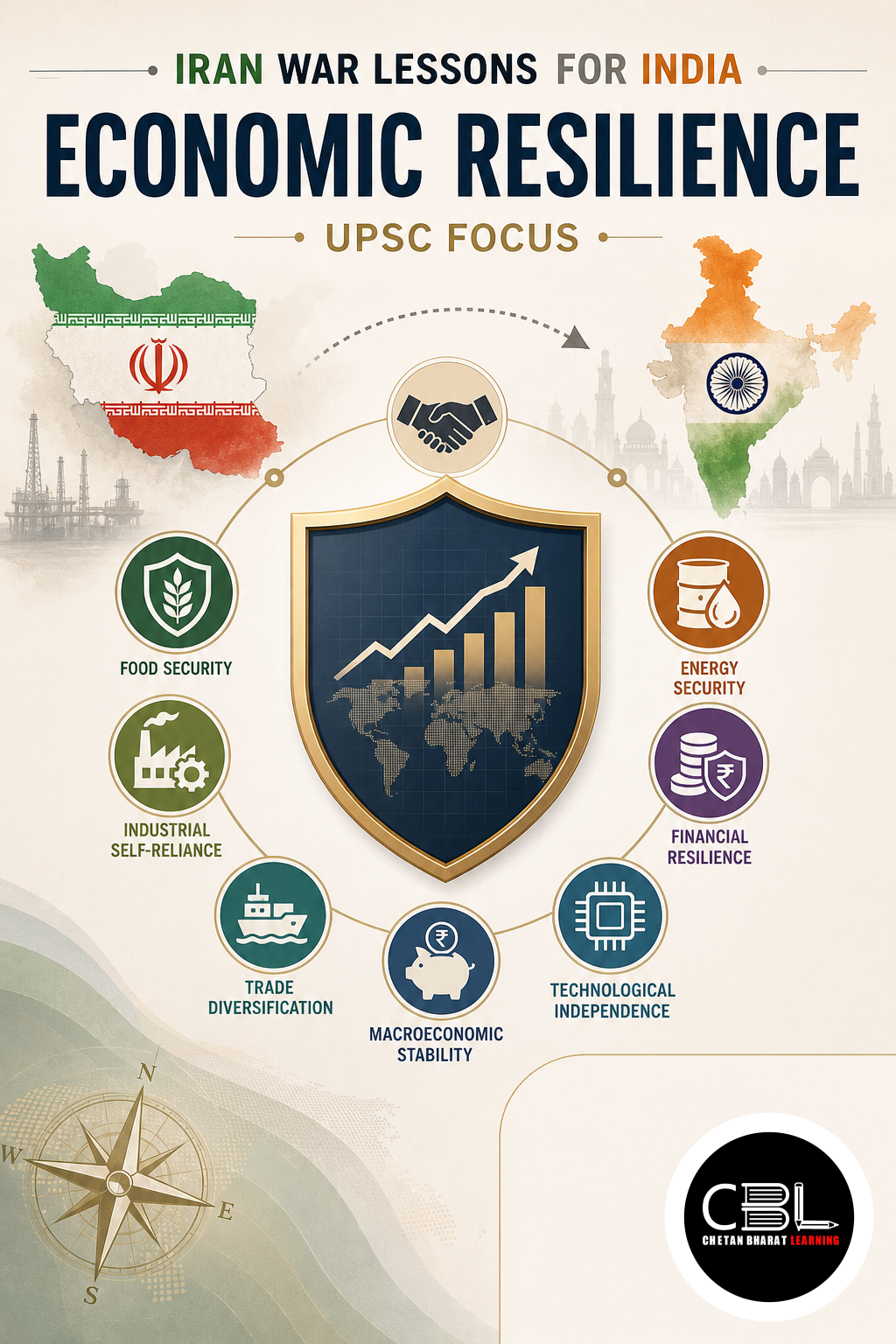
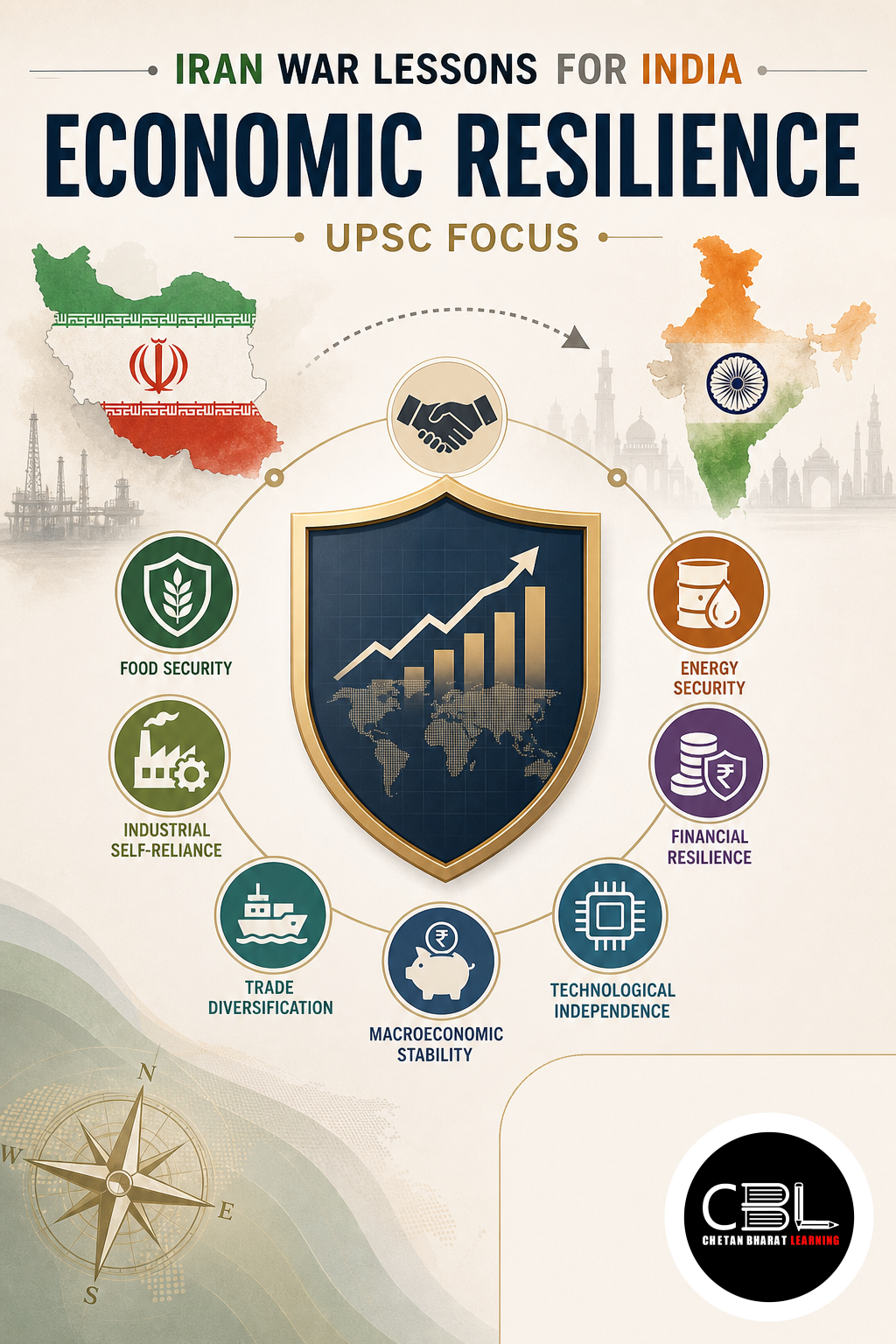
Economic resilience refers to an economy’s capacity to absorb shocks, adapt to disruption and restore sustainable growth without severe long-term damage. A resilient economy does not need to produce everything domestically. Instead, it manages critical dependencies so that disruptions in one country, commodity or transport route do not paralyse essential economic activity.
Resilience has several dimensions. Macroeconomic stability requires manageable inflation, adequate foreign-exchange buffers, sustainable public finances and a sound financial system. Meanwhile, structural resilience requires diversified energy sources, reliable infrastructure, productive industries and access to essential technologies.
Modern geopolitical competition has expanded the concept further. Semiconductors, artificial intelligence systems, rare earth elements and critical minerals now influence defence capabilities and industrial competitiveness. Consequently, economic policy and national-security strategy increasingly overlap.
For India, resilience also requires diversification rather than isolation. Global trade provides technology, capital, markets and resources that domestic production cannot always supply efficiently. Therefore, strategic autonomy works best when India combines stronger domestic capacity with diversified international partnerships.
Why is Economic Resilience in News?
The passage uses the Iran war and associated geopolitical uncertainty to examine India’s preparedness for external economic shocks. Energy remains a major concern because India depends heavily on imported crude oil. Consequently, instability affecting West Asian production or transport routes can transmit rapidly into domestic prices and trade balances.
The article also compares present vulnerabilities with India’s 1991 balance-of-payments crisis. In 1991, severe external constraints and weak foreign-exchange availability contributed to an acute economic crisis. India subsequently undertook major reforms involving liberalisation, privatisation and greater integration with the global economy.
Today’s challenges differ substantially. India has a much larger and more diversified economy, deeper integration with international markets and stronger institutional capacity. However, supply-chain concentration, technology restrictions, energy dependence and geopolitical fragmentation create a different set of vulnerabilities.
The central policy question is therefore how India should prepare for the next major disruption rather than merely manage the present one. Manufacturing, critical minerals, semiconductor capabilities and AI form four important pillars in this strategy. Aspirants can follow official economic policy initiatives through NITI Aayog.
Key Features
Manufacturing constitutes the first pillar. A stronger industrial base can create employment, expand exports and reduce excessive dependence on imported finished products. Moreover, manufacturing capabilities can support defence production, electronics, clean energy and other strategically important sectors.
Critical minerals form the second pillar because modern technologies depend on specialised raw materials. Lithium, cobalt, nickel, graphite and rare earth elements support batteries, renewable-energy systems, electronics and advanced manufacturing. Therefore, concentrated global supply chains can create strategic vulnerabilities for importing economies.
Semiconductors constitute the third pillar. Chips operate smartphones, vehicles, telecommunications networks, medical equipment, industrial machinery and defence systems. The pandemic-era chip shortages demonstrated how disruption in a relatively small component can constrain production across multiple industries.
Artificial intelligence forms the fourth pillar. India possesses a large digital ecosystem, skilled professionals and a substantial technology-services industry. However, advanced AI also depends on computing infrastructure, specialised chips, research capacity, data ecosystems and access to global technological networks.
Together, these four sectors illustrate a shift in the meaning of strategic resources. Earlier industrial power depended heavily on oil, steel and conventional manufacturing capacity. Today, energy remains vital, but chips, computing power, minerals and AI capabilities increasingly shape economic and military power.
Challenges
India’s dependence on imported energy remains a significant structural vulnerability. A geopolitical crisis can raise crude prices, transport costs and insurance expenses. As a result, an external energy shock can contribute to inflation and place pressure on India’s current account.
Critical-mineral supply chains create another challenge. Mining and processing capacity for several strategic minerals is geographically concentrated. Consequently, political disputes, export restrictions or transport disruptions can affect industries ranging from electric mobility to renewable energy and defence.
Technology dependence can be equally consequential. Advanced semiconductor manufacturing requires complex equipment, intellectual property, specialised materials and sophisticated skills. Therefore, establishing domestic capabilities involves far more than constructing fabrication plants.
Artificial intelligence presents a related challenge because frontier models demand substantial computing resources and specialised hardware. India must move beyond being primarily an adopter of imported technologies towards greater participation in research, infrastructure and innovation. Aspirants can connect such developments with the UPSC current affairs library.
Finally, self-reliance can become economically costly if policymakers interpret it as complete self-sufficiency. No major economy controls every mineral, technology and stage of modern production. Hence, India needs strategic diversification and trusted partnerships alongside selective domestic capability building.
Way Forward
India should deepen its manufacturing ecosystem rather than focus only on final assembly. Competitive logistics, reliable electricity, skilled labour and predictable regulation can help firms build larger domestic supply networks. Furthermore, stronger integration with global value chains can expand markets for Indian producers.
Critical-mineral security requires multiple strategies. India can diversify overseas suppliers, support exploration, develop processing capacity and promote recycling. Consequently, no single foreign source should become an avoidable point of failure for strategically important industries.
India also needs a broad semiconductor ecosystem covering design, fabrication, packaging, testing, materials and skills. International partnerships can accelerate this process because semiconductor supply chains are highly specialised. Meanwhile, sustained research and workforce development can gradually increase domestic value addition.
In AI, policy should strengthen computing infrastructure, research institutions, skills and responsible innovation. Collaboration between universities, start-ups, established firms and government can expand indigenous capabilities. Aspirants can examine technology initiatives through the Ministry of Electronics and Information Technology.
Economic resilience ultimately requires preparation before a crisis occurs. India can combine energy diversification, stronger manufacturing, secure mineral supplies and technological capability with stable macroeconomic management. Above all, strategic autonomy should rest on diversified partnerships and competitive domestic capacity rather than economic isolation.
Prelims Practice Corner
-
Which of the following are commonly regarded as critical minerals for modern technologies?
- 1. Lithium
- 2. Cobalt
- 3. Nickel
- 4. Rare earth elements
Options:
- A. 1 and 2 only
- B. 1, 2 and 3 only
- C. 2 and 4 only
- D. 1, 2, 3 and 4
Answer: D. These materials have important applications across batteries, electronics, renewable energy and other strategic technologies.
-
A sharp increase in imported crude-oil prices can directly place pressure on India’s:
Options:
- A. Current account
- B. Electoral system
- C. Seventh Schedule
- D. Delimitation process
Answer: A. Higher oil import costs can widen the merchandise trade deficit and place pressure on the current account.
-
Semiconductor chips are used in which of the following?
- 1. Automobiles
- 2. Telecommunications equipment
- 3. Medical devices
- 4. Defence systems
Options:
- A. 1 only
- B. 1 and 2 only
- C. 1, 2 and 3 only
- D. 1, 2, 3 and 4
Answer: D. Modern electronic and digital systems across all these sectors use semiconductors.
-
India’s 1991 economic crisis was closely associated with:
Options:
- A. Excessive foreign-exchange reserves
- B. A balance-of-payments crisis
- C. Complete absence of imports
- D. Introduction of GST
Answer: B. India faced a severe balance-of-payments and foreign-exchange crisis in 1991.
-
Consider the following statements:
- 1. Economic resilience necessarily requires complete economic self-sufficiency.
- 2. Diversification can reduce vulnerability to concentrated supply chains.
Which is correct?
- A. 1 only
- B. 2 only
- C. Both 1 and 2
- D. Neither 1 nor 2
Answer: B. Resilience can rely on diversification, domestic capacity and reliable partnerships rather than complete self-sufficiency.
Mains Practice Questions
-
Critical minerals and semiconductors are becoming as strategically significant as conventional energy resources. Discuss. (10 marks)
Outline: Define strategic resources; explain applications of minerals and chips; discuss supply concentration and geopolitical restrictions; link with energy transition, defence and AI; recommend diversification, recycling and domestic capabilities.
-
India’s ability to withstand future geopolitical shocks will depend on structural resilience rather than crisis management alone. Analyse. (15 marks)
Outline: Define resilience; briefly contrast present challenges with 1991; discuss energy security, manufacturing, critical minerals, semiconductors and AI; examine geopolitical and supply-chain risks; recommend diversification, technology partnerships, domestic capacity and macroeconomic stability.
FAQs on Economic Resilience
What does economic resilience mean?
It means an economy’s capacity to absorb external or domestic shocks, adapt to disruption and sustain or restore productive activity without severe long-term damage.
Why are critical minerals important for India?
They support technologies such as batteries, renewable-energy equipment, electronics and defence systems. Diversified access therefore affects India’s energy transition, industrial strategy and national security.
Does strategic autonomy require India to produce everything domestically?
No. Strategic autonomy can combine competitive domestic capabilities with diversified trade and technology partnerships. The objective is to avoid excessive dependence on vulnerable single sources while retaining the benefits of global economic integration.
Related Current Affairs
Preparing for UPSC, PCS or HCS?
Talk to a mentor at Chetan Bharat Learning, Chandigarh. Free guidance on choosing the right exam and building a study plan.
Chat on WhatsAppCall 97793 53345UPSC / IAS / PCS coaching in Chandigarh · Trusted by aspirants across Punjab & Haryana
Leave a Reply
You must be logged in to post a comment.