
UPSC Syllabus Mapping
| GS Paper | Prelims & GS-II |
|---|---|
| Subject | Miscellaneous — International Sports, Commonwealth, Inclusion and Sustainable Mega-Event Management |
What are the Glasgow Commonwealth Games?
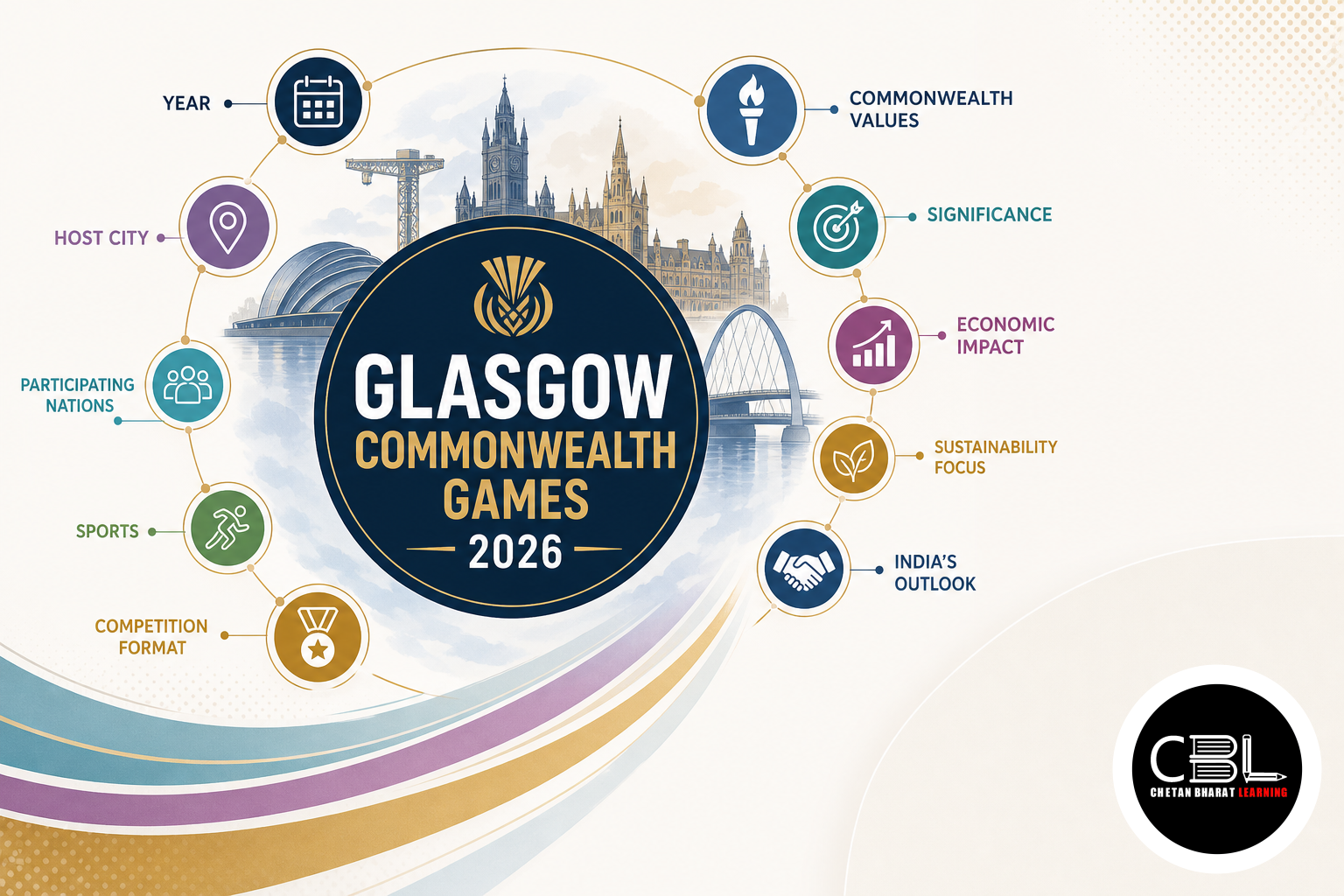
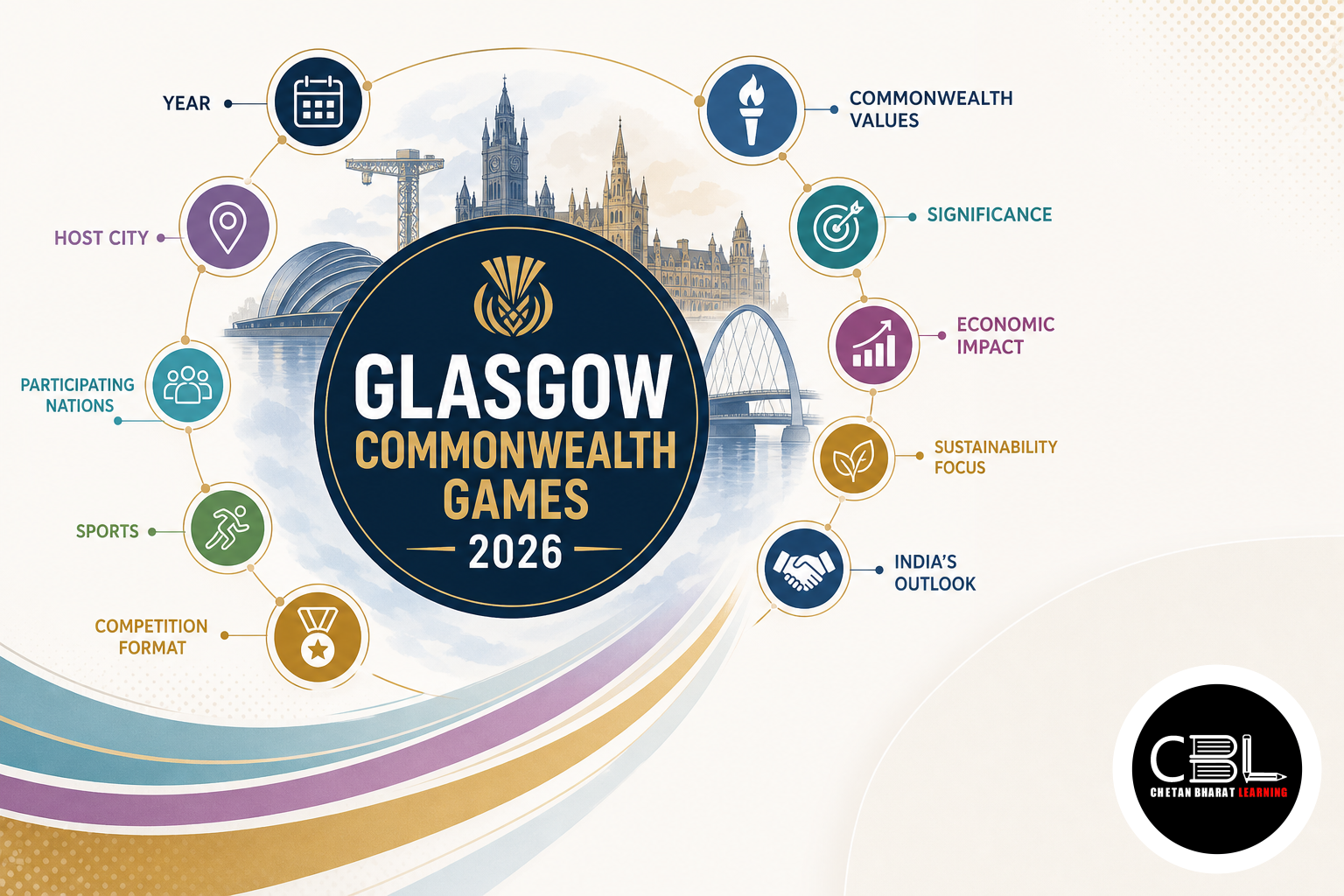
The Commonwealth Games are a major international multi-sport competition involving athletes representing nations and territories of the Commonwealth. The Games are normally held every four years and combine elite sporting competition with a distinctive integrated approach to Para sport. Glasgow 2026 is the 23rd edition and marks the return of the event to the Scottish city after Glasgow previously hosted the Games in 2014.
Scotland has a longer hosting history as well. Edinburgh hosted in 1970 and 1986, while Glasgow hosted in 2014 and again in 2026. Glasgow is only the third city to host the Commonwealth Games twice. The current edition is being delivered by Glasgow 2026 Limited in partnership with Commonwealth Sport and Commonwealth Games Scotland. Its organisers describe the event as an 11-day festival, with sporting competition and ceremonies taking place between July 23 and August 2.
Why are Glasgow Commonwealth Games in News?
The Games officially opened on July 23, 2026, bringing athletes from 74 nations and territories to Glasgow. The edition is notable for its reduced physical footprint and streamlined sporting programme. Instead of spreading competitions across numerous new facilities, organisers have concentrated events at established venues, including Scotstoun Stadium, Tollcross International Swimming Centre, the Glasgow International Arena and the Scottish Event Campus.
The host arrangement itself is unusual. Victoria in Australia had originally been selected to stage the 2026 Games but withdrew in 2023 after concerns about projected costs. Glasgow was formally confirmed as the replacement host in October 2024 with a redesigned delivery model based on existing facilities and a smaller programme. Official schedules, venues and competition information are available through the Glasgow 2026 official portal.
Key Features of the 2026 Games
The defining feature of Glasgow 2026 is compactness. Four venue clusters within an approximately eight-mile corridor reduce the need for dispersed infrastructure and simplify transport, security and event operations. The Games are expected to involve up to 3,000 athletes and feature 215 medal events across the programme.
- Ten-sport programme: The programme comprises athletics, swimming, artistic gymnastics, track cycling, netball, weightlifting, boxing, judo, bowls and 3×3 basketball, with relevant Para disciplines integrated into six sports.
- Record Para programme: There are 47 Para-sport medal events across six disciplines, described by organisers as the largest integrated Para-sport medal programme in Commonwealth Games history.
- Integrated competition: Para Athletics, Para Swimming, Para Powerlifting, Para Track Cycling, 3×3 Wheelchair Basketball and Para Bowls form part of the overall Games programme rather than a separate sporting event.
- Venue reuse: Scotstoun hosts athletics, Tollcross hosts swimming, while track cycling and artistic gymnastics use the Glasgow International Arena and Sir Chris Hoy Velodrome complex. Several other sports are concentrated at the Scottish Event Campus.
- Compact geography: The four main venue clusters are located within an eight-mile corridor, reducing logistical complexity.
- Accommodation model: The delivery model does not depend on constructing a conventional new athletes’ village, reducing the infrastructure burden associated with hosting.
Para-sport integration has particular institutional significance. Commonwealth Sport notes that Para athletes were fully integrated into their national teams at Manchester 2002, making the Commonwealth Games an early major international multi-sport event to adopt this approach. Para medals contribute to the same national medal tally, reinforcing the principle that disability sport is part of the central competition rather than a parallel programme.
Challenges Related to Hosting Major Sporting Events
The circumstances surrounding the 2026 edition demonstrate a central challenge facing international sporting events: escalating hosting costs. Purpose-built stadiums, athlete villages, transport infrastructure, security and temporary facilities can substantially increase expenditure. If long-term utilisation is weak, newly constructed venues may become expensive assets with limited post-event public value. The withdrawal of the original Australian host strengthened the debate over whether conventional mega-event models remain financially sustainable.
A smaller programme creates its own trade-offs. Reducing the number of sports and venues can control expenditure and operational complexity, but athletes in omitted disciplines lose access to a major international competition. Hosts must therefore balance financial sustainability, sporting diversity, broadcasting needs, spectator demand and athlete opportunities. The Glasgow model is best understood as one response to these competing pressures rather than a universal template.
Mega-events also need to demonstrate benefits beyond a short period of competition. Accessibility, community participation, environmental impact and post-event utilisation of facilities influence whether public investment produces a durable legacy. These themes are relevant to India’s own ambitions in international sport and can be followed through the UPSC current affairs library.
Way Forward for Sustainable Sporting Events
The Glasgow model highlights the potential advantages of prioritising existing infrastructure. Host cities can begin by mapping stadiums, public transport and accommodation already available before proposing major new construction. Temporary upgrades and targeted modernisation can be preferable to permanent facilities where future demand is uncertain. Compact venue planning can additionally reduce travel time for athletes and spectators while simplifying security and event logistics.
Inclusive design should also be embedded at the planning stage. Integrated Para competition requires accessible venues, transport, accommodation and communication rather than treating accessibility as a later modification. The record Para programme at Glasgow provides an opportunity to evaluate how international events can combine elite sport with greater representation of athletes with disabilities.
For future hosts, success should be measured not simply by the scale of construction but by sporting quality, accessibility, financial discipline and long-term community use. The Commonwealth Sport official portal provides authoritative information on the Games and its integrated Para-sport model. Glasgow 2026 will therefore be closely watched as a test of whether a smaller, venue-reuse approach can offer a sustainable direction for international multi-sport competitions.
Prelims Practice Corner
-
1. The 2026 Commonwealth Games are being hosted by: (a) Birmingham (b) Glasgow (c) Edinburgh (d) Manchester
Answer: (b) Glasgow. -
2. Consider the following statements regarding Glasgow 2026:
1. It is the 23rd Commonwealth Games.
2. It features 10 sports.
3. Para sports are integrated into the Games programme.
Which of the statements given above are correct?
(a) 1 only (b) 1 and 2 only (c) 2 and 3 only (d) 1, 2 and 3
Answer: (d) 1, 2 and 3. -
3. Which city also hosted the Commonwealth Games in 2014? (a) Glasgow (b) Melbourne (c) Delhi (d) Gold Coast
Answer: (a) Glasgow. -
4. Which of the following are part of the Glasgow 2026 programme?
1. Track Cycling
2. Judo
3. Netball
4. 3×3 Basketball
Select the correct answer:
(a) 1 and 2 only (b) 2 and 3 only (c) 1, 3 and 4 only (d) 1, 2, 3 and 4
Answer: (d) 1, 2, 3 and 4. -
5. Which statement best describes Para sport at the Commonwealth Games?
(a) It is always conducted as a separate Games after the main competition
(b) Para athletes cannot contribute to national medal tallies
(c) Selected Para disciplines are fully integrated into the main Games programme
(d) Para sport was discontinued after 2002
Answer: (c) Selected Para disciplines are fully integrated into the main Games programme.
Mains Practice Questions
-
1. The Glasgow 2026 model reflects a shift from infrastructure-intensive mega-events towards compact and existing-venue-based sporting events. Discuss its advantages and limitations. (10 marks)
Outline:
- Mega-event cost concerns
- Existing venue reuse
- Compact footprint
- Reduced construction and logistics
- Sustainability
- Smaller sports programme
- Athlete opportunity trade-offs
- Lessons for future hosts
-
2. Integration of Para sport into mainstream international sporting competitions can advance both sporting excellence and social inclusion. Examine. (15 marks)
Outline:
- Integrated Commonwealth model
- Equal national representation
- Visibility of Para athletes
- Accessible infrastructure
- Social attitudes towards disability
- Institutional requirements
- Record Glasgow programme
- Inclusion as part of event design
FAQs on Glasgow Commonwealth Games
When are the 2026 Commonwealth Games being held?
The 23rd Commonwealth Games run from July 23 to August 2, 2026, in Glasgow, Scotland.
How many sports are included at Glasgow 2026?
The programme contains 10 sports, including six sports with fully integrated Para disciplines and a record 47 Para-sport medal events.
Why is the Glasgow hosting model significant?
It concentrates competition in four existing venue clusters within an eight-mile corridor and avoids a construction-heavy hosting model, making it an important case study in the financial and environmental sustainability of major sporting events.
Related Current Affairs
Preparing for UPSC, PCS or HCS?
Talk to a mentor at Chetan Bharat Learning, Chandigarh. Free guidance on choosing the right exam and building a study plan.
Chat on WhatsAppCall 97793 53345UPSC / IAS / PCS coaching in Chandigarh · Trusted by aspirants across Punjab & Haryana
Leave a Reply
You must be logged in to post a comment.