
UPSC Syllabus Mapping
| GS Paper: | GS-III |
|---|---|
| Subject: | Indian Economy — Currency Management, RBI, Security Printing and Sustainability |
What is Polymer Banknotes?
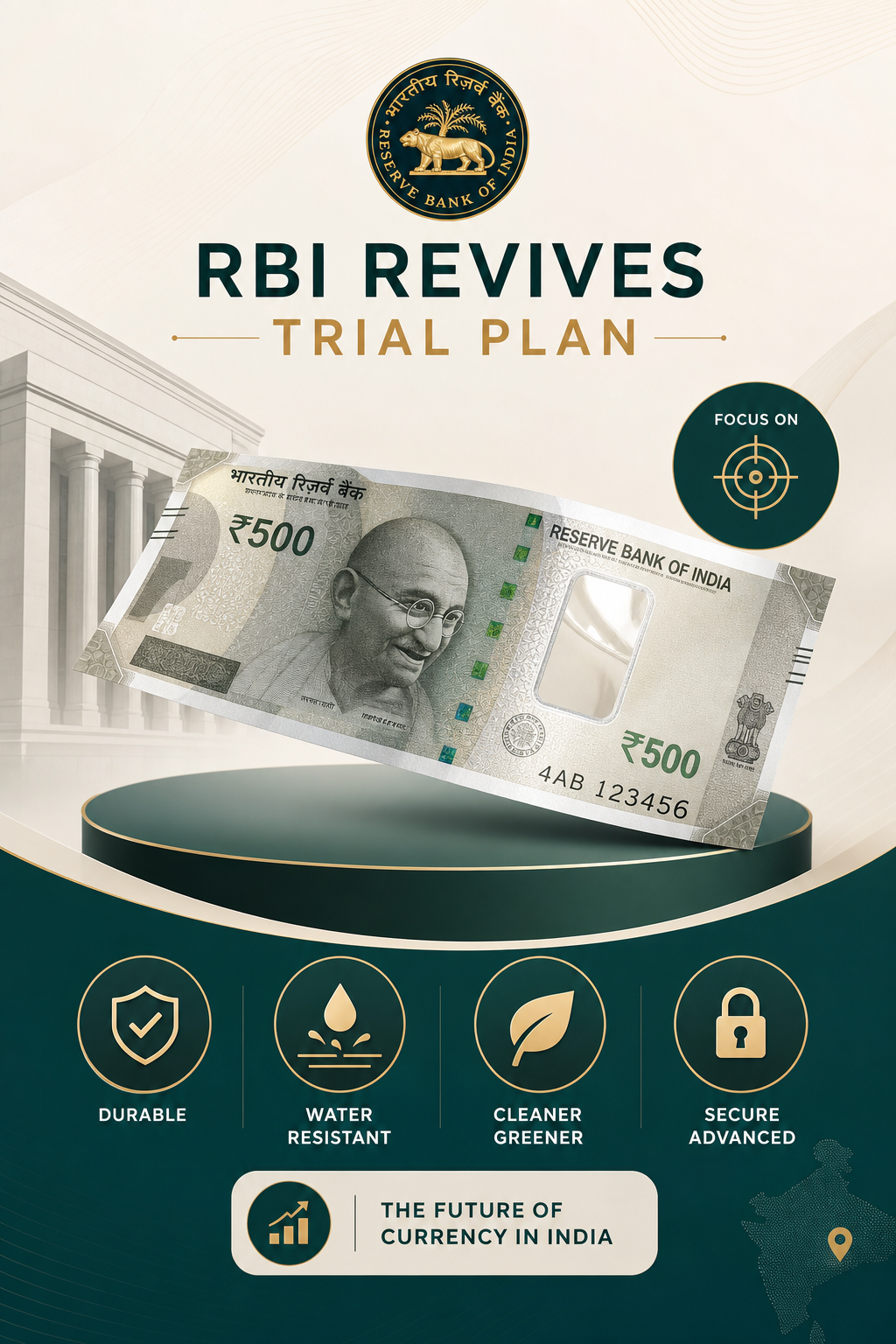
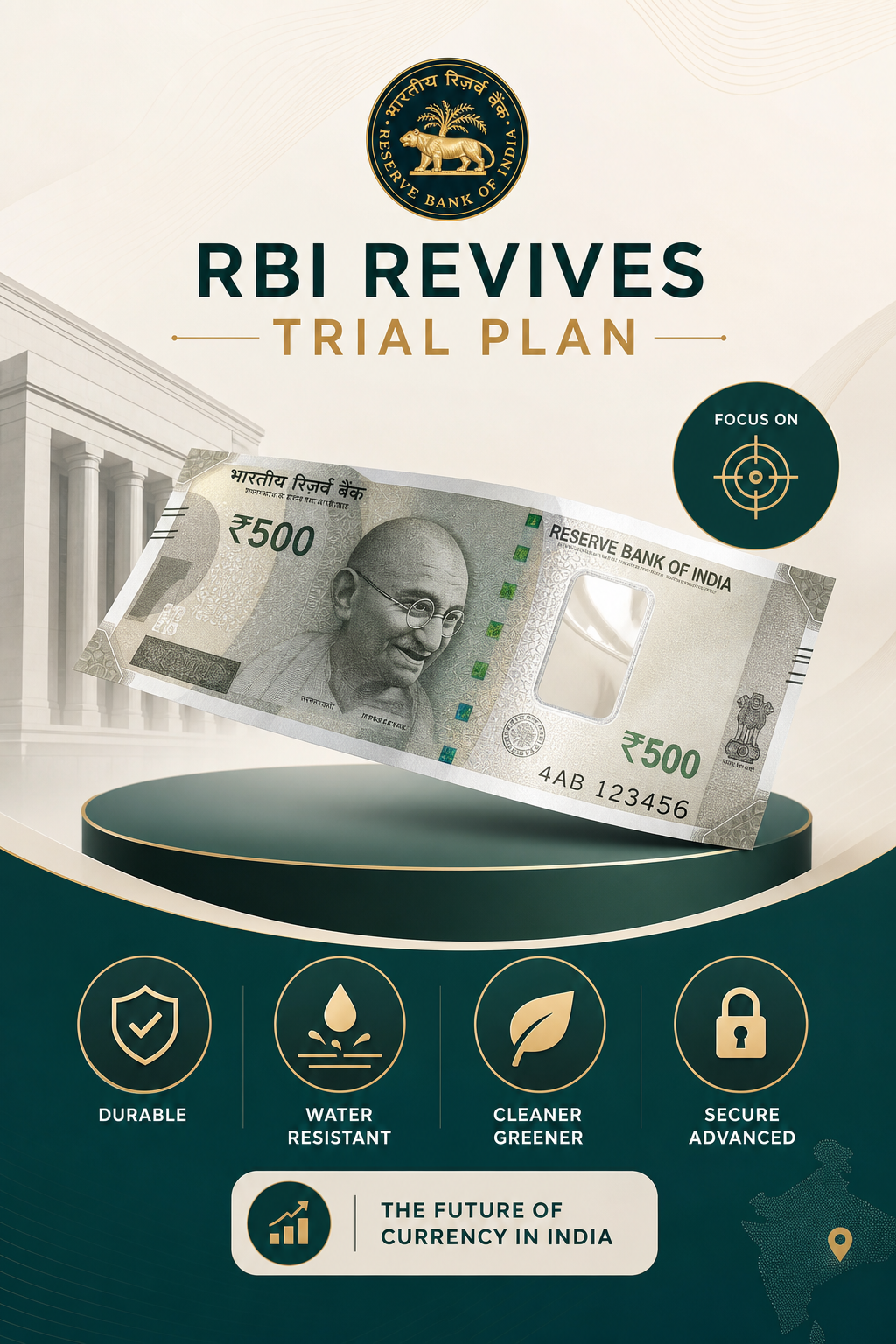
These are currency notes printed on a synthetic polymer substrate rather than conventional cotton-based banknote paper. A commonly used material is biaxially oriented polypropylene, or BOPP. The material is thin and flexible but has greater resistance to moisture, dirt and routine physical wear. Polymer currency should therefore not be understood simply as ordinary plastic carrying printed monetary designs; it is a specialised security-printing substrate engineered for circulation.
Indian banknotes are traditionally produced using specialised paper whose composition differs from ordinary writing paper. Currency must survive repeated folding, handling and transportation while supporting sophisticated anti-counterfeiting features. Polymer substrates approach the same requirements differently by using a non-porous and comparatively durable base that can incorporate transparent windows, optical devices and other security elements that are difficult to reproduce accurately.
Why are Polymer Banknotes in the News?
Bharatiya Reserve Bank Note Mudran Private Limited, an RBI subsidiary involved in banknote production, has floated a tender for polymer sheets intended for the manufacture of plastic currency notes. The reported procurement is an initial step towards trial and assessment rather than an announcement that India’s entire stock of paper currency will immediately be replaced. Evaluation would be necessary before any wider policy decision.
India has considered polymer currency earlier as well. A previous proposal to test polymer notes did not ultimately result in a large-scale transition. The renewed exercise is important because banknote technology, security threats, printing economics and sustainability considerations have continued to evolve. Any eventual decision would fall within the wider framework of currency management led by the Reserve Bank of India. Official monetary and currency-management information can be accessed through the Reserve Bank of India.
Key Features of Modern Polymer Currency
Durability is the principal economic argument for polymer currency. Conventional notes gradually become soiled, torn or otherwise unfit for circulation and must be withdrawn and replaced. Polymer substrates can withstand moisture and physical handling better, potentially allowing a note to remain usable for longer. Higher manufacturing costs at the beginning may therefore be offset by reduced replacement and printing requirements over the note’s full lifecycle.
- Greater durability: resistance to moisture and routine wear can extend the circulation life of notes.
- Improved hygiene: a non-porous surface absorbs less moisture and dirt and can be easier to clean.
- Security potential: transparent windows and sophisticated optical elements can make counterfeiting more difficult.
- Lifecycle economics: fewer replacements can reduce recurring printing, storage and transportation requirements.
- Resource implications: longer note life may reduce demand for conventional banknote substrate and associated processing.
The international experience provides useful evidence for evaluation. Australia pioneered modern polymer banknotes and several countries subsequently adopted them wholly or for selected denominations. However, international adoption does not automatically establish suitability for India. India’s enormous volume of cash transactions, climatic diversity, banking infrastructure, cash-processing equipment and public handling patterns require domestic trials before costs and benefits can be reliably assessed.
Challenges Related to Polymer Banknotes
The first challenge is upfront cost. Polymer substrates can be more expensive than traditional banknote material, so the economic case depends substantially on whether their longer circulation life produces sufficient savings over time. Printing presses, sorting machines, cash-handling equipment and automated teller machines may also require testing or adjustment to ensure that the new substrate performs reliably throughout India’s currency distribution system.
Environmental assessment is more complex than simply comparing plastic with paper. Polymer originates from petrochemical feedstocks, whereas conventional banknote production also consumes raw materials, water, energy and chemicals and requires frequent replacement of worn notes. A meaningful comparison must therefore examine the entire lifecycle, including production, transportation, longevity, withdrawal and recycling or disposal. Readers can connect such developments with wider monetary and economic issues through our UPSC current affairs library.
Way Forward for Currency Modernisation
A phased pilot is preferable to immediate large-scale replacement. Trials can examine durability under Indian climatic conditions, machine compatibility, public acceptance, counterfeiting resistance and the actual cost per year of circulation. Testing different denominations may also be useful because lower-value notes often experience different handling patterns and replacement cycles from high-value notes. Evidence from pilots should determine whether the technology provides measurable gains.
Currency modernisation should additionally consider domestic production capacity and secure supply chains. If polymer technology is adopted more widely, recycling arrangements for withdrawn notes would be essential for realising environmental benefits. Public awareness would also be necessary to explain security features and correct handling. Institutional information on currency policy and the broader financial system can also be followed through the RBI official portal. The final decision should rest on lifecycle cost, security, reliability and sustainability rather than novelty alone.
Prelims Practice Corner
1. Polymer currency notes are generally distinguished from conventional banknotes primarily by their:
- (a) Monetary value
- (b) Synthetic substrate
- (c) Lack of security features
- (d) Use only as commemorative currency
Answer: (b) Synthetic substrate. Polymer notes use a specialised synthetic substrate rather than conventional banknote paper.
2. Consider the following potential characteristics of polymer currency:
1. Greater resistance to moisture
2. Ability to incorporate transparent security windows
3. Potentially longer circulation life
Which of the statements given above are correct?
- (a) 1 only
- (b) 1 and 2 only
- (c) 2 and 3 only
- (d) 1, 2 and 3
Answer: (d) 1, 2 and 3. These are among the important technological advantages associated with polymer currency.
3. Bharatiya Reserve Bank Note Mudran Private Limited is associated with:
- (a) Securities-market regulation
- (b) Banknote production
- (c) Deposit insurance
- (d) Foreign-trade regulation
Answer: (b) Banknote production. It is an RBI subsidiary involved in currency-note production.
4. Which country is widely associated with pioneering modern polymer banknotes?
- (a) Australia
- (b) Brazil
- (c) India
- (d) Germany
Answer: (a) Australia. Australia pioneered the modern adoption of polymer banknote technology.
5. A proper environmental comparison between polymer and conventional currency should ideally consider:
- (a) Only the raw material
- (b) Only printing cost
- (c) The complete lifecycle of the banknote
- (d) Only its colour and design
Answer: (c). Production, durability, replacement frequency, transport, recycling and disposal are relevant to a lifecycle assessment.
Mains Practice Questions
1. Examine the economic and security rationale for experimenting with polymer currency notes in India. (10 marks)
Outline: Define polymer currency → durability → lifecycle cost → security features → hygiene → counterfeiting → initial cost → machine compatibility → pilot-based evaluation → conclusion.
2. The sustainability of currency cannot be judged merely by the material from which a banknote is produced. Discuss using a lifecycle approach. (15 marks)
Outline: Paper versus polymer → raw materials → energy and water → durability → replacement frequency → transportation → recycling and disposal → Indian scale and climatic conditions → lifecycle assessment → evidence-based policy.
FAQs on Modern Currency Notes
Are polymer currency notes ordinary plastic sheets?
No. They use specialised polymer substrates engineered for banknote printing, durability and sophisticated security features.
Does the latest procurement mean India has decided to replace all paper currency?
No. The reported development concerns procurement associated with trial and evaluation. A wider transition would require assessment of technical, economic, security and operational factors.
Why are polymer notes relevant for UPSC?
The topic connects RBI currency management with security printing, counterfeiting, lifecycle economics, environmental sustainability and technological modernisation, making it relevant to both Prelims and GS Paper III.
Related Current Affairs
Preparing for UPSC, PCS or HCS?
Talk to a mentor at Chetan Bharat Learning, Chandigarh. Free guidance on choosing the right exam and building a study plan.
Chat on WhatsAppCall 97793 53345UPSC / IAS / PCS coaching in Chandigarh · Trusted by aspirants across Punjab & Haryana
Leave a Reply
You must be logged in to post a comment.