
UPSC Syllabus Mapping
- GS Paper: GS-III
- Subject: Security — Maritime Security, Defence Technology and Indigenisation
What is INS Malvan?
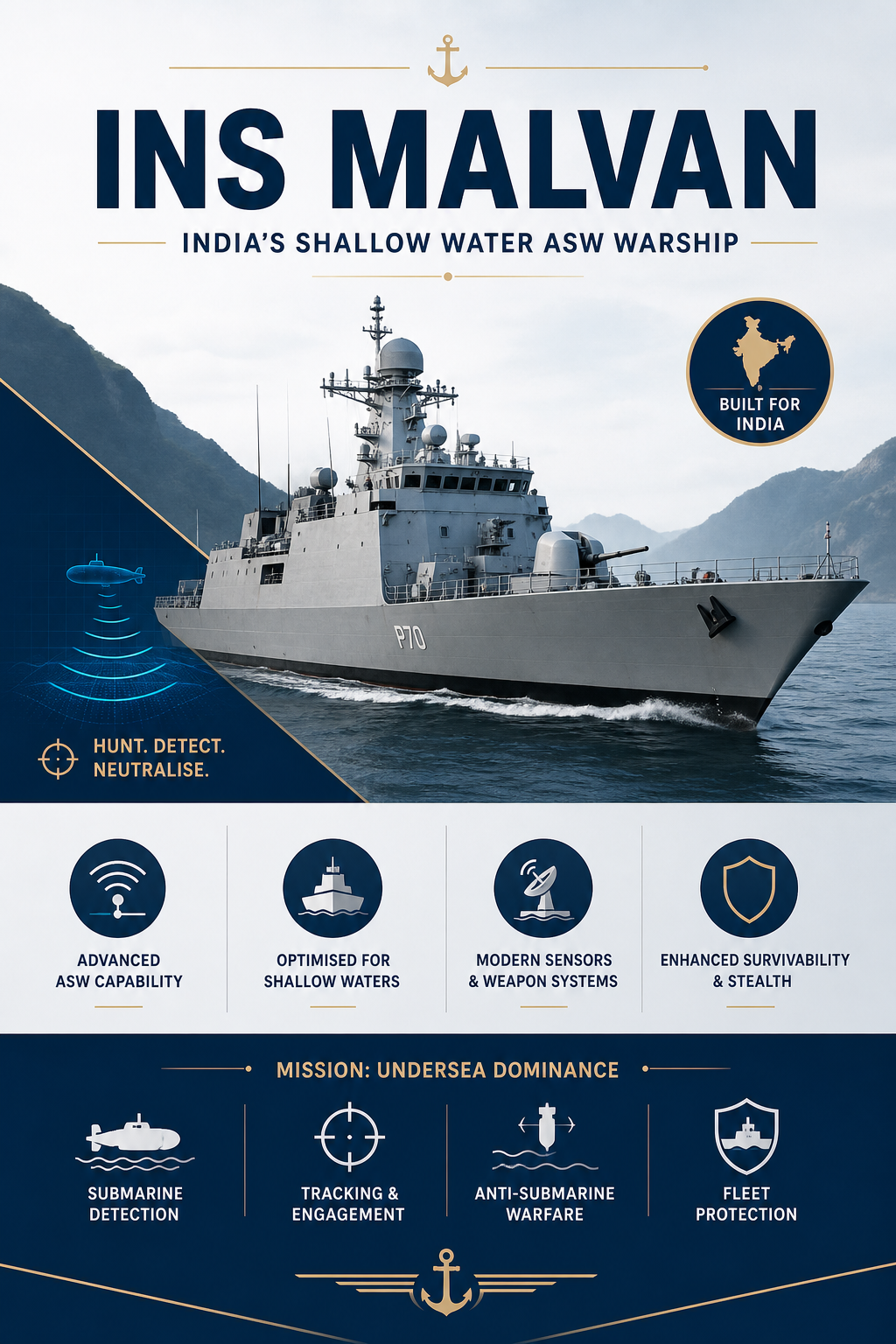
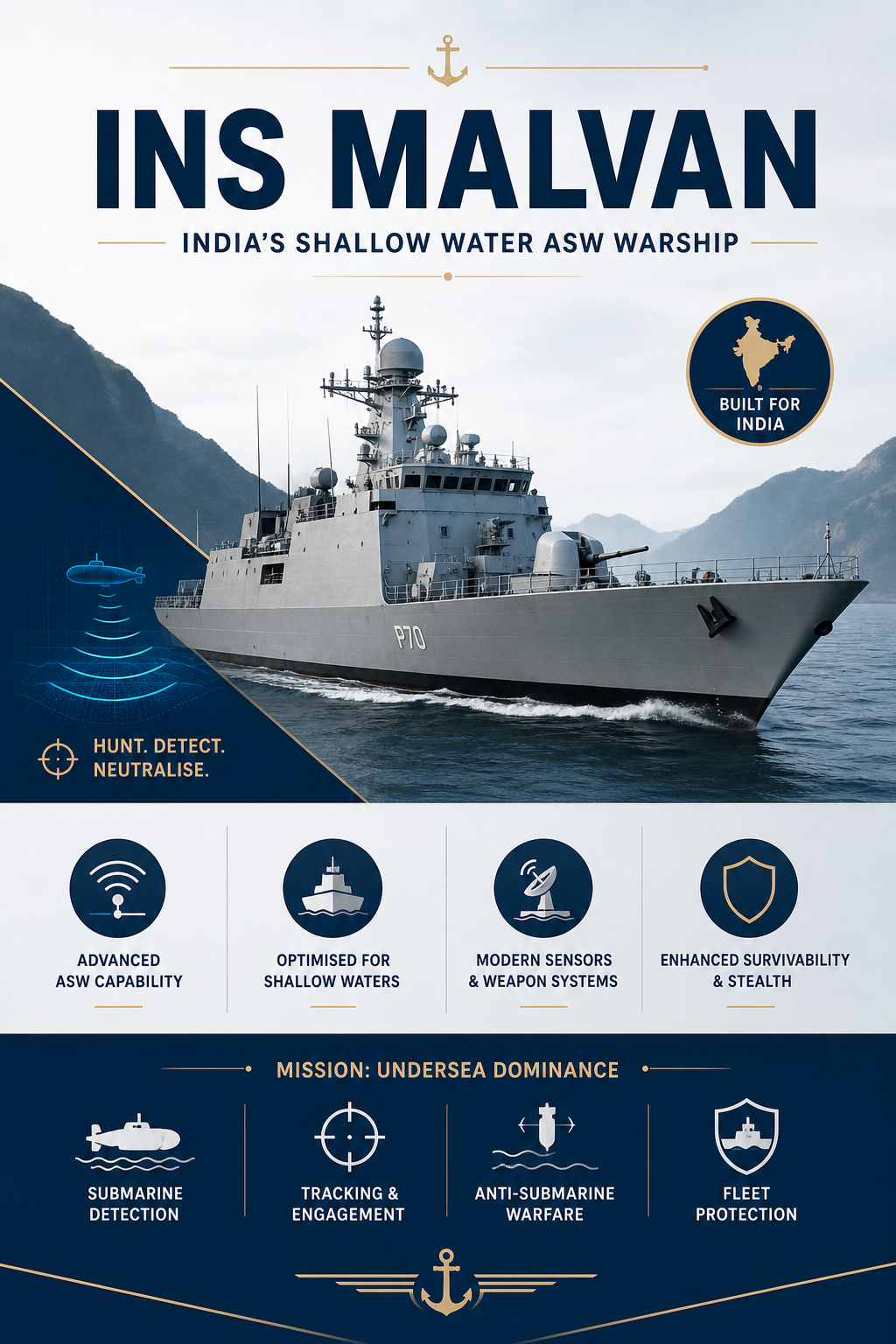
It is the second vessel of the Indian Navy’s Mahe-class Anti-Submarine Warfare Shallow Water Craft, commonly described as ASW-SWC. The class has been designed specifically for operations in coastal and relatively shallow maritime environments where larger warships may face operational constraints. The vessel has been built in India by Cochin Shipyard Limited, reinforcing the indigenous component of India’s naval modernisation programme.
Although anti-submarine warfare is its defining function, the platform has a broader maritime role. Such vessels can contribute to coastal surveillance, maritime patrol, search and rescue and other operational tasks. Their relatively shallow draft allows them to operate closer to the coast and in waters that may be unsuitable for larger combatants. This makes the class particularly relevant for protecting approaches to ports, harbours and other strategically important coastal infrastructure.
Why is INS Malvan in News?
The Indian Navy commissioned the warship at the Naval Dockyard in Visakhapatnam. Its induction represents another step in the Navy’s effort to strengthen specialised anti-submarine capability in littoral waters while replacing older platforms with modern indigenous vessels. Commissioning is an important stage in a naval vessel’s lifecycle because it formally brings the ship into active naval service following construction, trials and acceptance procedures.
The development also highlights India’s policy of increasing domestic participation in defence shipbuilding. Indigenous construction can build domestic industrial expertise, reduce external dependence and support maintenance throughout a vessel’s operational life. For the Navy, the induction of specialised shallow-water craft adds another layer to maritime domain awareness and underwater defence near India’s coastline. Official information can be followed through the PIB Official Release.
Key Features of the Mahe-Class ASW Craft
Anti-submarine warfare involves finding, identifying, tracking and, when necessary, engaging hostile submarines. The task is technically demanding because submarines are designed to remain concealed underwater. Naval forces consequently depend on specialised sensors, sonar systems, weapons, data processing and coordinated operations involving ships, aircraft and other platforms. A shallow-water ASW vessel adapts these capabilities to the complex acoustic conditions found near coastlines.
- Specialised ASW role: designed to detect and respond to underwater threats in coastal waters.
- Shallow draft: enables operations in relatively shallow areas where larger warships can face navigational restrictions.
- Multiple missions: the class can support coastal surveillance, maritime patrol and search-and-rescue operations.
- Indigenous construction: domestic shipbuilding contributes to technological capability and defence self-reliance.
- Littoral operations: the vessel can strengthen protection around ports, harbours, coastal infrastructure and maritime approaches.
Shallow-water submarine detection presents distinctive difficulties. Sound can reflect from the seabed and interact with coastal conditions, while fishing vessels and civilian maritime traffic create acoustic noise. Submarines can also use underwater terrain and complex coastal environments to reduce their detectability. Dedicated vessels equipped for this environment therefore complement larger surface combatants and other anti-submarine assets.
Challenges Related to INS Malvan
The principal challenge is the technical complexity of underwater detection. Sonar performance can be influenced by water depth, temperature, salinity, seabed characteristics, ambient noise and civilian vessel movement. Detecting a quiet submarine is therefore not simply a matter of possessing a sensor; crews must interpret complex acoustic information and integrate it with intelligence and other maritime-surveillance inputs.
A second challenge is integration. A specialised ASW vessel becomes more effective when connected with maritime patrol aircraft, helicopters, larger warships, coastal surveillance networks and command systems. India must also sustain domestic supply chains for sensors, weapons, propulsion, maintenance and upgrades if indigenisation is to provide long-term strategic benefits.
Way Forward for India’s Maritime Security
India requires a layered maritime-security architecture in which specialised shallow-water vessels complement destroyers, frigates, submarines, aircraft, helicopters and shore-based surveillance systems. Continued investment in sonar, underwater sensors, secure communications, unmanned systems and data fusion can improve detection and response. Regular exercises are equally important because effective anti-submarine warfare depends heavily on crew training, coordination and familiarity with local underwater conditions.
Domestic shipbuilding should also be accompanied by deeper indigenisation of critical onboard systems and lifecycle support. A reliable domestic ecosystem can improve availability, enable quicker upgrades and reduce vulnerability to external supply disruptions. As India’s trade, energy flows and strategic interests remain closely connected to the seas, strengthening littoral defence contributes to wider maritime security and strategic autonomy.
Prelims Practice Corner
1. INS Malvan is primarily associated with:
- (a) Ballistic missile defence
- (b) Anti-submarine warfare in shallow waters
- (c) Strategic nuclear deterrence
- (d) Satellite tracking
Answer: (b) It belongs to the Mahe-class Anti-Submarine Warfare Shallow Water Craft programme.
2. Consider the following statements regarding anti-submarine warfare:
1. Sonar can be used for detecting underwater targets.
2. Shallow-water acoustic conditions can complicate submarine detection.
3. Anti-submarine warfare can involve ships as well as aircraft.
Answer: (d) 1, 2 and 3. ASW is a multi-platform activity, and underwater acoustic conditions strongly influence detection.
3. In naval terminology, the draft of a ship refers to:
- (a) Maximum speed of the vessel
- (b) Vertical distance between the waterline and the lowest part of the hull
- (c) Width of the ship
- (d) Maximum radar range
Answer: (b) A lower draft helps a vessel operate safely in shallower waters.
4. The Mahe-class ASW Shallow Water Craft are being inducted into the:
- (a) Indian Coast Guard only
- (b) Indian Navy
- (c) Border Security Force
- (d) Central Industrial Security Force
Answer: (b) Indian Navy. They are specialised naval platforms designed principally for shallow-water anti-submarine operations.
5. Which of the following can make submarine detection in coastal waters difficult?
1. Seabed reflections
2. Civilian shipping noise
3. Complex underwater terrain
Answer: (d) All three can complicate the acoustic environment in shallow coastal waters.
Mains Practice Questions
-
Why is specialised shallow-water anti-submarine warfare capability important for India’s maritime security? Discuss. (10 marks)
Outline: Define ASW → coastal and littoral vulnerability → ports and maritime infrastructure → challenges of shallow-water detection → role of specialised vessels → integration with aircraft and surveillance systems → conclusion.
-
Defence indigenisation in naval shipbuilding contributes to both operational preparedness and strategic autonomy. Examine. (15 marks)
Outline: Indigenous shipbuilding → reduced import dependence → domestic technology and employment ecosystem → maintenance and lifecycle support → supply-chain resilience → indigenous sensors and weapons → integration challenges → sustained R&D and production → way forward.
FAQs on India’s Shallow-Water ASW Capability
What is an Anti-Submarine Warfare Shallow Water Craft?
It is a specialised naval vessel designed to conduct anti-submarine operations in coastal and shallow waters where underwater acoustic conditions and navigational constraints differ from the open ocean.
Why are submarines difficult to detect in shallow waters?
Sound reflections from the seabed, coastal noise, civilian vessel traffic and underwater terrain can complicate sonar detection and tracking, while submarines are specifically designed to minimise their detectable signatures.
Why is the commissioning relevant for UPSC?
The development connects GS Paper III themes of maritime security, defence technology, indigenous manufacturing, strategic autonomy and the modernisation of India’s naval capabilities.
Related Current Affairs
Preparing for UPSC, PCS or HCS?
Talk to a mentor at Chetan Bharat Learning, Chandigarh. Free guidance on choosing the right exam and building a study plan.
Chat on WhatsAppCall 97793 53345UPSC / IAS / PCS coaching in Chandigarh · Trusted by aspirants across Punjab & Haryana
Leave a Reply
You must be logged in to post a comment.