UPSC Syllabus Mapping
GS Paper: GS-III
Subject: Cyber Security, Internal Security and Digital Governance
What is Boss Scam?
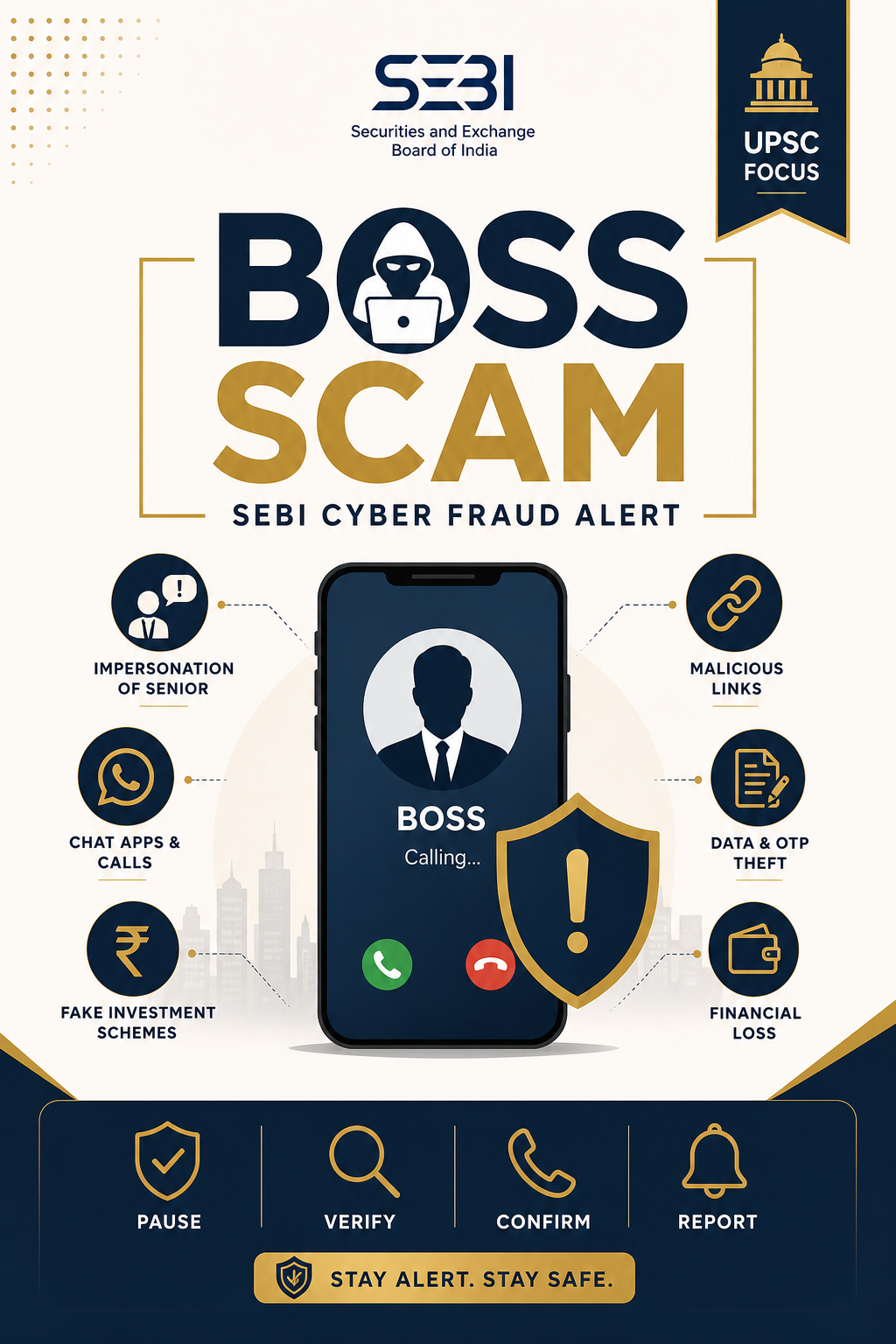
Boss Scam is a cyber fraud in which criminals impersonate senior executives such as the Chief Executive Officer (CEO) or Managing Director (MD) through emails, messaging platforms, voice calls or video calls to trick employees into transferring money to fraudulent bank accounts.
Modern Boss Scam attacks increasingly use AI-generated voice cloning, deepfake videos and malware to make fraudulent instructions appear genuine. Finance and accounts personnel are the most common targets because they have authority over corporate financial transactions.
Why is Boss Scam in News?
Boss Scam is in the news after SEBI issued an advisory based on inputs from the Indian Cyber Crime Coordination Centre (I4C), warning listed companies and regulated entities to strengthen internal verification procedures against sophisticated cyber fraud.
The regulator highlighted two major attack methods: AI-powered deepfake impersonation and malware distributed through malicious compressed files that compromise devices and messaging applications. Official updates can be accessed through PIB Official Release.
Key Features of Boss Scam
- Impersonation of CEOs, Managing Directors and senior executives.
- Use of AI-generated voice cloning and deepfake video calls.
- Distribution of malware through malicious .zip, .exe and .dll files.
- Hijacking of WhatsApp Web sessions and other communication platforms.
- Manipulation of contact lists to display fraudulent numbers as trusted executives.
- Transfers are routed to mule bank accounts controlled by cybercriminals.
- Targets primarily finance and accounts departments handling payments.
Challenges Related to Boss Scam
The rapid advancement of artificial intelligence has made digital impersonation highly convincing, making traditional verification methods inadequate. Employees often act under perceived urgency without independently verifying payment instructions.
India also faces challenges from increasing phishing, vishing, smishing, ransomware and malware attacks. Strengthening cyber awareness, multi-factor authentication and robust internal controls has become essential. Aspirants can explore related governance topics through Chetan Bharat Learning.
Way Forward for Boss Scam
Organisations should implement multi-level verification for financial transactions, mandatory callback procedures, employee cyber awareness programmes, endpoint security, regular software updates and zero-trust security architecture. Reporting suspected fraud immediately through the national cybercrime helpline (1930) and the National Cyber Crime Reporting Portal is equally important.
Greater coordination among SEBI, CERT-In, I4C, financial institutions and law enforcement agencies, along with stronger AI governance frameworks, will enhance India’s cyber resilience. Additional policy resources are available through PRS Legislative Research.
Prelims Practice Corner
| Question | Options | Answer |
|---|---|---|
| Boss Scam primarily targets | A. Farmers B. Finance and accounts personnel C. Students D. Tourists |
B. Finance and accounts personnel |
| Which technology is increasingly used in Boss Scam attacks? | A. Blockchain B. Quantum Computing C. Deepfake AI D. GIS |
C. Deepfake AI |
| The Indian Cyber Crime Coordination Centre (I4C) functions under | A. Ministry of Finance B. Ministry of Home Affairs C. Ministry of Electronics and IT D. NITI Aayog |
B. Ministry of Home Affairs |
| CERT-In is designated under which Act? | A. Companies Act, 2013 B. IT Act, 2000 C. SEBI Act, 1992 D. RBI Act, 1934 |
B. Information Technology Act, 2000 |
| SEBI primarily regulates | A. Banking sector B. Securities market C. Telecom sector D. Insurance sector |
B. Securities market |
Mains Practice Questions
- 1. Examine the emerging cyber security challenges posed by artificial intelligence and deepfake technologies in India. Suggest measures to strengthen institutional resilience.
Outline: AI-enabled threats, regulatory framework, CERT-In, I4C, organisational preparedness, awareness and technology adoption. - 2. Discuss the role of SEBI, CERT-In and the Indian Cyber Crime Coordination Centre (I4C) in strengthening India’s cyber security ecosystem.
Outline: Institutional framework, legal provisions, coordination mechanisms, challenges and reforms.
FAQs on Boss Scam
What is Boss Scam?
It is a cyber fraud in which criminals impersonate senior executives to induce employees to transfer funds fraudulently.
How does AI contribute to Boss Scam?
AI enables voice cloning, deepfake video creation and realistic impersonation, making fraudulent communication more convincing.
What should victims of Boss Scam do?
Immediately report the incident by calling the national cybercrime helpline 1930 or filing a complaint on the National Cyber Crime Reporting Portal, while informing the concerned organisation and bank.
Related Current Affairs
Preparing for UPSC, PCS or HCS?
Talk to a mentor at Chetan Bharat Learning, Chandigarh. Free guidance on choosing the right exam and building a study plan.
Chat on WhatsAppCall 97793 53345UPSC / IAS / PCS coaching in Chandigarh · Trusted by aspirants across Punjab & Haryana
Leave a Reply
You must be logged in to post a comment.