
UPSC Syllabus Mapping
GS Paper: GS-II
Subject: Indian Polity & Governance
Topic: Fundamental Rights, Public Order, Judiciary
Prelims: Articles 19, Reasonable Restrictions, BNSS Provisions
Mains: Balance between Fundamental Rights and Public Order.
Why in News?
The Right to Protest has once again entered public debate following nationwide discussions on legal restrictions governing demonstrations and protests. The issue highlights the constitutional protection available to peaceful protests while emphasizing that such rights are subject to reasonable restrictions in the interests of public order and national security.
What is the Right to Protest?
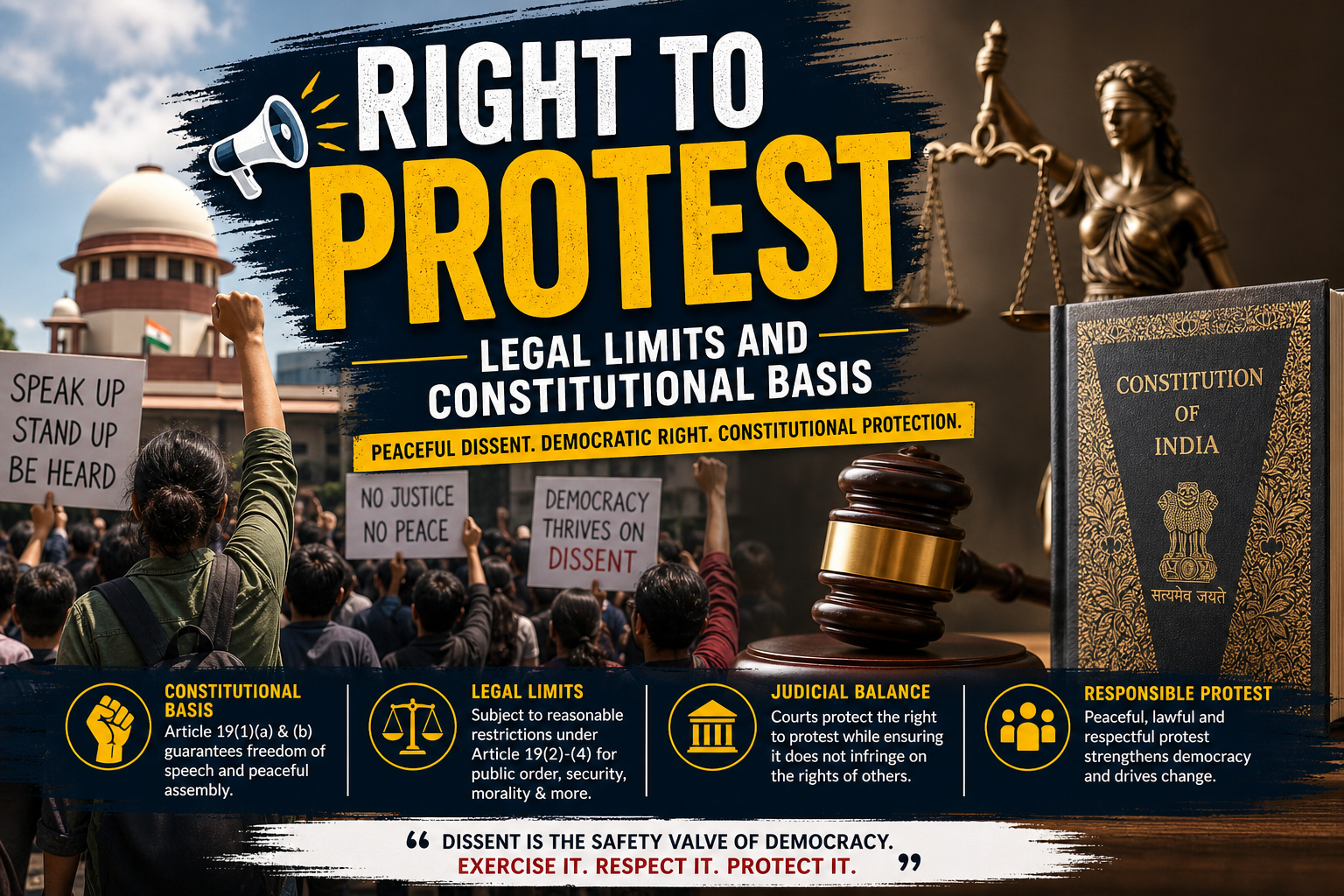
The Constitution of India does not explicitly mention a separate Right to Protest. However, the right is derived primarily from Article 19(1)(a), which guarantees freedom of speech and expression, Article 19(1)(b), which guarantees the right to assemble peacefully without arms, and Article 19(1)(c), which provides the freedom to form associations.
Relevant Constitutional Provisions
- Article 19(1)(a): Freedom of Speech and Expression.
- Article 19(1)(b): Right to Assemble Peacefully without Arms.
- Article 19(1)(c): Freedom to Form Associations.
- Articles 19(2) & 19(3): Permit reasonable restrictions in the interests of sovereignty, integrity, public order and morality.
Key Dimensions of Right to Protest
- Peaceful protest is a democratic method of expressing dissent.
- The right is not absolute and cannot infringe upon the rights of others.
- Authorities may regulate time, place and manner of protests.
- Violent protests, destruction of property and unlawful assemblies lose constitutional protection.
Reasonable Restrictions
- Sovereignty and Integrity of India
- Security of the State
- Friendly Relations with Foreign States
- Public Order
- Decency and Morality
- Contempt of Court
- Defamation
- Incitement to an Offence
Police Permission and Designated Protest Sites
Governments often require prior permission for large public gatherings to ensure traffic management, public safety, emergency services and law and order. Such regulation must facilitate democratic participation rather than amount to a blanket prohibition.
Section 163 BNSS
Section 163 of the Bharatiya Nagarik Suraksha Sanhita (BNSS) empowers Executive Magistrates to issue temporary orders in urgent situations to prevent obstruction, danger, nuisance or threats to public tranquillity. The provision replaces the corresponding preventive provision under the Criminal Procedure Code.
Important Supreme Court Judgments
- Himat Lal Shah v. Commissioner of Police (1973): Citizens possess the right to hold public meetings on public streets subject to reasonable regulation.
- Mazdoor Kisan Shakti Sangathan v. Union of India (2018): Protest is a democratic right but must be balanced with the rights of residents.
- Amit Sahni v. Commissioner of Police (Shaheen Bagh Case, 2020): Public roads cannot be occupied indefinitely in the name of protest.
UPSC Value Addition
| Aspect | Key Point |
|---|---|
| Nature of Right | Fundamental but not Absolute |
| Articles | 19(1)(a), 19(1)(b), 19(1)(c) |
| Restrictions | Articles 19(2) & 19(3) |
| Current Law | Section 163 BNSS |
Prelims Practice Corner
Q1. Which Article guarantees the right to assemble peacefully without arms?
A. Article 14
B. Article 19(1)(b)
C. Article 21
D. Article 32
Answer: B. Article 19(1)(b).
Q2. Which constitutional provision permits reasonable restrictions on the right to assemble?
A. Article 20
B. Article 19(3)
C. Article 22
D. Article 15
Answer: B. Article 19(3).
Q3. Section 163 BNSS primarily deals with:
A. Bail
B. Preventive Orders
C. Cybercrime
D. Appeals
Answer: B. Preventive Orders.
Q4. Which judgment held that indefinite occupation of public roads cannot be justified?
A. Kesavananda Bharati
B. Minerva Mills
C. Amit Sahni Case
D. SR Bommai
Answer: C. Amit Sahni Case.
Q5. Peaceful protest derives mainly from which Fundamental Rights?
A. Articles 14 & 15
B. Articles 19(1)(a), 19(1)(b) & 19(1)(c)
C. Articles 20 & 21
D. Articles 25 & 26
Answer: B. Articles 19(1)(a), 19(1)(b) & 19(1)(c).
Mains Practice Questions
Q1 (10 Marks): Discuss the constitutional basis of the Right to Protest in India. Examine why it is subject to reasonable restrictions.
Answer Framework: Introduction → Constitutional provisions → Judicial interpretation → Reasonable restrictions → Conclusion.
Q2 (15 Marks): ‘Balancing civil liberties with public order remains one of the biggest constitutional challenges in India.’ Discuss with suitable judicial examples.
Answer Framework: Introduction → Rights involved → State obligations → Supreme Court rulings → Way Forward.
FAQs
1. Is protesting a Fundamental Right?
Yes. It flows primarily from Article 19 freedoms, subject to reasonable restrictions.
2. Can the government completely ban protests?
No. Restrictions must be reasonable, proportionate and legally justified.
3. Are violent protests constitutionally protected?
No. Constitutional protection extends only to peaceful and lawful assemblies.
Related Current Affairs
Preparing for UPSC, PCS or HCS?
Talk to a mentor at Chetan Bharat Learning, Chandigarh. Free guidance on choosing the right exam and building a study plan.
Chat on WhatsAppCall 97793 53345UPSC / IAS / PCS coaching in Chandigarh · Trusted by aspirants across Punjab & Haryana
Leave a Reply
You must be logged in to post a comment.