
UPSC Syllabus Mapping
GS Paper: GS-III (Environment, Science & Technology) and GS-II (Governance & Public Health)
Subject: Air Pollution, Artificial Intelligence, Environmental Governance
Prelims: AQI, PM2.5, NCAP, CAQM, CPCB
Mains: Urban Air Pollution, AI in Governance, Public Health
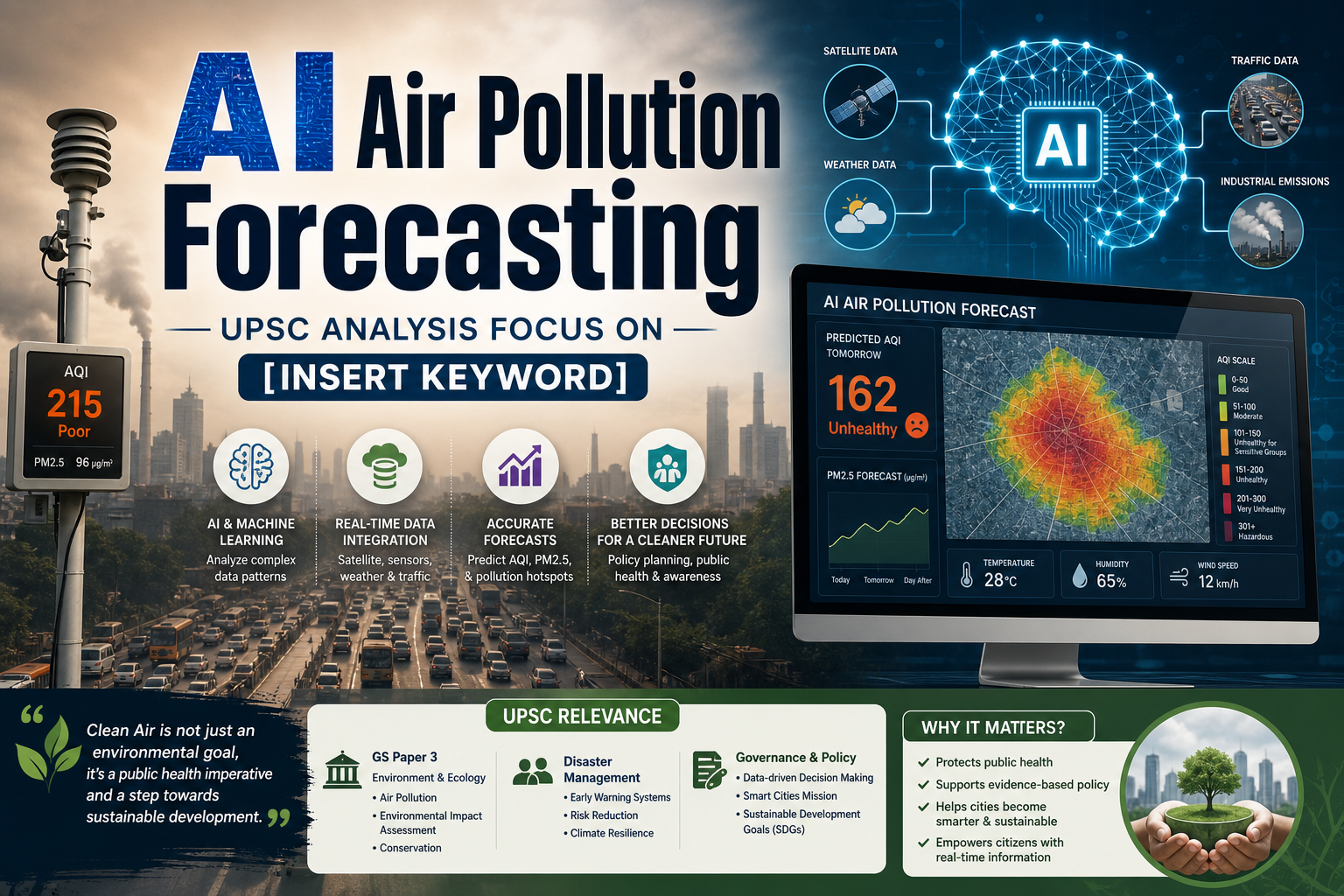
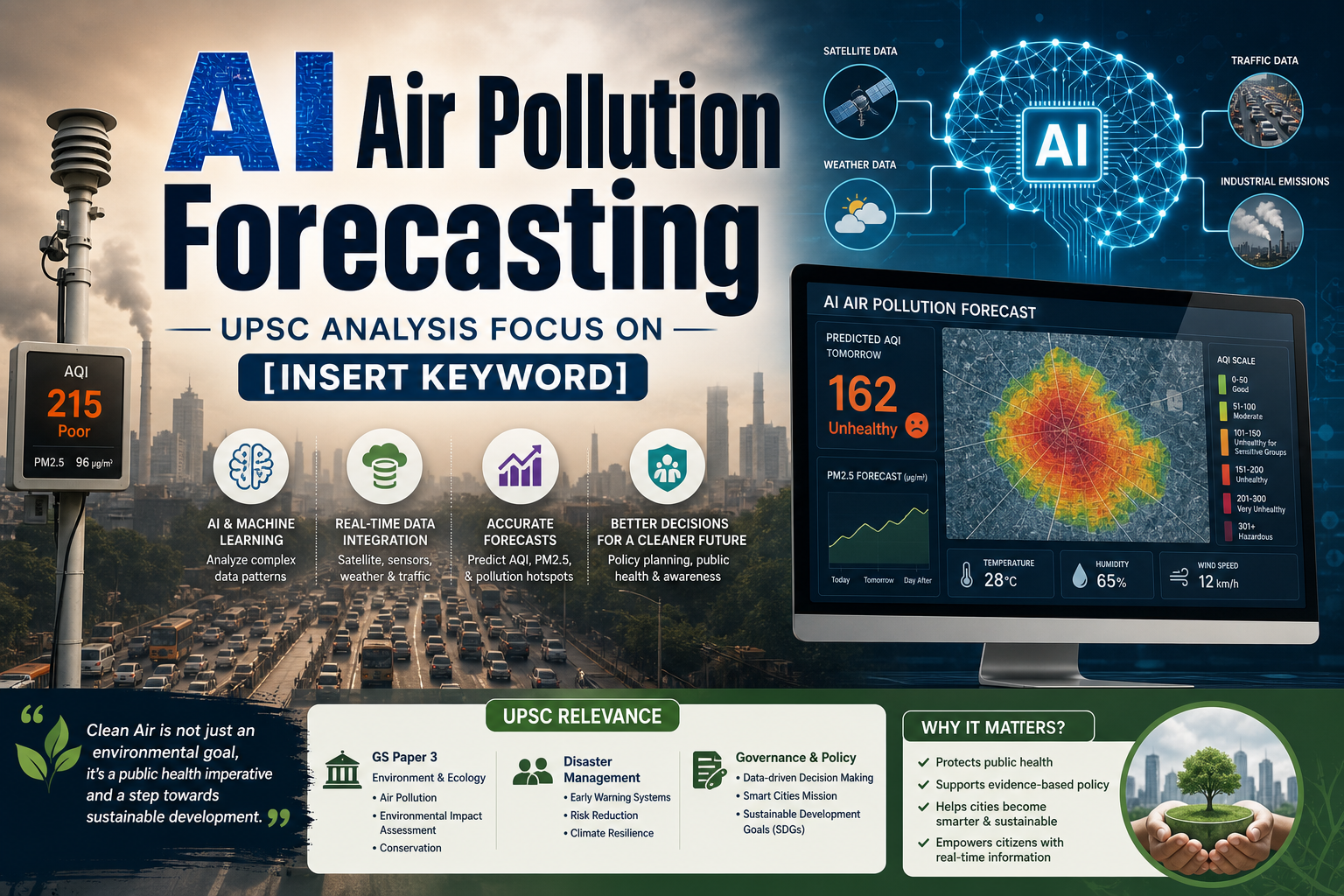
AI Air Pollution Forecasting has gained attention after Delhi adopted a permanent winter air pollution management framework that proposes using Artificial Intelligence (AI)-based air quality forecasting to identify safer outdoor hours and reduce pollution exposure, particularly for children. The initiative reflects the growing role of AI in evidence-based environmental governance.
What is Air Pollution?
Air pollution refers to the presence of harmful substances in the atmosphere that adversely affect human health, ecosystems and the climate. Major pollutants include particulate matter (PM2.5 and PM10), nitrogen oxides (NOx), sulphur dioxide (SO₂), carbon monoxide (CO) and ground-level ozone (O₃).
Why is PM2.5 Dangerous?
- PM2.5 particles are smaller than 2.5 micrometres and can penetrate deep into the lungs.
- They may enter the bloodstream and affect multiple organs.
- Long-term exposure increases the risk of asthma, bronchitis, cardiovascular diseases, stroke and lung cancer.
- Children, elderly people and pregnant women are among the most vulnerable groups.
Important Concepts
| Concept | Meaning |
|---|---|
| AQI (Air Quality Index) | A communication tool indicating the level of air pollution. It reflects pollution levels but does not directly specify the safest time for outdoor activities. |
| Temperature Inversion | A winter weather condition in which cold air is trapped near the surface, preventing pollutants from dispersing. |
| AI Forecasting | Machine learning models analyse weather, satellite imagery, pollution monitoring data and historical trends to predict future air quality. |
How AI Can Improve Air Quality Management
- Predict hourly pollution levels instead of providing only current AQI.
- Identify safer periods for children’s outdoor activities.
- Support schools, hospitals and local administrations in planning.
- Enable proactive public health advisories.
- Improve resource allocation during severe pollution episodes.
Government Initiatives
- National Clean Air Programme (NCAP).
- Commission for Air Quality Management (CAQM).
- Central Pollution Control Board (CPCB).
- National Air Quality Monitoring Programme (NAMP).
- National Ambient Air Quality Standards (NAAQS).
Challenges
- Accuracy depends on high-quality and continuous data.
- Forecasts remain uncertain due to changing weather conditions.
- Privacy, cybersecurity and algorithmic transparency concerns.
- AI can reduce exposure but cannot eliminate pollution at its source.
Way Forward
- Integrate AI forecasting with CPCB and IMD monitoring systems.
- Provide locality-specific pollution forecasts.
- Help schools schedule outdoor activities based on predicted AQI.
- Expand monitoring networks and improve emission inventories.
- Use AI as a decision-support tool while strengthening pollution control at source.
Prelims Practice Corner (5 MCQs)
Q1. PM2.5 refers to particulate matter with a diameter:
A. Less than 10 µm
B. Less than 5 µm
C. Less than 2.5 µm
D. Exactly 2.5 mm
Ans: C.
Q2. Which organisation implements the National Clean Air Programme (NCAP)?
A. RBI
B. CPCB under the Ministry of Environment, Forest and Climate Change
C. NITI Aayog
D. ISRO
Ans: B.
Q3. Temperature inversion contributes to:
A. Faster dispersion of pollutants
B. Heavy rainfall
C. Trapping pollutants near the surface
D. Formation of cyclones
Ans: C.
Q4. AI-based air quality forecasting primarily helps in:
A. Eliminating emissions instantly
B. Predicting pollution levels for better decision-making
C. Replacing pollution control laws
D. Increasing industrial production
Ans: B.
Q5. Which pollutant is considered most harmful because it can enter the bloodstream?
A. PM2.5
B. Carbon dioxide
C. Nitrogen gas
D. Water vapour
Ans: A.
Mains Practice Questions & Answer Structure
Q1. Discuss how Artificial Intelligence can strengthen urban air pollution management in India while addressing ethical and governance concerns.
Introduction: Urban pollution challenge.
Body: Forecasting, public health, governance, limitations, data quality and transparency.
Conclusion: AI should complement, not replace, pollution control measures.
Q2. Air pollution is both an environmental and public health challenge. Examine with suitable examples.
Introduction: Multi-dimensional nature of pollution.
Body: Health impacts, governance initiatives, technology interventions, institutional challenges.
Way Forward: Integrated policy, clean energy and scientific monitoring.
FAQs
What is PM2.5?
PM2.5 consists of extremely fine particulate matter that can penetrate deep into the lungs and bloodstream, posing serious health risks.
Can AI solve air pollution?
No. AI improves forecasting and helps reduce exposure through better planning, but pollution must ultimately be reduced by controlling emissions at their source.
Why is this topic important for UPSC?
It integrates Environment, Public Health, Artificial Intelligence and Governance, making it relevant for Prelims as well as GS-II and GS-III Mains.
Related Current Affairs
Preparing for UPSC, PCS or HCS?
Talk to a mentor at Chetan Bharat Learning, Chandigarh. Free guidance on choosing the right exam and building a study plan.
Chat on WhatsAppCall 97793 53345UPSC / IAS / PCS coaching in Chandigarh · Trusted by aspirants across Punjab & Haryana
Leave a Reply
You must be logged in to post a comment.