
Why Is This News Important?
The conflict between Israel and Hezbollah has taken another significant turn as Hezbollah rejected a proposed ceasefire while Israel continued military operations in southern Lebanon.
The development has raised concerns about regional stability and has complicated efforts by the United States to reduce tensions in West Asia.
For UPSC aspirants, this issue is important from the perspective of International Relations, regional security, conflict resolution, and Middle East geopolitics.
What Happened?
A ceasefire proposal aimed at reducing hostilities in Lebanon faced a setback after Hezbollah rejected the agreement.
At the same time:
- Israel continued military strikes in southern Lebanon.
- Israeli officials stated that troops would not withdraw immediately.
- Hezbollah maintained its resistance strategy.
- Diplomatic efforts to restore peace suffered a major setback.
As a result, tensions remain high across the region.
Background of the Israel-Hezbollah Conflict
Hezbollah is a political and militant organization based in Lebanon.
The group has been involved in several confrontations with Israel over the past decades.
The conflict is influenced by:
- Border disputes
- Security concerns
- Regional rivalries
- Iran’s support for Hezbollah
These factors have made peace efforts difficult.
Why Did Hezbollah Reject the Ceasefire?
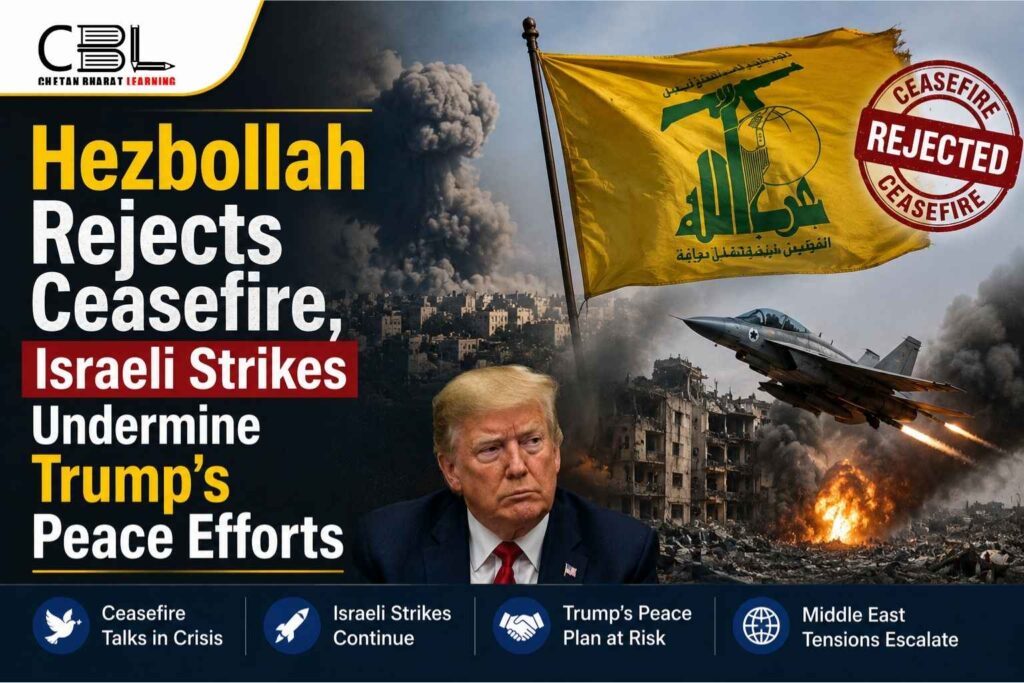
Hezbollah argued that a ceasefire should address broader regional concerns rather than only temporary military arrangements.
The group also linked developments in Lebanon with wider tensions involving Iran and Israel.
Consequently, negotiations have become more complex.
Why Is Israel Continuing Military Operations?
Israel maintains that military action is necessary to address security threats and prevent attacks from Hezbollah.
Israeli authorities have emphasized:
- Border security
- Protection of civilians
- Countering militant activities
- Long-term strategic objectives
Therefore, Israel has shown reluctance to halt operations without security guarantees.
Key Geopolitical Implications
Rising Regional Instability
The conflict increases uncertainty across West Asia and raises fears of broader escalation.
Impact on Diplomacy
Repeated ceasefire failures weaken ongoing diplomatic efforts.
Iran’s Influence
Iran’s support for Hezbollah adds another layer of complexity to the conflict.
Global Security Concerns
Prolonged instability can affect:
- International trade routes
- Energy markets
- Regional alliances
- Global security calculations
Impact on India
India closely monitors developments in West Asia because the region is important for:
- Energy imports
- Trade relations
- Indian diaspora
- Strategic interests
Any prolonged conflict could affect regional stability and economic interests.
Major Challenges
Several obstacles continue to hinder peace efforts:
- Lack of trust between parties
- Ongoing military operations
- Regional rivalries
- External involvement
- Humanitarian concerns
These challenges make conflict resolution difficult.
Way Forward
To achieve lasting peace, stakeholders should focus on:
- Meaningful dialogue
- Confidence-building measures
- Ceasefire monitoring mechanisms
- Protection of civilians
- Regional diplomatic engagement
Sustainable peace will require cooperation from all parties involved.
Prelims Pointers
| Topic | Key Fact |
|---|---|
| Organization | Hezbollah |
| Country | Lebanon |
| Regional Actor | Israel |
| Region | West Asia |
| Issue | Ceasefire Rejection |
Mains Perspective
Possible UPSC Question
“Discuss the geopolitical implications of the Israel-Hezbollah conflict and its impact on regional stability in West Asia.”
Key Dimensions
- Regional security
- Iran-Israel rivalry
- Conflict resolution
- Diplomatic challenges
- Energy security
- International relations
Frequently Asked Questions
What is Hezbollah?
Hezbollah is a Lebanese political and militant organization with significant regional influence.
Why was the ceasefire rejected?
Hezbollah argued that broader regional concerns needed to be addressed before accepting a ceasefire.
Why is the conflict important globally?
It affects regional stability, energy markets, and international diplomacy.
Why is it important for UPSC?
The issue is relevant under International Relations, Security Issues, and Current Affairs.
Conclusion
The rejection of the ceasefire by Hezbollah and the continuation of Israeli military operations highlight the fragile security situation in West Asia.
The episode demonstrates the challenges of achieving peace in a region shaped by complex political, security, and geopolitical factors. For UPSC aspirants, the topic offers valuable insights into contemporary international relations and regional conflicts.
For More UPSC Current Affairs
Stay updated with the latest developments in international relations and global geopolitics through UPSC Coaching in Chandigarh and IAS Coaching in Chandigarh at Chetan Bharat Learning.
Related Current Affairs
Preparing for UPSC, PCS or HCS?
Talk to a mentor at Chetan Bharat Learning, Chandigarh. Free guidance on choosing the right exam and building a study plan.
Chat on WhatsAppCall 97793 53345UPSC / IAS / PCS coaching in Chandigarh · Trusted by aspirants across Punjab & Haryana
Leave a Reply
You must be logged in to post a comment.