
Why Is This News Important?
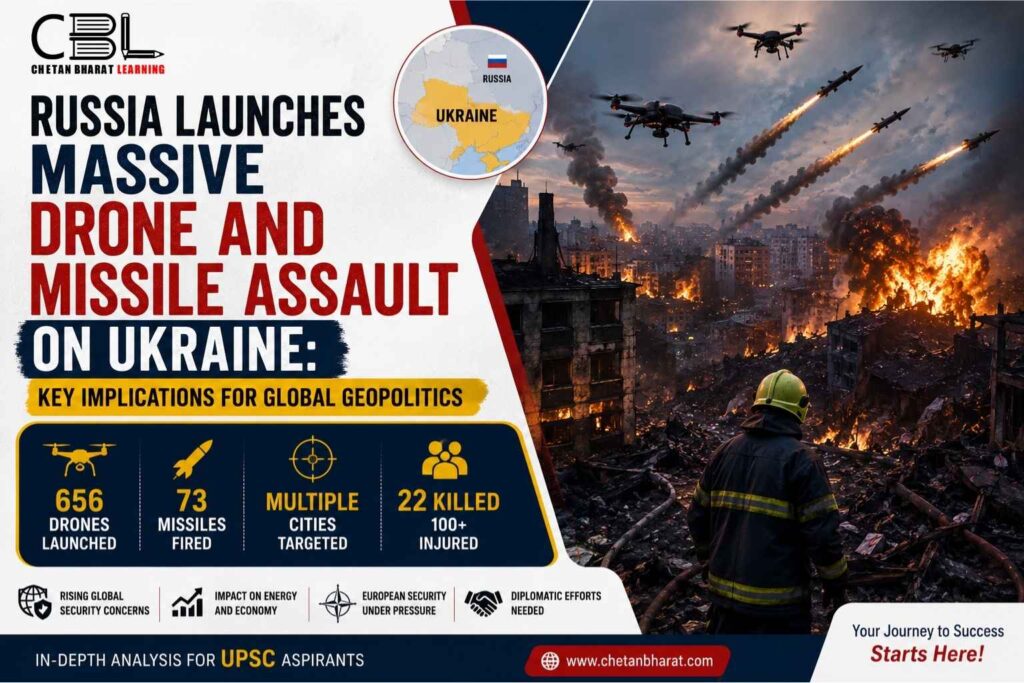
The Russia-Ukraine war has witnessed another major escalation. Russia recently launched one of its largest drone and missile attacks on Ukraine, targeting several cities overnight.
The assault caused significant casualties and widespread infrastructure damage. As a result, concerns regarding European security and global stability have intensified once again.
For UPSC aspirants, this development is important from the perspective of International Relations, Security Studies, and Global Geopolitics.
What Happened?
According to Ukrainian authorities, Russia launched a large-scale aerial assault involving:
- 656 drones
- 73 missiles
- Strikes on multiple cities, including Kyiv and Dnipro
- At least 22 deaths
- More than 100 injuries
The attacks damaged residential buildings, industrial facilities, and public infrastructure.
Officials described the assault as one of the largest coordinated attacks witnessed in recent months.
Background of the Russia-Ukraine Conflict
The conflict between Russia and Ukraine escalated significantly in February 2022 when Russia launched a full-scale military operation.
Since then, both countries have remained engaged in a prolonged conflict involving military offensives, drone warfare, missile strikes, and economic sanctions.
Despite several diplomatic efforts, a lasting peace agreement remains elusive.
Why Are These Attacks Increasing?
Several factors may be contributing to the recent escalation.
Strategic Pressure
Russia may be attempting to increase pressure on Ukraine by targeting critical infrastructure and urban centres.
Such attacks can disrupt economic activity and create operational challenges.
Battlefield Developments
Military operations continue across different regions.
As both sides seek strategic advantages, large-scale attacks have become increasingly common.
Stalled Peace Negotiations
Efforts to achieve a diplomatic breakthrough have made limited progress.
Consequently, military actions continue to dominate the conflict.
Impact on Ukraine
Humanitarian Impact
Civilians continue to suffer the most from the ongoing conflict.
The attacks have resulted in:
- Loss of life
- Injuries
- Displacement of families
- Psychological stress
Humanitarian concerns remain a major challenge.
Infrastructure Damage
Several important facilities have been affected.
These include:
- Energy infrastructure
- Industrial units
- Transport networks
- Residential buildings
The damage is likely to increase reconstruction costs in the future.
Economic Challenges
The conflict continues to place pressure on Ukraine’s economy.
Investment uncertainty, rising costs, and infrastructure losses have created long-term economic difficulties.
Global Geopolitical Implications
Rising Security Concerns in Europe
The conflict has significantly altered Europe’s security environment.
Many countries are increasing defence spending and strengthening military preparedness.
NATO’s Strategic Focus
The war has reinforced NATO’s emphasis on collective defence and regional security.
Member countries continue to monitor developments closely.
Energy Security Challenges
The conflict has also affected global energy markets.
Many nations are exploring alternative energy sources to reduce vulnerabilities.
Impact on Global Stability
The war continues to influence:
- International trade
- Supply chains
- Food security
- Diplomatic relations
Therefore, its consequences extend far beyond Europe.
India’s Perspective
India has consistently called for dialogue and diplomacy to resolve the conflict.
At the same time, India has emphasized:
- Respect for sovereignty
- Peaceful dispute resolution
- Humanitarian assistance
- International cooperation
India continues to balance its strategic interests while maintaining relations with multiple global partners.
Key Challenges Ahead
Several obstacles continue to hinder peace efforts.
These include:
- Lack of mutual trust
- Territorial disputes
- Security concerns
- External involvement by major powers
Without meaningful negotiations, the possibility of further escalation remains high.
Way Forward
A sustainable solution requires a combination of diplomacy and international cooperation.
Important steps include:
- Reviving peace negotiations
- Strengthening humanitarian support
- Building confidence between stakeholders
- Promoting long-term security arrangements
A peaceful resolution remains essential for regional and global stability.
Prelims Pointers
| Topic | Key Fact |
|---|---|
| Conflict | Russia-Ukraine War |
| Region | Eastern Europe |
| Important City | Kyiv |
| Security Alliance | NATO |
| Concern | European Security |
Mains Perspective
Possible UPSC Question
“The prolonged Russia-Ukraine conflict has reshaped global geopolitics and security architecture.” Discuss.
Key Dimensions
- European security
- NATO’s role
- Energy security
- Global economic impact
- Diplomatic challenges
- India’s foreign policy
Frequently Asked Questions (FAQ)
Why is the Russia-Ukraine conflict important?
It affects global security, energy markets, international trade, and international relations.
Why are drones increasingly used in warfare?
Drones provide surveillance, precision targeting, and cost-effective military capabilities.
How does the conflict affect Europe?
The war has increased security concerns and encouraged higher defence spending across Europe.
What is India’s position on the conflict?
India supports diplomacy, peaceful dialogue, and respect for international law.
Conclusion
The latest Russian drone and missile assault highlights the continuing intensity of the Russia-Ukraine conflict. While military operations continue, the humanitarian and economic costs are increasing.
The situation also demonstrates how regional conflicts can have global consequences. Moving forward, sustained diplomatic engagement will be essential to reduce tensions and promote long-term peace.
“Lasting peace can only be achieved when dialogue succeeds where conflict fails.”
Related Current Affairs
Preparing for UPSC, PCS or HCS?
Talk to a mentor at Chetan Bharat Learning, Chandigarh. Free guidance on choosing the right exam and building a study plan.
Chat on WhatsAppCall 97793 53345UPSC / IAS / PCS coaching in Chandigarh · Trusted by aspirants across Punjab & Haryana
Leave a Reply
You must be logged in to post a comment.