
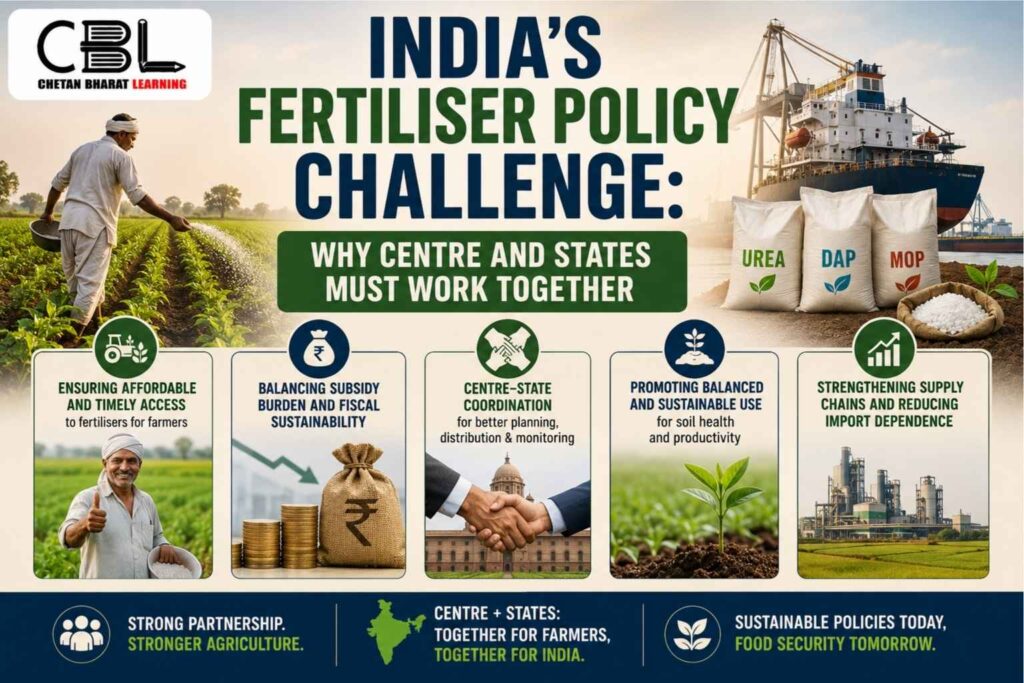
Why Fertiliser Policy Has Become a Major Concern
Fertilisers have played a crucial role in improving agricultural productivity and supporting India’s food security objectives. However, concerns are growing over the excessive use of chemical fertilisers, particularly urea, and their long-term impact on soil health, water resources, and agricultural sustainability.
The debate has gained attention as the Union Government has emphasized reducing chemical fertiliser consumption, while some states continue policies that encourage the use of subsidised fertilisers.
This situation highlights an important policy challenge: achieving coordination between the Centre and states on agricultural sustainability.
Students preparing through UPSC Coaching in Chandigarh and IAS Coaching in Chandigarh should closely follow topics like fertiliser subsidies, soil health, sustainable agriculture, and agricultural reforms because these themes are highly important for GS Paper 3, Essay, and UPSC Interview preparation.
Why Fertilisers Are Important
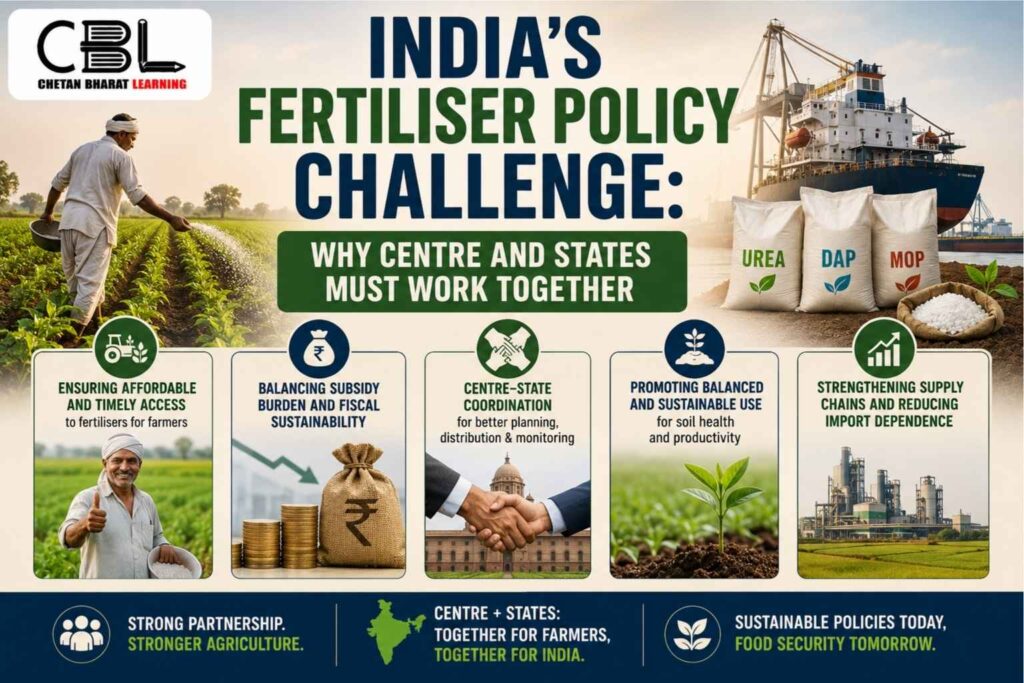
Fertilisers provide essential nutrients required for crop growth.
The three major nutrients are:
- Nitrogen (N)
- Phosphorus (P)
- Potassium (K)
Common fertilisers used in India include:
- Urea
- Di-Ammonium Phosphate (DAP)
- Potash-based fertilisers
These inputs have significantly contributed to increased agricultural production since the Green Revolution.
The Problem of Excessive Chemical Fertiliser Use
While fertilisers improve productivity, excessive use can create serious challenges.
Impact on Soil Health
Continuous overuse of chemical fertilisers may:
- Reduce soil fertility
- Decrease microbial activity
- Cause nutrient imbalance
- Lower long-term productivity
Healthy soil requires balanced nutrient management rather than excessive dependence on a single fertiliser.
Impact on Water Resources
Excess fertiliser use can lead to:
- Groundwater contamination
- Water pollution
- Nutrient runoff into rivers and lakes
This creates environmental concerns beyond agriculture.
Economic Burden
India spends substantial resources on fertiliser subsidies each year.
Heavy dependence on imported raw materials and fertiliser products can:
- Increase foreign exchange outflows
- Raise fiscal pressures
- Affect subsidy sustainability
Why the Centre Wants Reduced Chemical Fertiliser Use
The Union Government has increasingly promoted:
✔ Balanced nutrient application
✔ Nano fertilisers
✔ Organic farming practices
✔ Bio-fertilisers
✔ Soil Health Card initiatives
The objective is not to eliminate fertilisers but to encourage efficient and scientific use.
Reducing excessive chemical fertiliser consumption can:
- Improve soil health
- Reduce environmental damage
- Lower subsidy burdens
- Improve long-term agricultural sustainability
The Role of States in Fertiliser Policy
Agriculture is closely linked with state-level governance.
Many states influence agricultural practices through:
- Subsidy policies
- Procurement incentives
- Extension services
- Farmer support schemes
If state policies encourage greater fertiliser consumption while national policy seeks moderation, implementation challenges emerge.
This highlights the importance of policy coordination.
Alternative Approaches to Nutrient Management
1. Nano Fertilisers
Nano fertilisers are designed to improve nutrient-use efficiency by delivering nutrients more effectively to plants.
Potential benefits include:
- Lower fertiliser consumption
- Reduced environmental impact
- Better nutrient absorption
2. Bio-Fertilisers
Bio-fertilisers use beneficial microorganisms to improve nutrient availability and soil health.
Advantages include:
✔ Eco-friendly farming
✔ Reduced chemical dependence
✔ Improved soil quality
3. Integrated Nutrient Management (INM)
Integrated Nutrient Management combines:
- Chemical fertilisers
- Organic manure
- Bio-fertilisers
This approach seeks to balance productivity with sustainability.
The Soil Health Perspective
India’s agricultural future depends heavily on maintaining healthy soils.
Key challenges include:
- Nutrient imbalance
- Declining organic carbon
- Soil degradation
- Micronutrient deficiencies
Long-term productivity requires protecting soil as a strategic agricultural resource.
Balancing Productivity and Sustainability
The policy challenge is not choosing between productivity and sustainability.
Instead, policymakers must ensure:
✔ Adequate food production
✔ Farmer income security
✔ Soil conservation
✔ Efficient fertiliser use
A balanced approach can help achieve all these objectives simultaneously.
Prelims Pointers
Important Fertilisers
- Urea
- DAP (Di-Ammonium Phosphate)
- MOP (Muriate of Potash)
Important Initiatives
- Soil Health Card Scheme
- Nano Urea Initiative
Key Concept
Integrated Nutrient Management (INM)
Mains Perspective
Possible Question
“Excessive dependence on chemical fertilisers poses economic, environmental, and agricultural challenges for India.” Discuss.
Key Dimensions to Include
- Soil health
- Fertiliser subsidies
- Sustainable agriculture
- Nutrient management
- Food security
- Environmental sustainability
Frequently Asked Questions (FAQ)
Why is excessive fertiliser use a concern?
It can damage soil health, increase environmental pollution, and create long-term sustainability challenges.
What are nano fertilisers?
Nano fertilisers are advanced fertiliser formulations designed to improve nutrient-use efficiency while reducing overall consumption.
What is Integrated Nutrient Management?
It is a farming approach that combines chemical fertilisers, organic inputs, and bio-fertilisers to maintain soil health and productivity.
Why is Centre-State coordination important in fertiliser policy?
Different policy approaches can create implementation gaps. Coordinated action helps achieve agricultural productivity and sustainability goals simultaneously.
Conclusion: Towards Smarter Fertiliser Use
India’s fertiliser policy challenge is ultimately about finding the right balance between food security, farmer welfare, and environmental sustainability.
As concerns about soil degradation, subsidy costs, and resource efficiency increase, future agricultural policy will likely focus on smarter nutrient management rather than simply increasing fertiliser use.
The success of these reforms will depend on effective cooperation between the Centre, states, scientific institutions, and farmers.
“Sustainable agriculture is not about using fewer nutrients—it is about using the right nutrients, in the right quantity, at the right time.”
Related Current Affairs
Preparing for UPSC, PCS or HCS?
Talk to a mentor at Chetan Bharat Learning, Chandigarh. Free guidance on choosing the right exam and building a study plan.
Chat on WhatsAppCall 97793 53345UPSC / IAS / PCS coaching in Chandigarh · Trusted by aspirants across Punjab & Haryana
Leave a Reply
You must be logged in to post a comment.