
Why the Judiciary Matters in a Democracy
The judiciary is one of the most important pillars of a constitutional democracy. It acts as:
- The guardian of the Constitution
- A protector of fundamental rights
- A check on executive and legislative power
- An institution that upholds the rule of law
Recently, Chief Justice of India (CJI) B.R. Gavai expressed concern over increasing “attacks” on the judiciary by sections of:
- Media
- Social media platforms
- Activist groups
The remarks triggered a broader debate on judicial independence, institutional trust, accountability, and the limits of public criticism in a democracy.
Students preparing through UPSC Coaching in Chandigarh and IAS Coaching in Chandigarh should closely follow topics like judicial independence, constitutional morality, institutional accountability, and democratic governance because these themes are highly important for GS Paper 2, Essay, Ethics, and UPSC Interview preparation.
What Did the CJI Say?
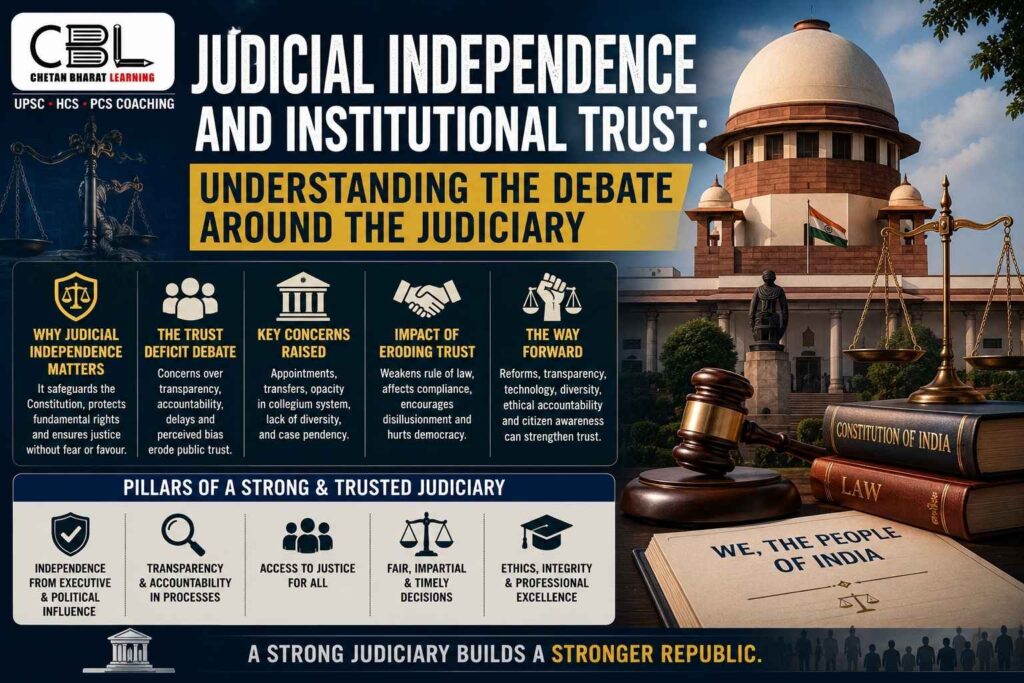
While hearing a case related to allegations concerning fake law degrees, the CJI observed that some individuals and groups often attack the judiciary without proper understanding of institutional processes.
The Court emphasized that:
✔ Judicial institutions must maintain dignity
✔ Public criticism should remain responsible
✔ Constitutional offices deserve institutional respect
The observations highlighted growing concerns regarding:
- Misinformation
- Social media trials
- Public distrust in institutions
- Declining institutional credibility
Judicial Independence: The Core Principle
Judicial independence means that courts must function free from:
- Political pressure
- Public intimidation
- Executive interference
- External influence
An independent judiciary is essential because it ensures:
✔ Fair justice delivery
✔ Protection of rights
✔ Constitutional balance
✔ Accountability of state institutions
Without judicial independence, democratic systems weaken significantly.
Can the Judiciary Be Criticized?
The Balance Between Accountability and Institutional Respect
In a democracy, public institutions are open to scrutiny and criticism. The judiciary is no exception.
Constructive criticism can help:
- Improve transparency
- Strengthen accountability
- Encourage institutional reforms
However, concerns emerge when criticism becomes:
- Personal attacks
- Misinformation campaigns
- Organized disinformation
- Attempts to delegitimize institutions
The central debate therefore revolves around balancing:
✔ Freedom of expression
✔ Institutional dignity
✔ Democratic accountability
The Role of Media and Social Media
The Rise of Instant Public Narratives
Social media has transformed how judicial proceedings are discussed and interpreted.
Today:
- Court proceedings trend online instantly
- Public opinion forms rapidly
- Partial information spreads quickly
This creates risks such as:
- Trial by media
- Misrepresentation of legal proceedings
- Polarization
- Erosion of institutional trust
While digital platforms improve democratic participation, they can also amplify misinformation and emotional reactions.
Judiciary and Constitutional Morality
India’s constitutional framework depends heavily on institutional trust.
The judiciary plays a central role in:
- Protecting constitutional values
- Defending civil liberties
- Preserving checks and balances
When trust in constitutional institutions weakens, democratic stability can suffer.
This is why courts often emphasize:
- Constitutional morality
- Institutional restraint
- Responsible democratic engagement
Why Institutional Trust Matters
Strong democracies function not only through laws but also through public confidence in institutions.
Institutional trust:
✔ Strengthens rule of law
✔ Reduces democratic instability
✔ Encourages peaceful dispute resolution
✔ Prevents constitutional breakdown
A decline in trust may increase:
- Political polarization
- Conspiracy narratives
- Public cynicism
- Governance challenges
The Debate Around Transparency
Critics often argue that greater transparency can improve judicial credibility.
Key demands include:
- Faster case disposal
- Clearer judicial communication
- Live-streaming of proceedings
- Judicial accountability mechanisms
Supporters of institutional restraint argue that excessive politicization of courts may undermine judicial neutrality.
This debate continues to shape India’s evolving constitutional discourse.
Prelims Pointers
Important Constitutional Principles
- Judicial Independence
- Rule of Law
- Separation of Powers
- Constitutional Morality
Relevant Institutions
- Supreme Court of India
- High Courts
- Collegium System
Mains Perspective
Possible Question
“Judicial independence and institutional accountability must coexist in a constitutional democracy.” Discuss.
Key Dimensions to Include
- Judicial autonomy
- Media responsibility
- Democratic accountability
- Constitutional trust
- Transparency reforms
- Social media challenges
Frequently Asked Questions (FAQ)
What is judicial independence?
Judicial independence means courts can function without political or external pressure while delivering fair and impartial justice.
Can the judiciary be criticized in a democracy?
Yes. Constructive criticism is part of democratic accountability, but misinformation and institutional delegitimization can weaken public trust.
Why is institutional trust important?
Institutional trust helps maintain democratic stability, rule of law, and peaceful constitutional functioning.
How does social media affect the judiciary?
Social media increases public engagement but can also spread misinformation, create polarization, and encourage trial-by-media narratives.
Conclusion: Democracy Depends on Institutional Balance
The debate around criticism of the judiciary reflects a deeper constitutional challenge:
How can democracies preserve both accountability and institutional dignity?
An independent judiciary remains essential for protecting constitutional governance and civil liberties. At the same time, democratic institutions must remain open to informed scrutiny and public discussion.
The long-term strength of constitutional democracy ultimately depends on maintaining:
- Judicial independence
- Responsible public discourse
- Institutional transparency
- Constitutional trust
“Democracies survive not only through elections and laws, but through public faith in the fairness and legitimacy of institutions.”
Related Current Affairs
Preparing for UPSC, PCS or HCS?
Talk to a mentor at Chetan Bharat Learning, Chandigarh. Free guidance on choosing the right exam and building a study plan.
Chat on WhatsAppCall 97793 53345UPSC / IAS / PCS coaching in Chandigarh · Trusted by aspirants across Punjab & Haryana
Leave a Reply
You must be logged in to post a comment.