
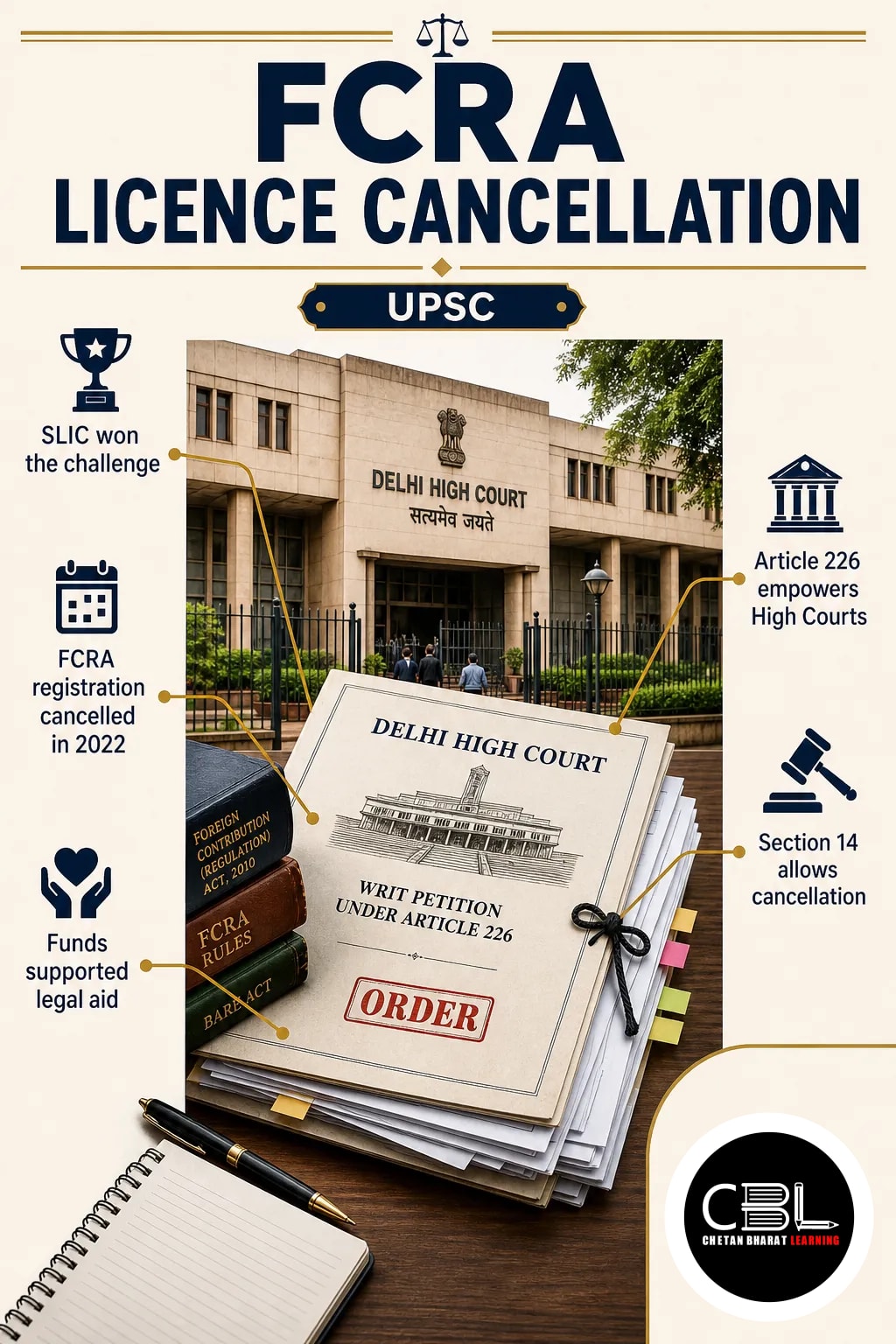
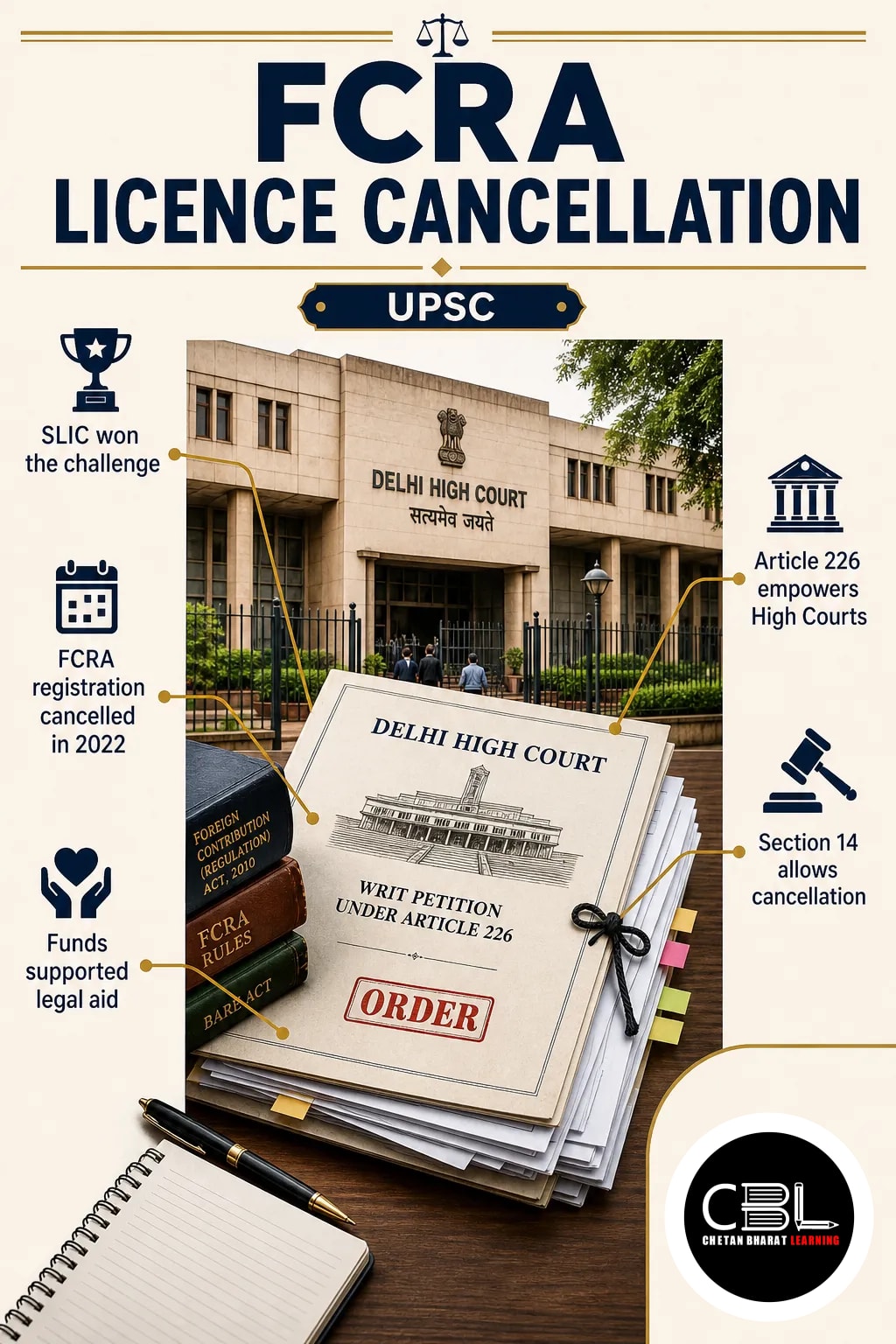
FCRA licence cancellation of the Socio Legal Information Centre (SLIC) has been set aside by the Delhi High Court. The ruling links foreign funding oversight with evidence-based administrative decisions, a key theme in polity and governance.
Quick answer: On 26 November 2026, the Delhi High Court overturned the FCRA licence cancellation of SLIC, a non-governmental organisation (NGO). Justice A.J. Bhambhani found no supporting material for the allegation of anti-government political activism or likely harm to national security, sovereignty, integrity or public interest.
What did the Delhi High Court hold?
The court set aside the Ministry of Home Affairs order cancelling SLIC’s registration under the Foreign Contribution (Regulation) Act, 2010 (FCRA). Justice Bhambhani found the order legally unsustainable and disproportionate in its impact.
The ministry had alleged that SLIC engaged in aggressive anti-government political activism. However, the court found no documents or other material on record supporting that allegation. It also found no material showing that SLIC’s activities would likely prejudice India’s sovereignty, integrity, security or public interest.
Moreover, the court examined how SLIC used foreign contributions. It found that the funds supported legal aid and social welfare, consistent with the organisation’s stated objectives.
Background of the case
SLIC challenged the ministry’s cancellation order of 17 October 2022 and the freezing of its foreign contribution accounts. The challenge covered its designated account and utilisation accounts held with several banks across India.
The allegations underlying the FCRA licence cancellation principally concerned registration conditions and alleged diversion or misuse of funds. The ministry also alleged that SLIC’s activities portrayed Indian public institutions negatively before the international community. However, the court rejected that characterisation as baseless.
The source reports that SLIC challenged the account freezes, but it does not specify a separate direction on each account. For broader context, see CBL’s analysis of the 2026 FCRA amendment proposal.
Which legal provisions are relevant?
The FCRA regulates foreign contributions, while constitutional provisions provide the wider framework for association and judicial review.
| Provision | Relevance |
|---|---|
| FCRA, 2010: Section 12 | Sets conditions for registration or prior permission to receive foreign contributions. |
| FCRA, 2010: Section 14 | Provides for cancellation of registration on specified grounds and an opportunity of hearing. |
| Article 14 | Guarantees equality before the law and equal protection of the laws. |
| Article 19(1)(c) and 19(4) | Protects citizens’ freedom of association, subject to permitted reasonable restrictions. |
| Article 226 | Empowers High Courts to issue writs for fundamental rights and other purposes. |
These provisions are useful for analysis; the source does not identify every provision invoked in the judgment. In addition, freedom of association should not be confused with an unrestricted right to receive foreign funding.
Why does the ruling matter for governance?
The ruling highlights the need to connect regulatory allegations with evidence and the actual use of funds.
- Evidence-based decisions: The court examined the record rather than treating the allegation of political activism as sufficient by itself.
- Access to remedies: It distinguished assisting aggrieved persons before courts and statutory commissions from political activity, absent adverse material.
- Proportionality: The judgment also assessed the rigour and impact of cancellation, not merely the stated regulatory objective.
- Civil society oversight: Foreign contributions remain subject to law; however, enforcement must address demonstrable non-compliance.
The distinction matters for organisations that pursue legal remedies as part of their work. Meanwhile, CBL’s analysis of the FCRA Bill and civil society provides a wider policy context.
What are the regulatory concerns and way forward?
The central challenge is to scrutinise foreign funding without treating lawful grievance redressal as evidence of wrongdoing.
First, regulators need records that link an alleged violation to specific transactions or activities. Otherwise, broad labels can obscure whether funds actually breached legal conditions. At the same time, organisations need transparent accounts and documentation showing how contributions advance their stated objectives.
Second, a fair process should give the affected organisation a meaningful chance to answer the allegations. Finally, reasoned orders should explain why the evidence supports the chosen action and why its consequences are proportionate. These steps are governance recommendations, not a claim that the court prescribed a new procedure in this case.
Source: The Hindu, 27 November 2026
- FCRA Amendment: UPSC Analysis of the 2026 Bill (10 Aug 2026)
- FCRA Bill 2026: UPSC Analysis on Civil Society (31 Jul 2026)
- Foreign Contribution Regulation Act: Science & Research UPSC (23 Jul 2026)
Punjab PCS and Haryana HCS questions can connect foreign funding regulation with civil society and administrative accountability. In addition, revise High Court writ jurisdiction and the distinction between legal aid and political activity.
Prelims Practice Corner
Mains Practice Questions
Frequently Asked Questions
Which NGO won the Delhi High Court case?
The Socio Legal Information Centre won the challenge to its registration cancellation. The court set aside the ministry’s 17 October 2022 order.
Why did the court set aside the cancellation?
The court found no supporting material for key allegations and held the order disproportionate. Moreover, it found that the funds supported SLIC’s stated legal-aid and social-welfare objectives.
Does the ruling remove regulation of foreign contributions?
No, because the judgment concerned a specific cancellation order. Foreign contributions remain subject to the FCRA and its applicable conditions.
Can helping people approach courts be treated automatically as political activity?
No, the court rejected that automatic characterisation in this case. It distinguished assistance through constitutional machinery from political activity, absent adverse material.
Related Current Affairs
Preparing for UPSC, PCS or HCS?
Talk to a mentor at Chetan Bharat Learning, Chandigarh. Free guidance on choosing the right exam and building a study plan.
Chat on WhatsAppCall 97793 53345UPSC / IAS / PCS coaching in Chandigarh · Trusted by aspirants across Punjab & Haryana






Leave a Reply
You must be logged in to post a comment.