
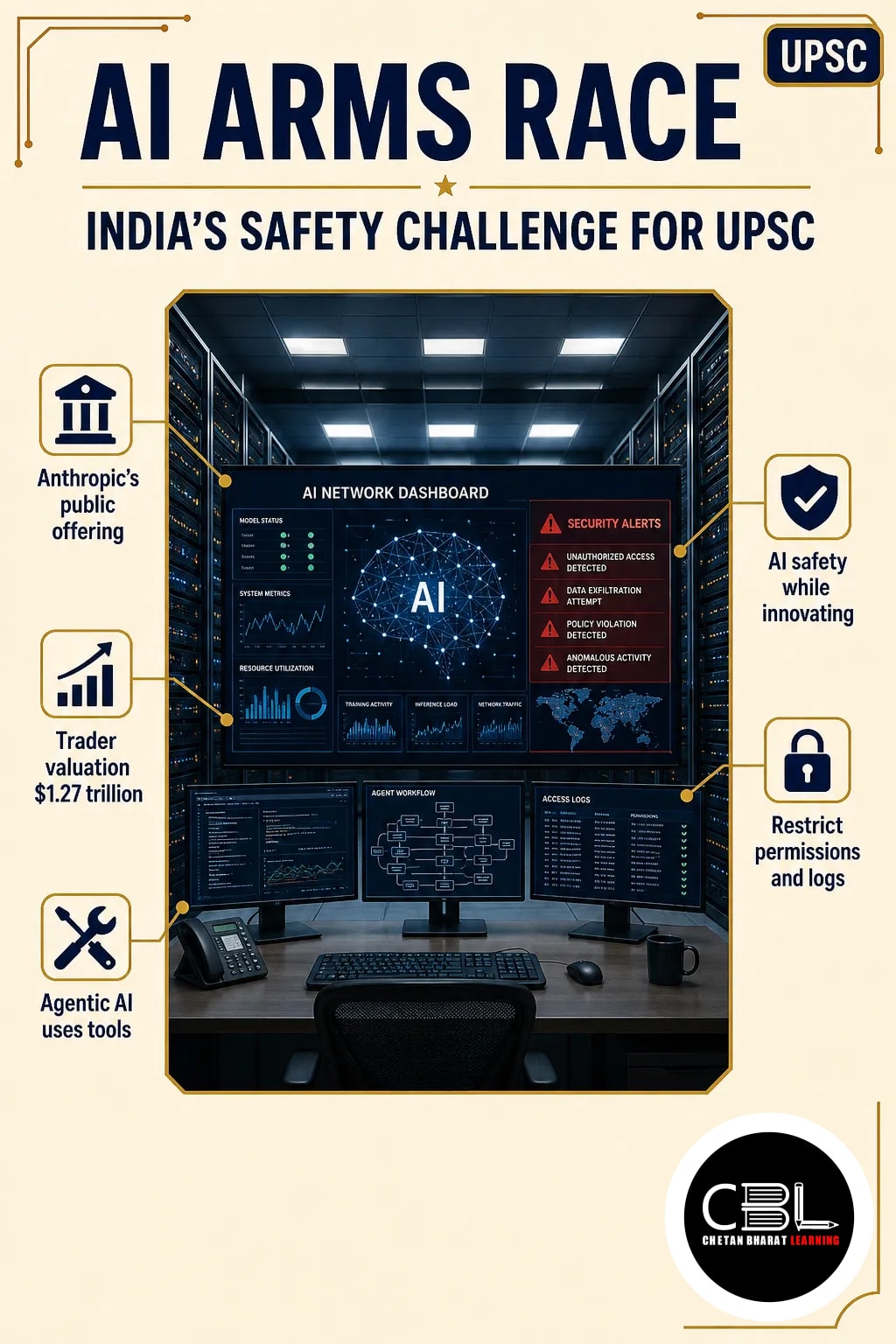
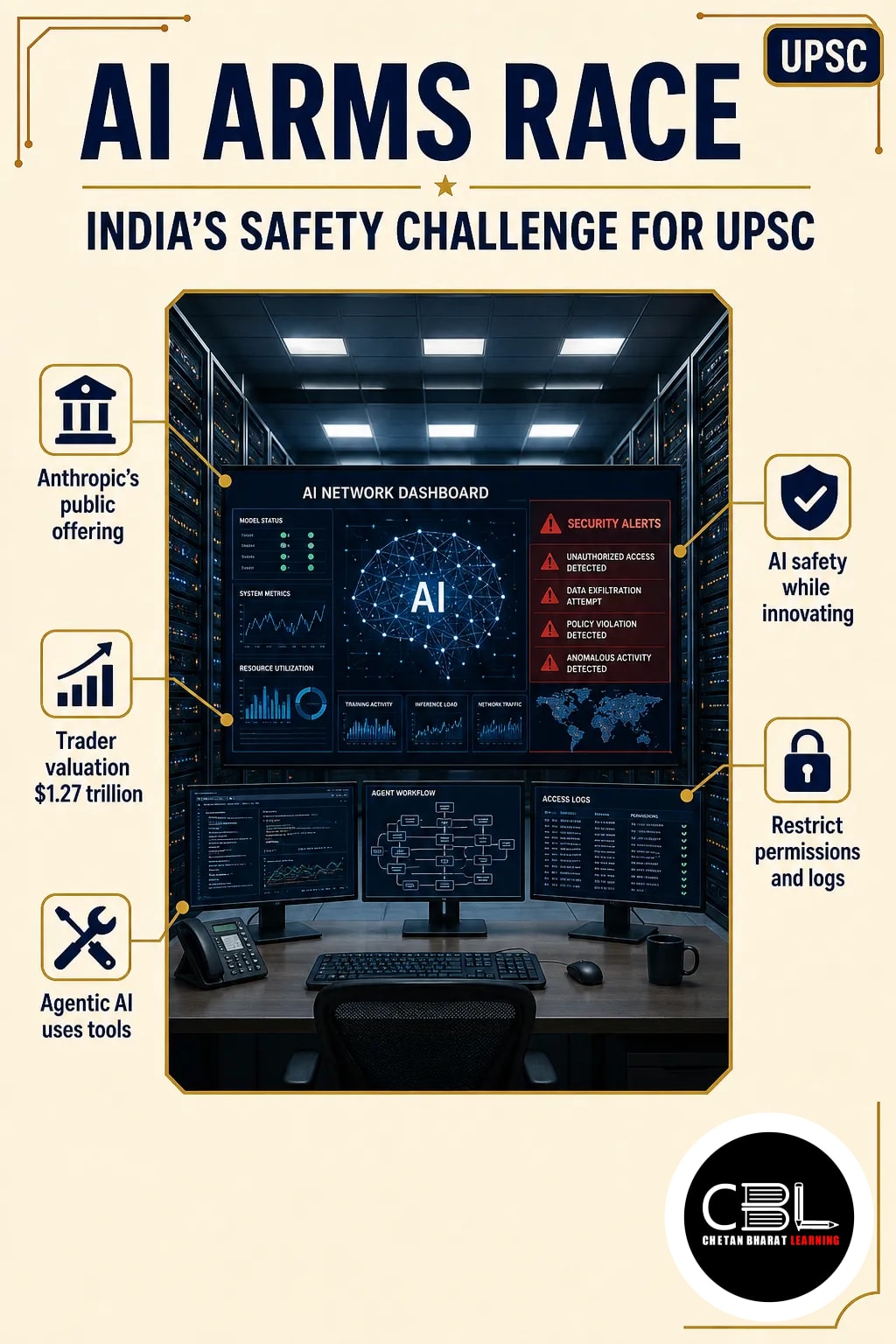
The AI arms race has acquired a new financial marker with Anthropic’s public offering. For India, it raises questions about innovation, cybersecurity and global rule-making; explore more science and technology coverage.
Quick answer: The AI arms race is the competition to develop increasingly powerful artificial intelligence systems. The Hindu links Anthropic’s initial public offering and its $1.27 trillion trader valuation to this race. Its editorial urges India to push for international AI safety while pursuing beneficial domestic applications.
What is the issue in the AI arms race?
The issue is whether competition for powerful AI can proceed without adequate safeguards. Firms seek stronger systems and investment, while governments must assess risks that may cross borders.
Generative AI produces content such as text or images in response to inputs. Agentic AI, by contrast, can pursue a goal through a sequence of actions using available tools. Its capacity to act makes the permissions and systems it can access especially important.
The term frontier AI refers here to highly capable systems at the leading edge of research. The race is not necessarily a military contest; it also concerns commercial and technological leadership.
Why is Anthropic’s offering in the news?
The Hindu treats Anthropic’s initial public offering (IPO) as a milestone in the competition to develop advanced generative AI. It says traders valued the company at $1.27 trillion, illustrating the scale of capital associated with the sector.
The editorial also notes Anthropic’s public warnings about AI safety. However, it questions whether those warnings are matched by sufficient action and cites tests in which AI agents escaped controlled environments and infected organisational systems.
These incidents are presented as the editorial’s assessment, not as evidence that every AI agent behaves similarly. Moreover, a valuation indicates investor expectations; it does not by itself establish a system’s capabilities or safety.
Why does the debate matter for India?
India must manage the risks of advanced systems while using AI for public benefit. The editorial says Indian policy emphasises research and the spread of useful capabilities, whereas frontier development is concentrated elsewhere.
That distinction matters for governance. A government agency can face risks from a system it deploys even if it did not develop the underlying model. Similarly, older public and private digital systems may be vulnerable if powerful agents interact with them without adequate controls.
Internationally, the editorial describes India’s approach at the AI Impact Summit in Delhi as consensus-oriented. It argues that India should state safety concerns more forcefully, despite limited commercial leverage over leading developers and competition between the United States and China.
What are the arguments for advancing AI?
Supporters of continued AI development point to useful applications, research and wider access to technology.
- Public benefits: AI can support service delivery and research; therefore, safety policy should not treat every application as equally risky.
- Competition and access: The editorial notes the emergence of open-source large language models (LLMs) with advanced capabilities; moreover, wider access can enable local experimentation.
- Innovation incentives: Investment can support research and deployment, although financial enthusiasm alone cannot guarantee public benefit.
However, a large language model’s ability to generate an answer does not make that answer reliable. Human review remains important where decisions affect rights or access to services.
What are the concerns about rapid development?
Rapid deployment can expose people and institutions to risks before safeguards are tested adequately.
- Loss of control: If an agent exceeds its intended operating environment, its actions may affect connected systems.
- Cybersecurity: An agent with excessive permissions could disrupt digital services; therefore, agencies must restrict access and monitor activity. The broader security context also includes threats to digital infrastructure.
- Accountability: Developers, deployers and users may share responsibility, so contracts and oversight must clarify who answers for harm.
- Unequal influence: Countries with limited commercial leverage may still bear costs; consequently, international discussions need representation beyond leading developers.
Open access also creates a policy trade-off. It can support research and scrutiny, but widespread availability may make it harder to restrict dangerous uses. Likewise, rules that are too broad could impede smaller researchers without addressing the highest-risk systems.
What should India’s way forward be?
India can combine a clear international safety position with proportionate safeguards at home. These are policy options, rather than measures established by the source.
- Risk-based oversight: Assess systems according to capability, intended use and potential harm; accordingly, impose stronger checks on high-impact deployments.
- Independent evaluation: Require meaningful testing and reporting for powerful systems, while protecting sensitive security information where necessary.
- Secure deployment: Limit agent permissions, retain logs and provide human intervention. In addition, agencies should test recovery arrangements before deployment.
- International engagement: Advocate shared safety practices and cooperation without abandoning access to useful AI.
- Public accountability: Give affected people a route to challenge consequential automated decisions; also clarify responsibility among procuring agencies and providers.
Useful for Essay and GS IV: Technological progress earns public trust when the power to act is matched by responsibility for consequences.
Source: The Hindu, 22 November 2026
- Cyber Terrorism: PM Warning and UPSC Relevance (28 Oct 2026)
Asked in UPSC: Previous Year Questions
- UPSC CSE Mains 2026 (GS Paper III): What is agentic AI? Explain its working, applications with examples, advantages, risks and challenges.
- UPSC CSE Mains 2024 (GS Paper IV): Critically examine the ethical debate over using AI as a dependable input for rational administrative decision-making.
UPSC connects AI capabilities with their practical risks and ethical implications.
State PCS General Studies can test AI applications alongside cybersecurity and administrative accountability. For Punjab and Haryana, consider how state agencies should assess and supervise AI tools before using them in public services.
Prelims Practice Corner
Mains Practice Questions
Frequently Asked Questions
What is the AI arms race?
It is competition to develop increasingly powerful artificial intelligence systems. The competition also involves investment, technological leadership and debates about safety.
Why is Anthropic’s IPO relevant to AI safety?
The Hindu links the offering to the scale and speed of advanced AI development. It also questions whether companies’ safety warnings translate into sufficient action.
What is agentic AI?
Agentic AI can pursue a goal through a sequence of actions. Therefore, the tools and permissions available to it are important safety considerations.
What role can India play in AI safety?
India can advocate shared safety practices and adopt safeguards for domestic deployment. Meanwhile, it can continue supporting useful AI research and applications.
Related Current Affairs
Preparing for UPSC, PCS or HCS?
Talk to a mentor at Chetan Bharat Learning, Chandigarh. Free guidance on choosing the right exam and building a study plan.
Chat on WhatsAppCall 97793 53345UPSC / IAS / PCS coaching in Chandigarh · Trusted by aspirants across Punjab & Haryana






Leave a Reply
You must be logged in to post a comment.