
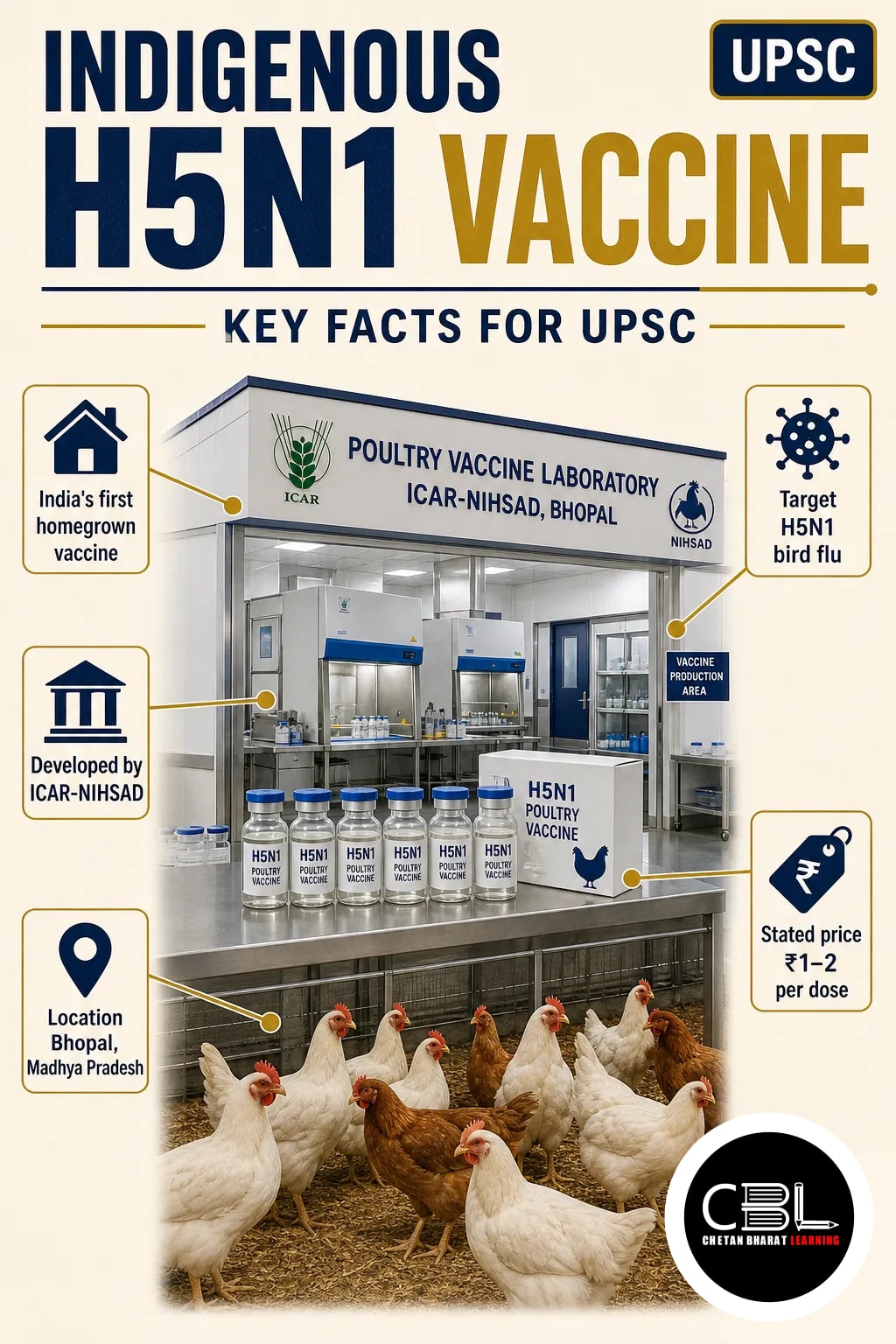
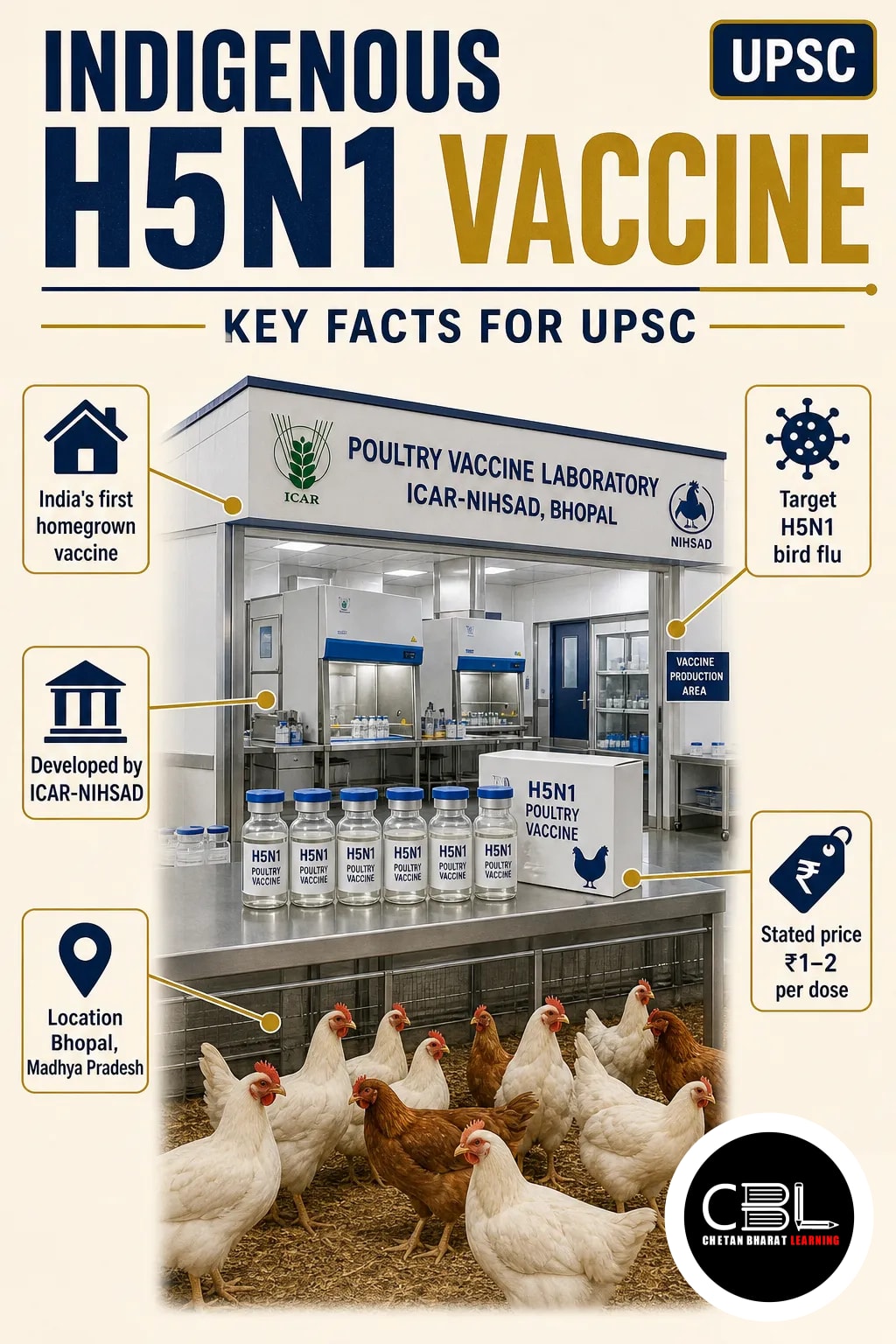
India’s indigenous H5N1 vaccine marks a development in animal health research. Scientists at a government institute in Bhopal developed it to help protect poultry against bird flu.
Quick answer: The indigenous H5N1 vaccine is India’s first homegrown vaccine against the highly pathogenic bird flu strain. The Indian Council of Agricultural Research–National Institute of High Security Animal Diseases developed it in Bhopal. Agriculture Minister Shivraj Singh Chouhan dedicated it to the nation; its stated price is ₹1–2 per dose.
What is the indigenous H5N1 vaccine?
It is India’s first domestically developed vaccine against H5N1 avian influenza, intended to protect chickens. The Bhopal-based institute works under the Indian Council of Agricultural Research (ICAR).
H5N1 is a subtype of influenza A virus; its name refers to two viral surface proteins, haemagglutinin and neuraminidase. Moreover, avian influenza primarily affects birds, although some strains can infect humans.
| Fact | Details |
|---|---|
| Developer | ICAR–National Institute of High Security Animal Diseases (NIHSAD) |
| Location | Bhopal, Madhya Pradesh |
| Target | H5N1 bird flu in poultry |
| Stated price | ₹1–2 per dose |
Why is the vaccine in the news?
Union Agriculture Minister Shivraj Singh Chouhan dedicated the vaccine to the nation at a Bhopal ceremony. At the same event, he announced a proposed ₹300-crore animal disease research laboratory.
The proposed facility is expected to strengthen research on high-risk animal pathogens and vaccine development. Meanwhile, the vaccine research team followed stringent biosafety and sanitisation procedures.
How does it relate to other animal disease measures?
The H5N1 vaccine adds to India’s animal disease prevention efforts alongside vaccines for livestock diseases. However, aspirants should distinguish the poultry vaccine from the measures below.
- Foot and Mouth Disease: The minister cited 147.16 crore free doses administered under the National Animal Disease Control Programme.
- Lumpy Skin Disease: Scientists developed Lumpi-ProVacInd following the 2022 outbreak, according to the source.
- Economic losses: Government estimates cited by the minister put combined annual losses from four livestock diseases at about ₹56,000 crore.
Those four diseases are Foot and Mouth Disease, Lumpy Skin Disease, brucellosis and Peste des Petits Ruminants. The estimate is not specific to bird flu.
Why does this development matter?
The vaccine can support bird flu control while adding an Indian-developed tool for poultry protection. Because outbreaks can kill chickens and hurt farmers’ incomes, accessible prevention matters for rural livelihoods.
In addition, domestic development may reduce dependence on external technologies. The source does not specify the vaccine platform, efficacy or a rollout schedule; therefore, these should not be assumed.
Source: The Indian Express, 21 November 2026
Asked in UPSC: Previous Year Questions
- UPSC CSE Mains 2022 (GS Paper III): What is the basic principle of vaccine development, how do vaccines work, and what approaches did Indian manufacturers adopt for COVID-19 vaccines?
UPSC also tests vaccine principles and platforms, so revise the science alongside current developments.
State PCS General Studies can test the vaccine’s developer, location, target disease and price. Additionally, revise animal health as a component of agricultural and rural livelihoods.
Prelims Practice Corner
Mains Practice Questions
Frequently Asked Questions
Who developed India’s indigenous H5N1 vaccine?
ICAR-NIHSAD developed it in Bhopal. The institute works under the Indian Council of Agricultural Research.
What is the price of the H5N1 vaccine?
The stated price is ₹1–2 per dose. This price may help make disease prevention more accessible to poultry farmers.
Is the new H5N1 vaccine intended for humans?
No, the source describes it as a vaccine to protect chickens. Therefore, it should not be presented as a human vaccine.
Related Current Affairs
Preparing for UPSC, PCS or HCS?
Talk to a mentor at Chetan Bharat Learning, Chandigarh. Free guidance on choosing the right exam and building a study plan.
Chat on WhatsAppCall 97793 53345UPSC / IAS / PCS coaching in Chandigarh · Trusted by aspirants across Punjab & Haryana





Leave a Reply
You must be logged in to post a comment.