
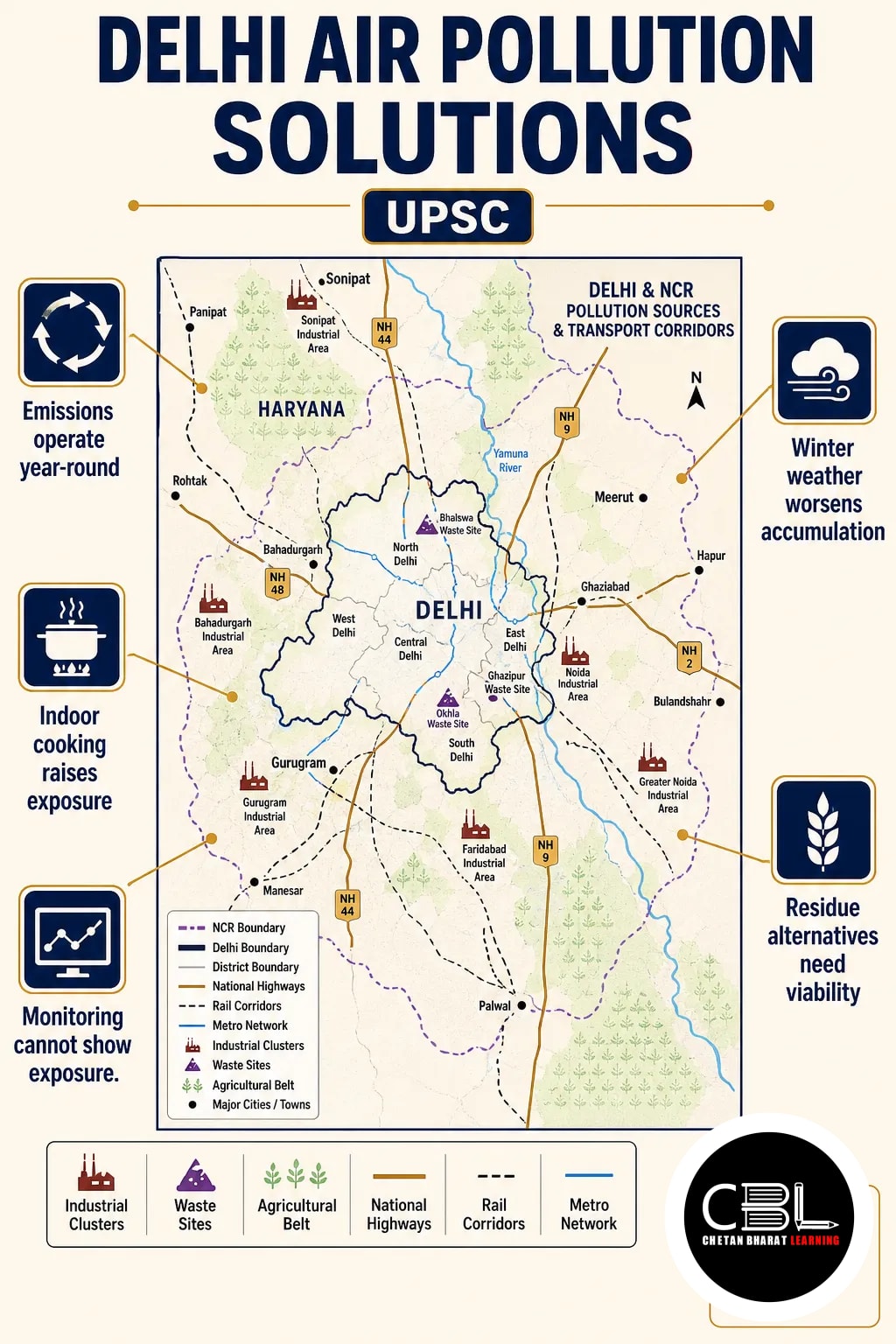
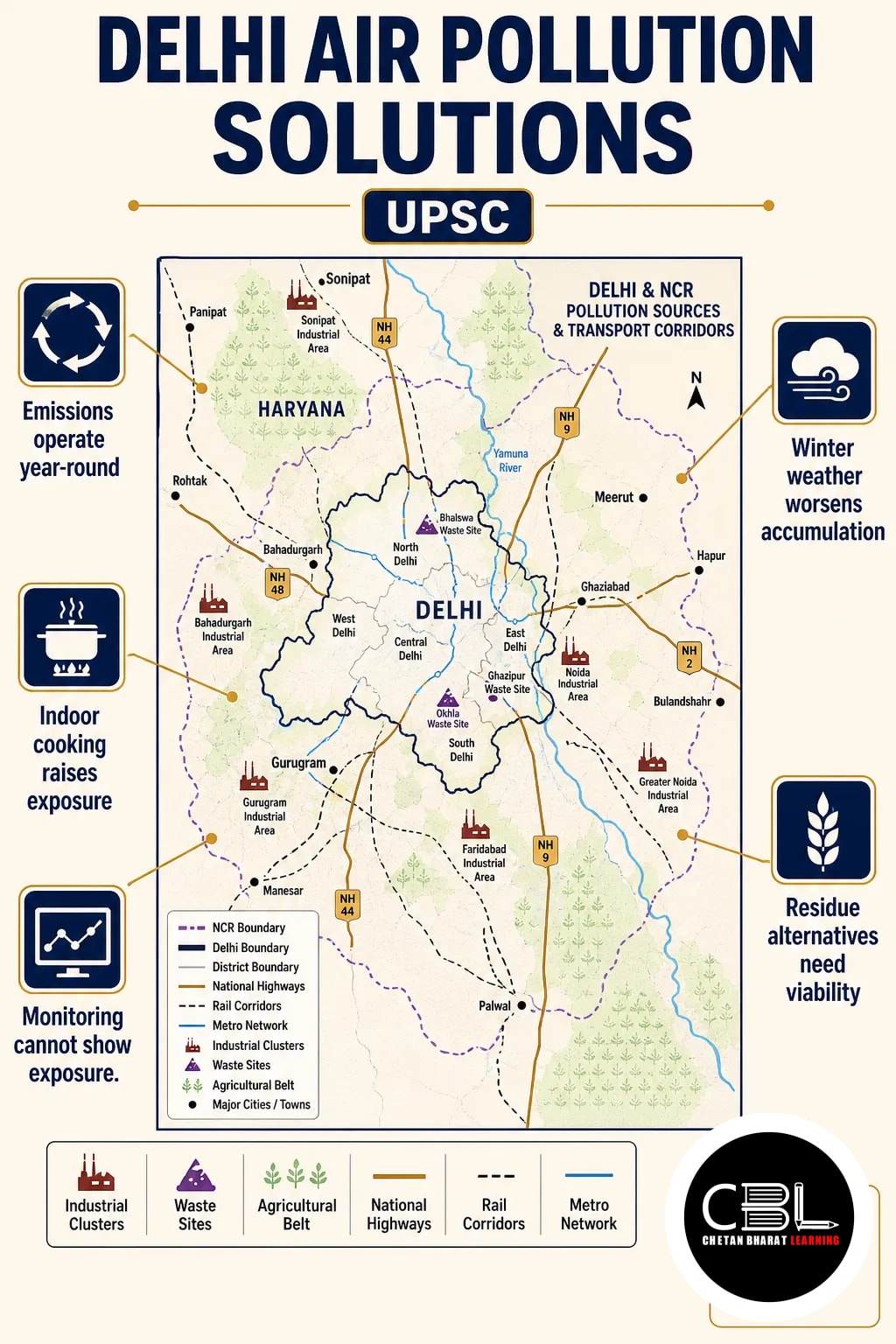
Delhi air pollution solutions need more than winter emergency measures or individual devices. An Indian Express explainer by atmospheric scientist Shahzad Gani argues for sustained action across transport, energy, agriculture and waste. For wider context, explore environment current affairs.
Quick answer: Delhi air pollution solutions must address emissions throughout the year, not just winter episodes in the National Capital Region. The explainer calls for two actions: reducing emitting sources and cutting emissions from those that remain. It also stresses clean household energy, credible monitoring, viable alternatives for farmers and sustained institutional commitment.
Why is air pollution a year-round policy issue?
Air pollution affects many parts of India throughout the year, both inside homes and outdoors. Delhi and the National Capital Region (NCR) receive particular attention during winter; however, the problem extends beyond that geography and season.
North India experiences severe winter episodes because multiple emissions coincide with unfavourable meteorology. Weather influences dispersion and accumulation; it does not itself create the emissions. Therefore, a policy focused only on seasonal peaks can miss sources that operate throughout the year.
Gani, an Assistant Professor at the Centre for Atmospheric Sciences at the Indian Institute of Technology Delhi, argues that known sources justify immediate action. Meanwhile, better research can refine the choice and design of interventions.
Which sources require different responses?
Transport, household fuels, waste burning, industry, power plants and construction contribute across the year, while some sources peak seasonally.
| Source or condition | Policy implication |
|---|---|
| Transport | Improve public transport and reduce reliance on private vehicles. |
| Solid cooking and heating fuels | Expand access to clean household energy. |
| Agricultural residue burning | Provide alternatives suited to farming practices and costs. |
| Waste burning | Strengthen municipal waste management. |
| Industry and power plants | Apply effective emissions regulation. |
| Fireworks | Combine restrictions and enforcement with community engagement. |
For example, the discussion of Punjab stubble-burning alerts provides a state-level context for the agricultural challenge. Similarly, scrutiny of vehicle pollution-check centres in Uttar Pradesh illustrates the importance of credible enforcement systems.
Why are technical fixes alone insufficient?
Technical measures cannot resolve the economic and institutional conditions that sustain emissions.
- Farmer incentives: Residue-burning alternatives must fit farming practices and farmers’ financial constraints; otherwise, restrictions alone may not change behaviour.
- Household choices: Clean cooking and heating require usable energy options, not merely advice to stop burning solid fuels.
- Social norms: Firecracker restrictions need enforcement; in addition, schools, communities and religious leaders can encourage behavioural change.
- Institutional capacity: Public transport, municipal waste services and industrial regulation need funding, coordination and political commitment over time.
Smog towers and artificial rain attract attention as visible interventions. However, the explainer identifies questions about their effectiveness and scale. Governments should therefore subject proposals to independent scrutiny, including their claims and use of public funds, rather than treat visibility as proof of emissions reduction.
What can monitoring reveal and what can it miss?
Monitoring identifies pollution patterns, but an ambient reading does not necessarily represent an individual’s exposure.
Monitoring networks measure outdoor conditions, while emission inventories catalogue sources and their estimated emissions. Source apportionment studies assess the contributions of different sources. Together, these tools can improve targeting; however, uncertainty in inventories and atmospheric chemistry will remain.
For example, a rooftop monitor cannot show the particulate matter a person breathes while cooking with firewood or dung cakes indoors. Household pollution also contributes to outdoor pollution. Therefore, exposure research should examine homes and workplaces alongside ambient air.
Street vendors, construction and sanitation workers, farmers and communities near industry can face exposure linked to their work or location. Women who spend long hours cooking with polluting fuels may also experience substantial indoor exposure. Moreover, a daily-wage worker may not be able to avoid exposure without a viable livelihood alternative.
What is the way forward for Delhi air pollution solutions?
The way forward is to reduce known emissions now while improving the evidence and institutions needed for sustained action.
- Act at source: Reduce the number of emitting sources and control emissions from those that remain, rather than rely only on episode management.
- Make alternatives viable: Improve public transport, clean household energy and residue-management options; also account for users’ costs and livelihoods.
- Coordinate delivery: Bring municipal officials, regulators, urban planners, agricultural economists and public health experts into policy design alongside atmospheric scientists and engineers.
- Measure and scrutinise: Invest in monitoring and personal-exposure research; meanwhile, independently assess the effectiveness and costs of proposed interventions.
Overall, better information and immediate action are complementary. The policy test is whether sustained measures reduce emissions and protect people across seasons and settings.
Source: The Indian Express, 18 November 2026
- UP PUC licences: 20 centres suspended (14 Nov 2026)
Asked in UPSC: Previous Year Questions
- UPSC CSE Prelims 2025 (GS Paper I): Which substances are used to artificially cause rainfall to reduce air pollution?
UPSC has tested the science of a proposed pollution response; also examine its policy limitations.
Punjab PCS and Haryana HCS candidates should connect residue management with farmer incentives and administrative coordination. In addition, state General Studies answers can examine municipal waste services and household exposure.
Prelims Practice Corner
Mains Practice Questions
Frequently Asked Questions
Is air pollution in India only a winter problem?
No, because many sources operate throughout the year across India. However, unfavourable winter weather can intensify outdoor pollution episodes in North India.
Why is a rooftop air monitor insufficient to measure personal exposure?
Because it measures outdoor conditions rather than the air a person breathes in every setting. For example, it cannot directly capture particulate matter during indoor solid-fuel cooking.
Should governments wait for exact source estimates before acting?
No, because major sources are already known well enough to justify action. Meanwhile, monitoring and source studies can improve the targeting of policies.
Why do crop-residue solutions need more than enforcement?
Because farmers need alternatives that fit their practices and economic constraints. Therefore, policy design must consider costs and availability as well as restrictions.
Related Current Affairs
Preparing for UPSC, PCS or HCS?
Talk to a mentor at Chetan Bharat Learning, Chandigarh. Free guidance on choosing the right exam and building a study plan.
Chat on WhatsAppCall 97793 53345UPSC / IAS / PCS coaching in Chandigarh · Trusted by aspirants across Punjab & Haryana









Leave a Reply
You must be logged in to post a comment.