
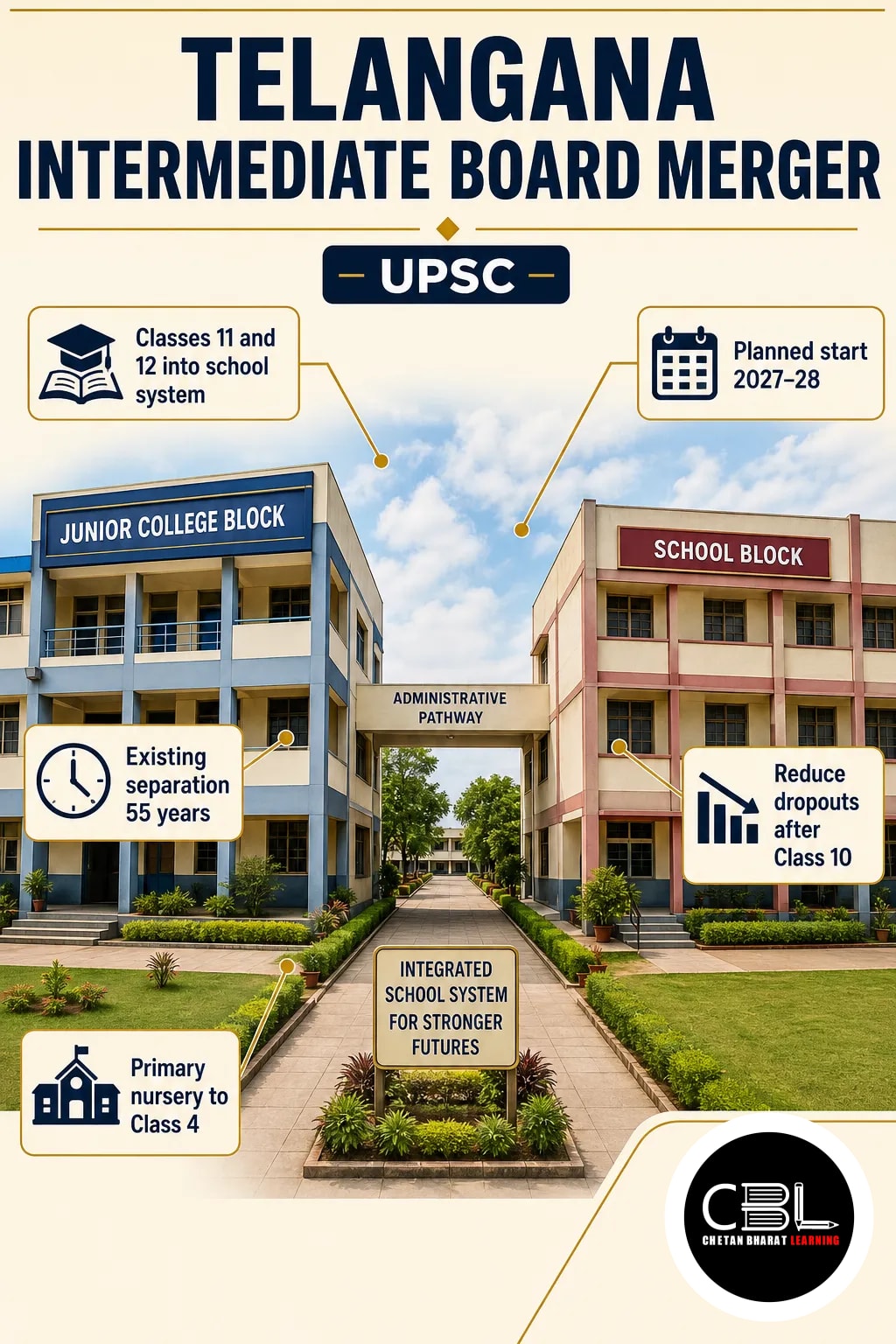
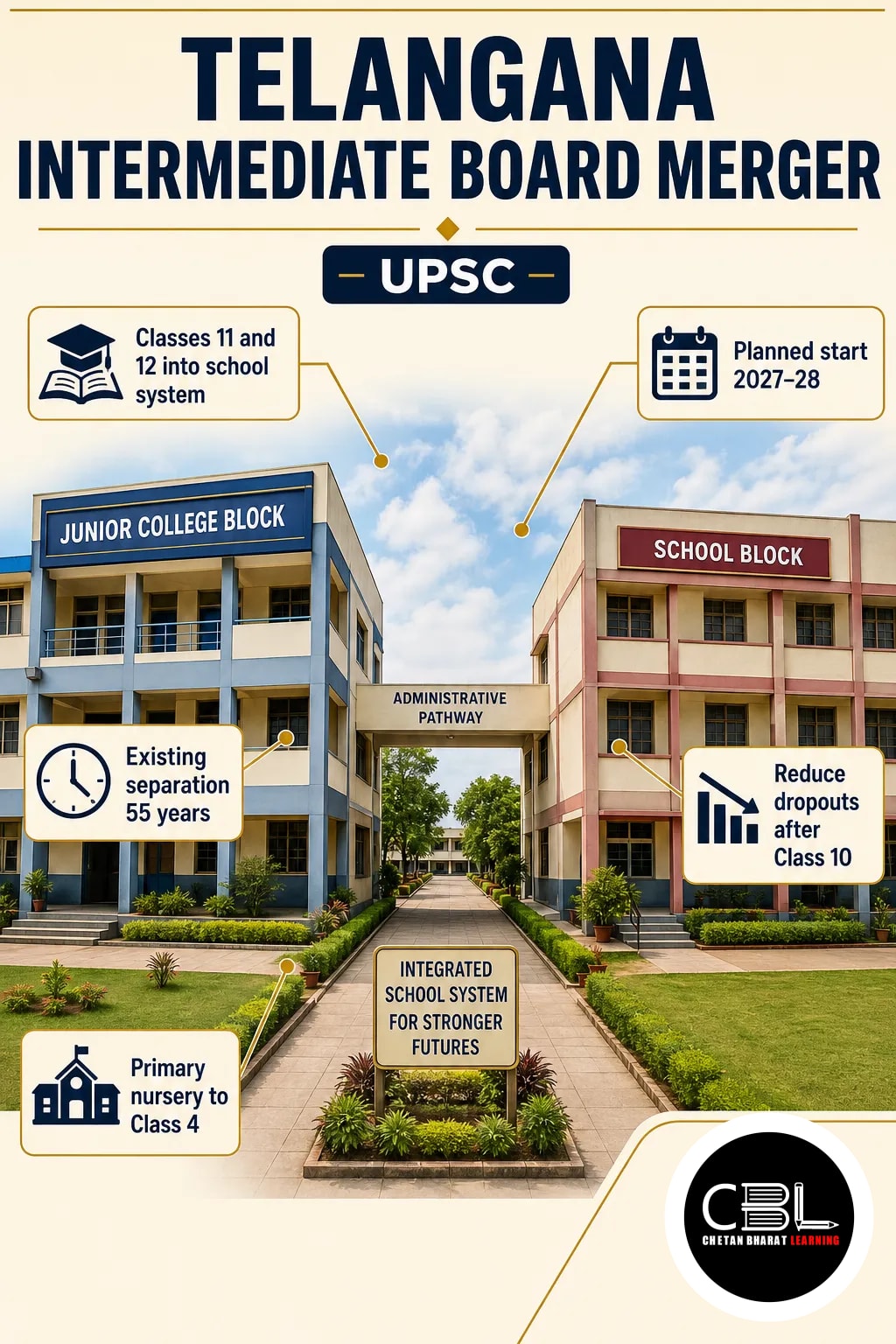
The Telangana intermediate board merger proposes to bring Classes 11 and 12 into the school system from 2027–28. The move connects administrative reform with student retention, a key theme in social sector governance.
Quick answer: The Telangana intermediate board merger is a proposed integration of Intermediate education with the school system from 2027–28. Chief Minister A. Revanth Reddy announced it on 11 November 2026. The government aims to reduce dropouts after Class 10, particularly among girls and students from disadvantaged backgrounds.
What is the Telangana intermediate board merger?
The proposal would integrate Intermediate education, covering Classes 11 and 12, into Telangana’s school education framework. It would end a 55-year administrative separation between schools and junior colleges.
Consequently, the proposed senior secondary stage would cover Classes 9 to 12. The change is planned for the 2027–28 academic year; it should not be treated as an already completed merger.
Administrative integration and classroom access are distinct questions. For example, a common framework can support continuity, but it does not by itself guarantee a nearby seat or affordable transport.
Why is Telangana restructuring school education?
The government cites dropouts after Class 10 as the principal reason for the proposed restructuring. It particularly identifies girls and students from disadvantaged backgrounds as groups needing attention.
Chief Minister A. Revanth Reddy announced the proposal at a review meeting on 11 November 2026 and directed officials to implement the restructuring. Thus, the stated objective is to make continuation beyond Class 10 easier within a unified framework.
However, the available source does not provide dropout rates or specify the detailed arrangements for examinations, staff or institutional management. These details matter when assessing implementation, rather than the stated intention alone.
What are the proposed school stages?
The proposed structure groups nursery through Class 12 into three administrative stages.
| Stage | Classes covered |
|---|---|
| Primary | Nursery to Class 4 |
| Secondary | Classes 5 to 8 |
| Senior secondary | Classes 9 to 12 |
For exam purposes, these labels describe Telangana’s proposed structure. Therefore, candidates should not automatically apply them to every state or national classification.
Why does the reform matter for education governance?
The reform places the transition after Class 10 within a single school education framework. It also offers a way to examine whether administrative continuity can support educational continuity.
Potential benefits
- Continuity: A common framework could help officials track whether students progress from Class 10 to Class 11.
- Coordination: Bringing stages together could make planning for teachers, facilities and student support more coherent.
- Equity: Attention to girls and disadvantaged students can direct monitoring towards groups named in the government’s rationale.
These are potential benefits, not established outcomes. Similarly, the school social audit initiative in Uttar Pradesh illustrates a separate approach to school accountability.
Constitutional context
Education is in the Concurrent List, so both Parliament and state legislatures can legislate on it, subject to constitutional rules. In addition, Article 21A provides for free and compulsory education for children aged six to fourteen, as determined by law.
That age-based guarantee should not be confused with an automatic guarantee covering every student in Classes 11 and 12. Article 45, meanwhile, directs the state to endeavour to provide early childhood care and education for children below six years.
What challenges could affect implementation?
The main challenge is to turn an administrative merger into uninterrupted access and effective learning.
- Transition management: Officials would need clear responsibilities for institutions and personnel, because uncertainty can disrupt routine administration.
- Capacity: Class 11 and 12 students need suitable teachers, classrooms and learning resources; therefore, capacity planning matters alongside restructuring.
- Access: Distance, costs and safety can affect continuation, so a common administrative structure alone may not remove every barrier.
- Assessment: Clear examination and certification arrangements would help students and institutions prepare for the transition.
- Measurement: Without comparable transition and retention data, the government cannot easily establish whether the reform has reduced dropouts.
These are implementation considerations, not claims that Telangana has already faced each problem. In another area of state school governance, Himachal Pradesh’s proposed private school fee amendment highlights the relevance of affordability to education policy.
What should the way forward focus on?
The transition should combine clear administrative rules with measurable support for students after Class 10.
- Publish a transition plan: Specify institutional responsibilities, timelines and arrangements for staff, examinations and certification.
- Map access: Assess seats, travel requirements and facilities before implementation; then address gaps in provision.
- Target retention: Consult girls and disadvantaged communities, and design support around the barriers identified.
- Monitor outcomes: Track progression from Class 10 to Class 11 and completion through Class 12, with appropriate group-wise analysis.
Ultimately, the Telangana intermediate board merger should be judged against student progression and learning, not organisational change alone. Regular public reporting would also allow the government to adjust the reform as evidence emerges.
Source: The Hindu, 17 November 2026
Punjab PCS and Haryana HCS candidates can use this case to discuss state-level education governance and retention after Class 10. In addition, compare administrative integration with practical measures for access and accountability.
Prelims Practice Corner
Mains Practice Questions
Frequently Asked Questions
When will Telangana integrate Intermediate education into schools?
The integration is planned from the 2027–28 academic year. Therefore, it remains a proposal rather than a completed merger.
Why is Telangana proposing the board merger?
The government aims to reduce dropouts after Class 10. In particular, it cites girls and students from disadvantaged backgrounds.
Which classes will form the proposed senior secondary stage?
Classes 9 to 12 will form the proposed senior secondary stage. Thus, it will include the present Intermediate classes, 11 and 12.
Does Article 21A guarantee free education for all Class 11 and 12 students?
No, because Article 21A specifies children aged six to fourteen. Its age-based guarantee should therefore not be equated automatically with coverage of Classes 11 and 12.
Related Current Affairs
Preparing for UPSC, PCS or HCS?
Talk to a mentor at Chetan Bharat Learning, Chandigarh. Free guidance on choosing the right exam and building a study plan.
Chat on WhatsAppCall 97793 53345UPSC / IAS / PCS coaching in Chandigarh · Trusted by aspirants across Punjab & Haryana









Leave a Reply
You must be logged in to post a comment.